Municipal wastewater systems are operating under conditions that look very different from those they were designed for. One of the biggest operational headaches is solids handling pump clogging, which can be caused by wipes, rags, fibrous debris, and highly variable flows that place increased strain on pump stations. While infrastructure ages and operating budgets tighten, the wastewater stream itself has become more unpredictable — laden with wipes, rags, fibrous debris and highly variable flows that place increased strain on pump stations.
Many of the performance issues utilities face today (ragging, clogging, declining efficiency, recurring pump pulls) are often treated as unavoidable realities of wastewater operations. But in many cases, these problems point to a deeper issue: pumps that are no longer suited for the conditions they operate in.
Solids-handling pumping has evolved beyond simply “passing debris.” Today, it requires maintaining stable hydraulic performance, predictable energy use, and reliable operation despite inconsistent solids loading. For many utilities, this realization is what’s driving a shift toward newer pump technologies, and specifically toward solutions like SyFlo.
When “solids handling” no longer describes the job
Historically, a solids-handling pump was expected to move wastewater that contained relatively predictable debris. Under those assumptions, passing solids through the pump once was often sufficient.
That assumption no longer holds.
Modern wastewater solids interact with pumps differently. Fibrous materials tend to wrap or accumulate rather than pass cleanly, disrupting internal flow paths and creating low-velocity zones where material collects. The result is not always an immediate clog, but a gradual loss of performance: rising amperage, reduced flow, and increasing maintenance intervention.
Traditional pump designs often struggle in this environment because they were not developed with today’s debris profiles in mind. As a result, operators are forced to respond reactively, scheduling frequent pump pulls and accepting reduced performance as a tradeoff.
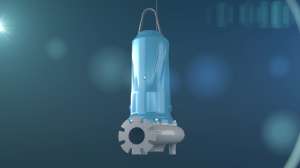
SyFlo was engineered to address this challenge directly. By combining scroll and vortex hydraulics, SyFlo is designed to better manage how solids behave inside the pump. Rather than allowing debris to linger or accumulate, the hydraulic design promotes controlled movement through the pump, reducing the likelihood of ragging and partial blockage.
For utilities switching to SyFlo, solids-handling becomes less about reacting to problems and more about maintaining consistent operation under real-world conditions.
Why so many “efficient” pumps lose efficiency in the field
Energy efficiency is a major priority for municipal utilities, and for good reason. Pumping represents a significant portion of operating costs, and efficiency gains on paper can look compelling during the selection process.
However, many operators discover that efficiency ratings do not tell the full story.
Efficiency curves are developed under controlled test conditions using clean water and steady flow. In the field, wastewater introduces variables that those curves don’t capture. As solids interfere with hydraulic performance, efficiency can degrade steadily and silently, without triggering alarms or indicating mechanical failure.
In response, utilities sometimes oversize pumps or operate outside their best efficiency point in an attempt to maintain capacity. These approaches often increase energy consumption and accelerate wear without resolving the underlying hydraulic instability.
What preserves efficiency over time is not just motor design, but the ability of the pump to maintain stable internal flow paths despite solids loading. SyFlo’s hydraulic design helps mitigate the impact of debris on flow, allowing the pump to operate closer to its intended performance point for longer periods.
For utilities focused on life cycle cost rather than short-term metrics, switching to SyFlo means efficiency that holds up under everyday operating conditions, not just at startup.
Breaking the maintenance cycle without rebuilding the system
Many municipalities are caught in a cycle of recurring pump station maintenance. Aging infrastructure, limited staff, and constrained budgets leave little opportunity for major redesigns. Instead, crews spend their time managing known problem stations through frequent inspections, regular pump pulls, and incremental fixes.
While this approach keeps systems running, it rarely improves long-term reliability.
In many cases, the pump itself becomes the most practical and impactful intervention point. A pump that handles debris poorly magnifies upstream system challenges, while a pump that maintains stable performance reduces stress throughout the station.
SyFlo provides a practical path forward for utilities looking to stabilize operations without large capital investments. Designed to tolerate variable solids loading and maintain consistent hydraulic performance, SyFlo reduces the frequency of maintenance events that pull crews away from other critical work.
Utilities that switch to SyFlo often find they can move from a reactive maintenance posture to a more predictable operating rhythm — one where resources are spent proactively rather than responding to the same recurring problems.
Why utilities are making the switch to SyFlo
Across municipal systems, the reasons for switching to SyFlo tend to converge around the same operational goals:
- Fewer clog-related callouts
- More stable energy consumption
- Reduced pump pulls and maintenance labor
- Equipment that reflects real wastewater conditions
SyFlo was developed as a high-efficiency, clog-resistant solids-handling pump specifically for these challenges. Its combination of advanced hydraulics and practical design features makes it well suited for retrofits, upgrades, and new installations where reliability matters more than theoretical performance.
For utilities facing increasing debris loads and operational pressure, switching to SyFlo represents a move toward equipment that works with modern wastewater realities, not against them.
The bottom line
Solids-handling non-clog pumps no longer succeed simply by passing debris. Utilities now judge performance by how consistently pumps operate, how well they retain efficiency, and how little maintenance they demand over time.
SyFlo delivers on those expectations. By addressing debris interaction, hydraulic stability, and long-term efficiency together, SyFlo helps utilities regain control of pump station performance.
For many municipalities, switching to SyFlo isn’t about trying something new. It’s about finally using a pump built for the wastewater they manage every day.
As wastewater conditions continue to evolve, utilities need pump solutions that reflect that evolution. SyFlo was designed with this reality in mind, helping municipalities reduce maintenance cycles, protect long-term efficiency, and regain predictability in their pump stations.
For many, switching to SyFlo isn’t about trying something new. It’s about finally matching the pump to the job and solving solids-handling pump clogging.