
It’s 4:30 p.m. downtown, rush hour just beginning, wind chill minus 30. The last thing a water utility needs now is a major line break.
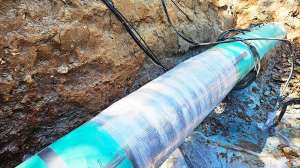
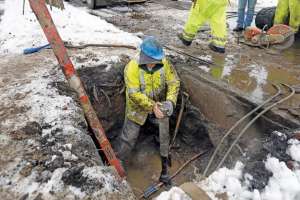
Yet that’s exactly what happened in January 2014 in Columbus, Ohio. A 24-inch water main popped, flooding about 10 city blocks. Water poured into basements. Worse yet, a nearby hospital faced possible evacuation of patients and staff. “We had a river flowing four ways at once in downtown Columbus,” recalls Mike Spriggs, water maintenance coordinator. “The water turned to ice. Locators were freezing up.”
But it wasn’t the disaster it could have been. By 9 p.m., the Columbus crew had the valves located and the water shut off. The team stayed with the emergency all night and had the leak repaired and the water turned back on by morning. Most critically, although some elective surgeries were postponed, patient care at the hospital was not affected.
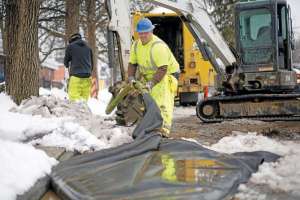
“Our guys didn’t hesitate to come in and stay overnight,” says Spriggs. “Second shifters were called in to operate the valves. We had multiple crews who worked through it, even though they were standing in water.”
The Water Division of the Columbus Department of Public Utilities is ready for such situations. Emergency response is among a number of best management practices (BMPs) the utility has put in place, and it’s just one reason the utility received 2013 Platinum Award recognition from the Association of Metropolitan Water Agencies (AMWA). Other attributes cited by AMWA were strategic planning, asset management, benchmarking, environmental stewardship, employee training, community outreach, customer service and fiscal responsibility.
The award was a natural in the eyes of Richard Westerfield, P.E., Ph.D., division administrator: “We won the AMWA gold award some 10 years ago, and we were essentially doing all the BMPs that people were talking about. We were using BMPs to run our system. It wasn’t hard to put the application together and submit it.”
The Columbus Division of Water serves some 1.1 million people, delivering clean, safe water through a sophisticated system of reservoirs, groundwater wells, treatment plants, and storage and distribution networks. It’s a system recognized internationally for innovation and advancement of water treatment science. In 1908, in what was known as the Columbus Experiment, water filtration was successfully combined with water softening for the first time.
Today, source water is drawn from three reservoirs on the Scioto River and Big Walnut Creek, as well as from a groundwater aquifer between the two rivers. Three water treatment plants produce a total of 140 mgd of high-quality water. The Hap Cremean Water Plant produces 68.5 mgd, the Dublin Road Water Plant 49 mgd and the Parsons Avenue Water Plant 22.5 mgd.
The treatment process is similar at all three facilities. Water is pumped into the plants through rotating screens, and alum is added to aid in flocculation. After 20 to 40 minutes of flocculation, the water passes to the sedimentation basins, where it is held for two to four hours. Sodium carbonate and hydrated lime are added to remove calcium and magnesium, softening the water.
After additional sedimentation, carbon dioxide lowers the pH to about 7.8. (When groundwater is used, the influent does not need screening or initial sedimentation.)
Media filters – gravel, sand and anthracite coal – polish the product water, which is disinfected with chlorine before passing to the clearwell. Solids collected in treatment are pumped to lagoons for drying.
Treatment is only part of the quality equation. Columbus is recognized for its watershed approach to water supply. The department’s website states, “The most important part of the water treatment process is protection of our water sources.”
Since 1994, the Division of Water has had responsibility not only for managing the water source reservoirs but for land management, boat safety and public education on protection of drinking water sources. In 1996, the Ohio EPA approved the division’s wellfield protection plan.
The improvements continue. The Hap Cremean plant is undergoing a $70 million upgrade to increase capacity to 125 mgd and address disinfection byproducts by adding ozone with biologically active filtration. The ozone generators are from Mitsubishi. Leopold - a Xylem Brand, supplied the underdrain system and the I.M.S. 1000 media retainer. A pressurized solution feed recarbonation system (Tomco2 Systems) is also being installed.
The Dublin Road plant is getting a $200 million upgrade that includes a capacity boost to 80 mgd, a $40 million anion exchange system to remove nitrates, a recarbonation basin with pressurized solution feed system (Tomco2), Mitsubishi ozone generators and conversion to biologically active filtration (AWI Phoenix filter underdrain, WesTech Engineering media retaining troughs).
A $50 million upgrade at the Parsons Avenue plant includes electrical improvements, a new clearwell, a filter rebuild with the existing Leopold clay tiles and a new recarbonation basin.
The Dublin Road plant was recently converted from chlorine gas to sodium hypochlorite disinfection, and the other two plants will be similarly converted in the next five years. The two surface water plants (Dublin Road and Hap Cremean) will get standby power and UV disinfection as an additional disinfection barrier within the next three years.
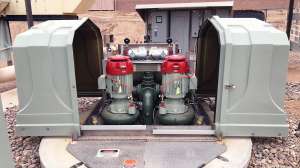
The distribution system serves most of Franklin County – 2,700 miles of pipe within the city and 900 miles in neighboring suburbs served by the division. The system includes 20 pump stations and 37 storage tanks with a combined 77 million gallons capacity. The system’s countywide footprint raises special challenges, especially in leak repairs: “Some of our piping is over 100 years old,” Spriggs says.
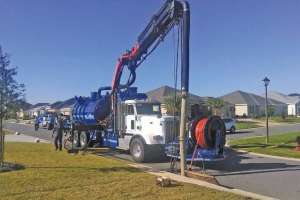
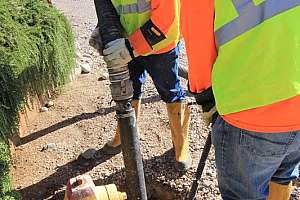
While age is one issue, condition is another. “We battle all the elements here, plus traffic issues,” says Spriggs. The crew fixes at least 1,500 leaks a year and checks out twice that many. “Our group does a great job,” Spriggs says. “We try to get to a leak within three to five days, with no leak going over 14 days. We stay pretty even with that.
“When we get a call, we send out our supervisors that day. If it’s an owner’s leak, we shut off service to that property if it’s causing damage or a safety concern. If not, it is left on and the customer has 14 days to repair it. If it’s an emergency, like the downtown leak last January, we get out there that day.”
The team helps the customer suburbs with leaks, as well. “We have contracts with each of those areas, based on a usage formula,” Spriggs says. “If the number of leaks goes beyond the contract, we just charge them labor and materials. We help each other out. That’s the culture we’ve grown up with here.”
Dwayne Maynard, water maintenance coordinator, ticks off improvements made recently in the control center and distribution system: “We’re using an Oracle database and asset management system. It creates work orders, tracks all funding and adds preventive maintenance schedules. We have it linked to our storerooms so we can track stock on hand – certain pumps, valves, parts and equipment.”
The hard assets have also been improved. The division has built a number of new storage tanks, essentially doubling the above-ground storage capacity. In addition, standby generators can now provide backup power to the booster stations. “We also inspect tanks for coating, painting, debris removal and rusting, especially in the bowl itself,” Maynard says. “We put a lot of extra effort into the tank interiors.”
The key to efficiency at Columbus is continuous improvement based on performance measurement. “Product quality is key, along with customer satisfaction,” Westerfield says. On the same level is compliance with regulations: “We actually try to stay ahead of the regs.”
Financial viability is right up there, too. Columbus is one of few cities its size to have an AAA bond rating, which holds financing costs down. Here are some specific tools Columbus employs to maintain its award-winning efficiency:
Asset management
“This was new to us until about five years ago,” says Westerfield. “We use it to measure risk. When deciding whether to move ahead with a capital project, we look at the risk. What are the options? We take a triple-bottom-line approach – the financial risk as well as the social and environmental risk.” That’s especially important as the division looks at replacing and repairing its vast piping system: “We’re able to prioritize our water system and all the pipes and plan for replacement of those that will eventually fail.”
Environmental management system
“We have a group in the department that focuses on environmental management,” Westerfield says. “They are concerned with anything that will have an environmental impact. In fact, now the whole department is trained in environmental management.” The program deals with matters such as spill control, emergency response, protecting the stormwater system from mud in the streets, and proper handling of material excavated from main breaks. The city recently upgraded its water emergency plan and hired an emergency planning section chief. The Water Division also works with other emergency response organizations in the community.
Sustainability
Since a serious drought in central Ohio in 1987, the division has had an extensive plan for drought conditions. That includes additional storage capacity: A $120 million upground reservoir completed in November 2013 added 25 million gallons for Columbus and 4 million gallons for a partner utility (Del-Co Water Company).
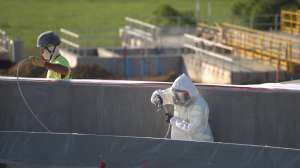
The 850-acre reservoir is one of the nation’s largest lined drinking water reservoirs (liner from the Rufco Division of Raven Industries). As part of the reservoir, a pump station and inflatable weir (Obermeyer Hydro) were built on the Scioto River to allow pumping during high flows.
Sustainability is also supported through a GreenSpot community conservation program that encourages conservation through the use of water-saving showerheads and fixtures and efficient lawn and garden watering.
Community relations
Extensive community involvement in the division’s planning and operation is also high on the list. The water department holds regular and frequent meetings with stakeholder groups like the Sierra Club and neighborhood organizations. “We talk about things that need to be done to protect the watershed – stormwater management, creek cleanups, projects affecting neighborhoods,” says Westerfield.
Fiscal responsibility
“Our success hinges on our ability to finance these programs and projects,” Westerfield says. “Our rates are in a good place – about in the middle of other large cities in the United States.”
The city council and the community have supported rates over the years, recognizing the need for water infrastructure improvements.
Of course, the best of BMPs is to be ready for the future. Westerfield focuses on being prepared and merging water utility plans with community needs. The recently built earthen-dike upground reservoir is an example. “We knew it wouldn’t be easy or acceptable to the community to build another dam,” he says. “So we constructed a pump station along one of the rivers and used an inflatable rubber dam to divert water and fill the reservoir.”
He knows the utility needs to be ready for growth by maintaining a reliable and redundant system for customers. And he adds that a fourth water treatment plant is already in the discussion stages. There’s nothing quite like being ready for anything.
Continue reading for free