Background
Chandler, Arizona, is located just 20 miles from downtown Phoenix. The microchip manufacturer Intel employs nearly 12,000 people in the region. In 1980, Chandler had a population of less than 30,000. In tandem with the exponential growth of computer technology, Chandler’s population had also exponentially swelled to over a quarter of a million today. With such a rapid growth rate the city’s wastewater infrastructure was becoming strained.
The Chandler Airport Water Reclamation Facility was built in 1998 with a 5 mgd capacity and is one of three WRFs in the area. Given the scarcity of water in south-central Arizona, Chandler Airport WRF is able to reclaim/reuse 100% of its wastewater. Chandler’s effluent water is held to a Class A+ water standard allowing direct use in lakes, golf courses, aquifer recharge, and landscape irrigation.
The Problem
As a result of the growing population the plant had already been expanded three times until it could treat today’s 27 mgd capacity. Despite the three upgrades, a grit removal system had never been installed.
Historically, incoming grit had led to increasingly frequent maintenance on all types of processes, reduced operating capacity, shortened equipment life, and increased energy costs to run grit choked aeration basins. This forced the plant to hire contractors every two to three years to perform the arduous task of cleaning out grit accumulated throughout various plant processes.
Tired of wasting money, time and effort on this futile but necessary task, the plant hired Wilson Engineers to evaluate various grit removal technologies to determine which type of system would be capable of eliminating their grit problem.
An independent third party performed on-site influent grit sampling to determine the ideal size of grit that the plant needed to target based on their endemic conditions. The testing showed that 79% of the influent grit was larger than 300 micron but when settling velocity (sand equivalent size) was taken into consideration a 300 micron system would only remove 27% of the influent grit. The data showed that a system designed for 106 micron sand equivalent size would capture 99% of their influent grit. The influent grit testing confirmed that the HeadCell system with a 106 micron design would provide the solution that the WRF needed.
Located adjacent to a busy municipal airport, the plant had limited space available for a new headworks grit removal system. Given their decades of experience struggling with the impacts of unchecked grit, the Chandler Airport WRF wanted a very low maintenance separation system with minimal moving parts and a proven track record of fine grit removal performance.
The Solution
Wilson Engineers (Phoenix) evaluated aerated grit basins, mechanically induced vortex, and stacked tray grit separation. They found the best system to finally solve their grit problem was Hydro International’s HeadCell stacked tray grit removal system. The HeadCell has no moving parts, and the stacked tray design provides increased surface area in a very small footprint. With over 1,000 installed units, HeadCell offers decades of independently verified performance.
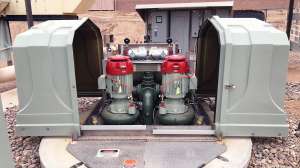
Two HeadCell, two TeaCup, and two Grit Snail systems were installed at the plant. This provided total plant protection for up to 45 mgd peak flows with 95% removal of all grit 106 micron and larger at peak flows and 95% removal of all grit 75 micron and larger at average flows.
After startup the new system’s performance was independently measured on-site and the performance results were even better than expected. In addition to protecting all downstream equipment in their plant and reducing energy consumption, the Advanced Grit Management system eliminated one of their most expensive recurring maintenance costs.
Plant flows at the time of installation
- Peak flow capacity of 45 mgd with both sets of equipment in service
- 95% capture of grit ≥106 micron (μm) at 2.65 specific gravity at peak flows and 75 μm at average flows
Installed equipment
- Two 12-foot, 12-tray HeadCell units
- Two 32-inch TeaCup units
- Two 1-cubic-yard/hr Grit Snail units
Learn more about Oldcastle Infrastructure’s HeadCell technology