With a population of 1.6 million and a five-year growth rate of 19.4%, the Canadian city of Calgary (Alberta) is in a constant race to expand and reinforce its underground utilities.
Key to this effort is the Nose Creek Sanitary Sewer Trunk project. It is a solution to a very real problem, namely that the capacity of the city’s existing sanitary system was predicted to reach its absolute maximum capacity by 2030 if upgrades were not made.
The NCSST project addresses this capacity issue by twinning Calgary’s existing sanitary sewer trunk from the Bow River northward beyond Beddington Trail Northeast. The final, completed stage of the NCSST — Phase B, Contract 4 — includes the longest microtunnel drilled in North America. It is about 0.9 miles long.
In recognition of this achievement, NASTT awarded Phase B the 2025 No-Dig North Project of the Year for New Installation. The award went to Ward & Burke Microtunnelling (the contractor), Jacobs Engineering Group and the city of Calgary’s Water Services department.
An ambitious plan
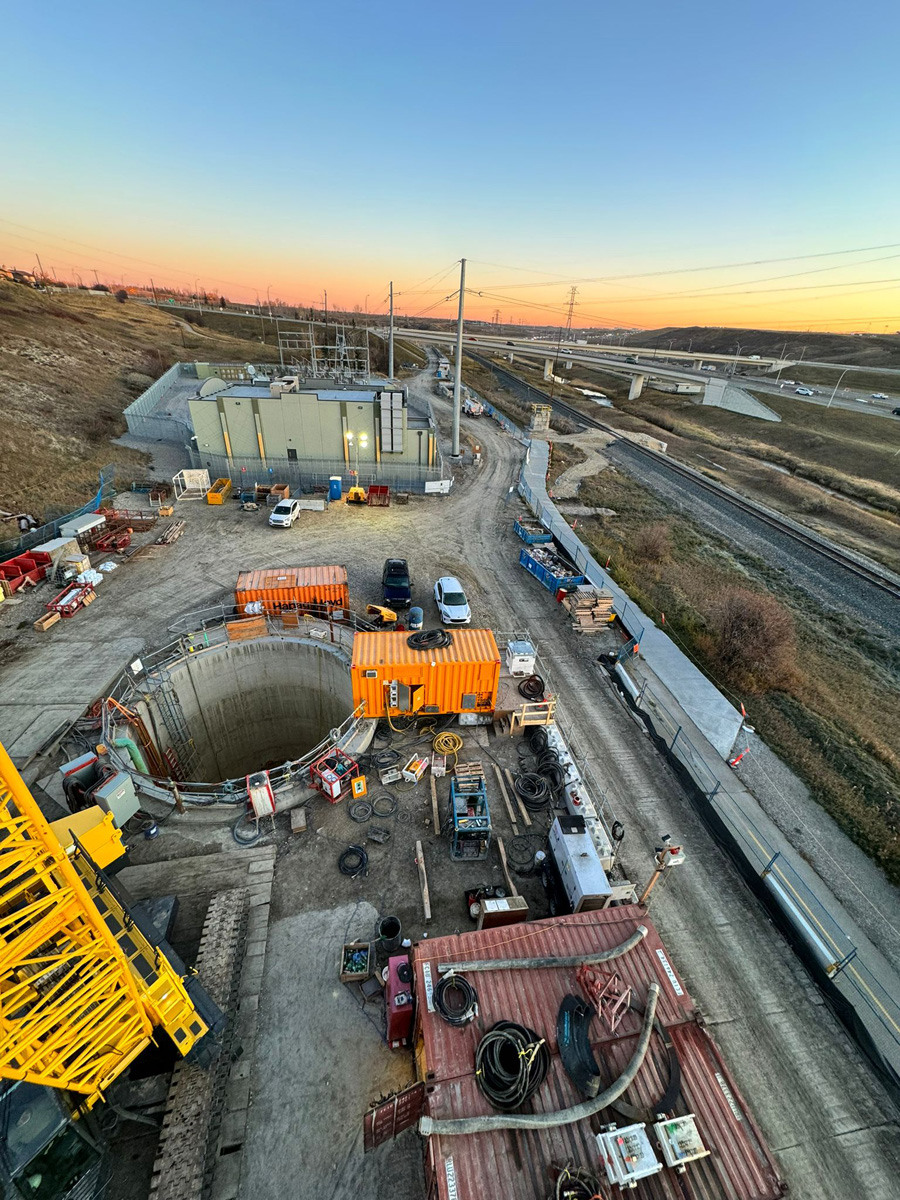
The NCSST project began in 2008, when the city of Calgary chose Jacobs (formerly CH2M) as the design engineer. Their job was to design and manage the twinning project across three distinct construction phases. Using a phased approach allowed the city to tackle the NCSST’s various geographical and logistical issues over more than a decade.
Phase A kicked off the initiative in 2010. It focused on twinning the existing sanitary sewer trunk along the Nose Creek valley from the Bow River up to 32 Avenue Northeast, for a distance of about 2.7 miles. It was finished in 2013, laying the groundwork for the next two phases further north.
Next, the city and Jacobs worked on Phase C, which is known as the Saddle Ridge Sanitary Sewer Trunk Upgrade. About a mile in length, this relief sanitary sewer trunk runs from the Fox Hollow Golf Course, passes beneath the Deerfoot Trail freeway, and then ties into the existing sanitary system near the intersection of 11 Street Northeast and 12 Street Northeast Phase C serves a major part of northeast Calgary. It was completed in 2017.
Once phases A and C were done, the stage was set for the final and most complex stretch of the NCSST project: Phase B.
Phase B in detail
Phase B was the biggest part of the NCSST. It required the twinning of over 6 miles of sanitary pipe stretching from 32 Avenue Northeast to past Beddington Trail Northeast.
Due to its sheer size, Phase B was divided into five separate subcontracts. The most notable of these was Contract 4, which involved the construction of approximately 1.4 miles of twinned sewer.
The contract for Phase B Contract 4 was officially awarded to Ward & Burke Microtunnelling in January 2024. They were responsible for drilling the main microtunnel and installing 0.9 miles of 65-inch I.D., HDPE-lined reinforced concrete pipe. Ward & Burke also had to install an 847-foot siphon section consisting of 59-inch I.D., HDPE-lined RCP, again using microtunneling. The company also did a 1,640-foot opencut installation of 65-inch fiberglass reinforced pipe, plus building permanent works chambers and a live sewer tie-in.
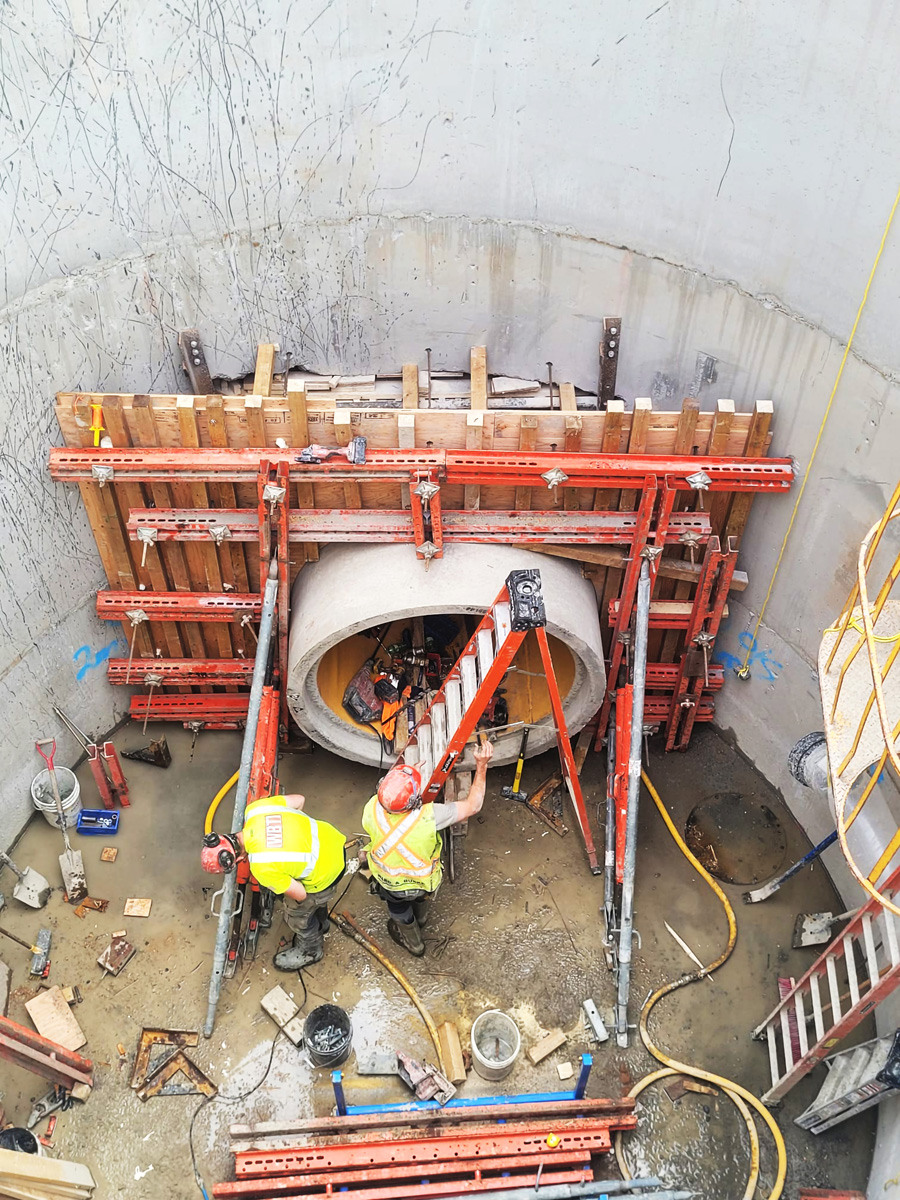
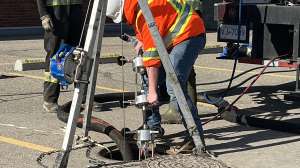
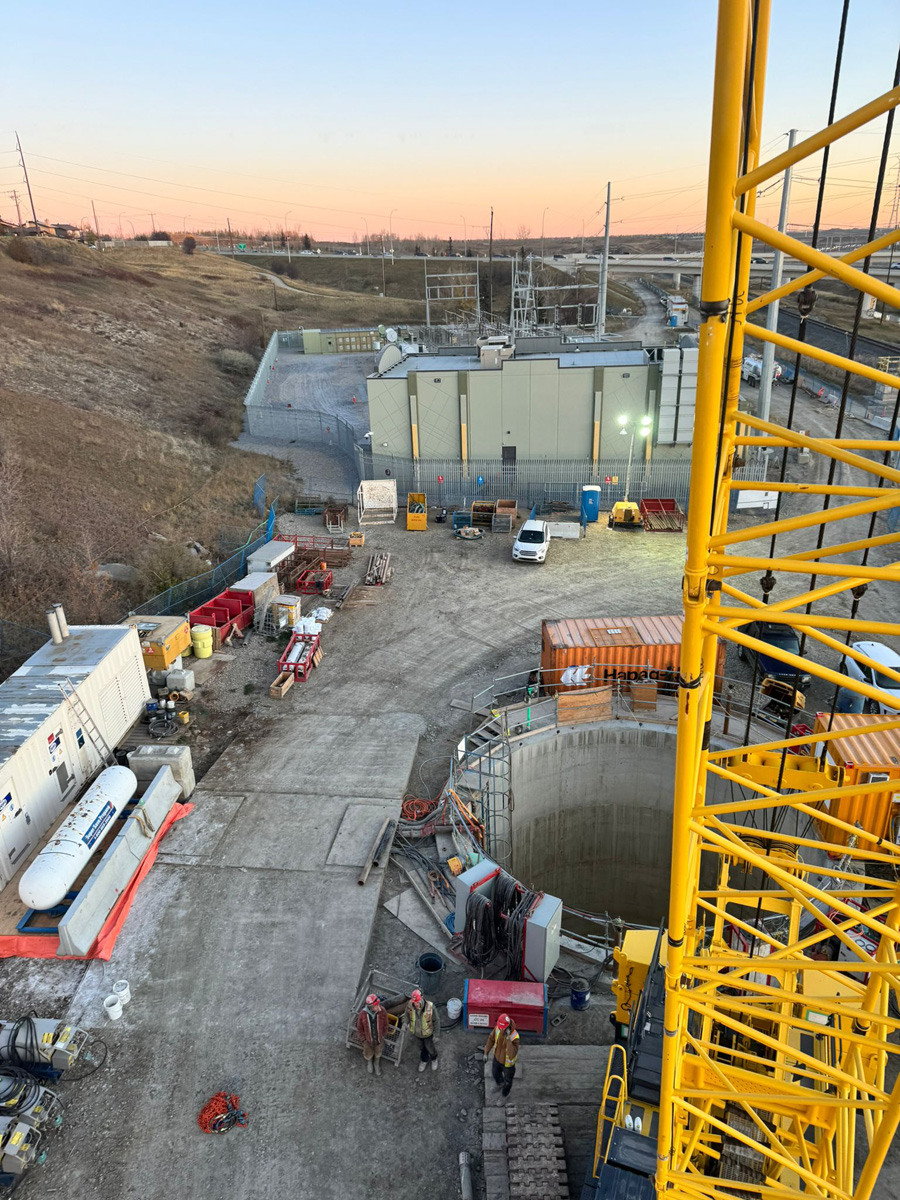
To do the trenchless work, Ward & Burke used a Herrenknecht AVN 1500 microtunnel boring machine, which was fitted with an upskin kit and a mixed-face cutting head. To support the underground work, the company sank three massive concrete caissons, measuring 30, 19.5 and 16.4 feet in diameter. All three caissons cut straight through the site’s upper clay layers and anchored into underlying claystone bedrock. Because microtunneling requires the pipe string to be pushed from behind, the primary 30-foot launch shaft was heavily reinforced at the back. This allowed it to absorb the massive thrust loads that were produced by the jacking frame.
Record-breaking drive
Without a doubt, the centerpiece of NCSST Phase B Contract 4, and the reason for its industry-wide recognition, is the project’s unprecedented 0.9-mile single microtunnel drive. Ward & Burke’s crews spent roughly four months doing it. They sent the AVN 1500 underground on May 22, 2024, and reached the reception shaft by late September 2024.
The route was far from a straight shot. To do the job, the crews had to carefully steer the MTBM through four separate horizontal curves with turning radiuses spanning anywhere from 2,296 to 5,577 feet. The ground they were cutting through varied from stiff clay/weak claystone to 20 MPa sandstone. It was a challenging mix to say the least.
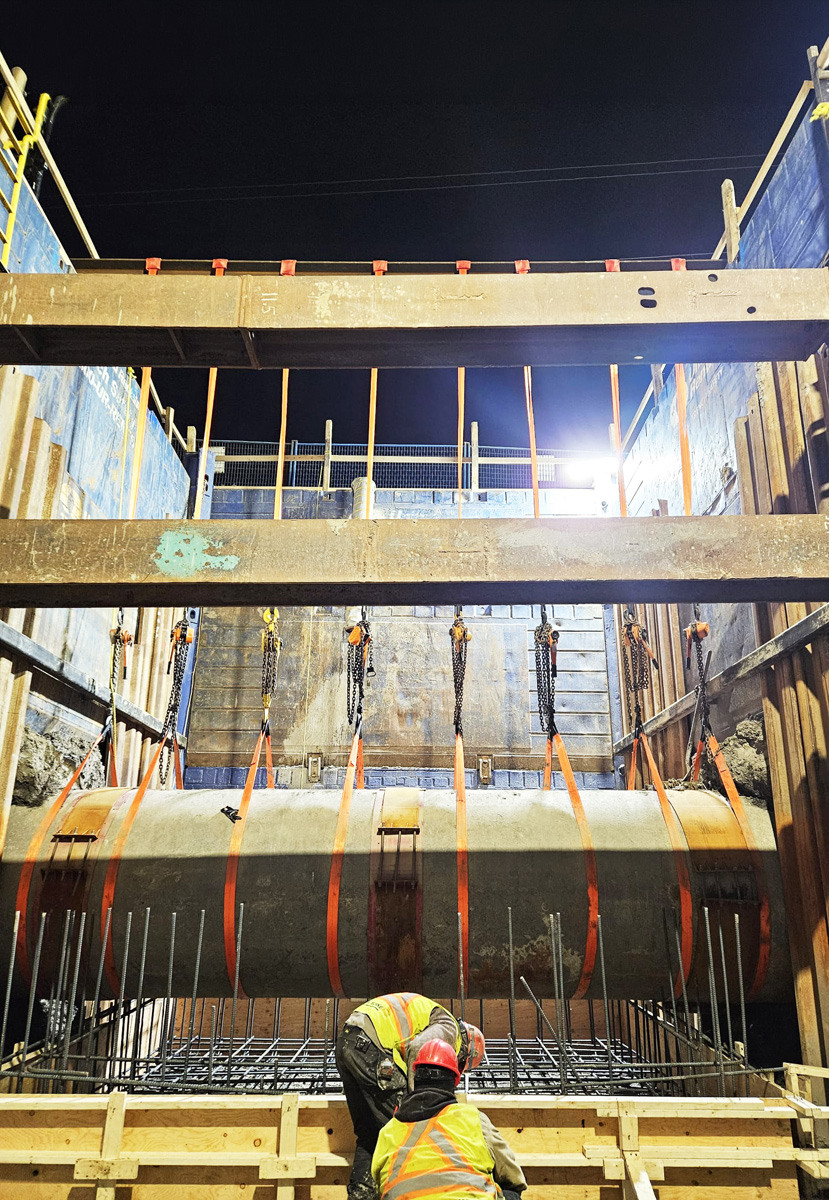
“Normally for a tunnel drive length that’s 0.9 miles long, you’re looking at using conventional tunneling,” says Mohi Parata, a civil design engineer at Ward & Burke. “Microtunneling hadn’t been done at these lengths before in North America. But we’ve had enough experience in Calgary that, looking at this project, we knew that we could do this in a single drive.
“We knew as soon as that job started that if we did finish this, it would be a record-breaking drive,” he adds. “I won’t say we weren’t thinking about it, but it was more about getting the job done on time and on budget.”
Ward & Burke’s confidence came from experience. In 2020, they drove a 3,714-foot microtunnel as part of the York Region/Newmarket Force Main Twinning project north of Toronto. At the time it was the longest microtunnel dug in Canada. Ward & Burke also built a 2,722-foot curved microtunnel for the Kingsbury Run Culvert Repair project in Cleveland, Ohio, in 2017. It was the longest curved microtunnel completed in North America.
On the NCSST project, Ward & Burke’s experience really paid off. The reason? In line with standard industry practices, the 0.9-mile microtunnel drive included three intermediate jacking stations to provide supplemental thrust along the pipeline string. But when the piping was installed on this project, “We never engaged a single one,” says Parata. “In fact, we came out into our retrieval shaft after 0.9 miles with only about 400 tons of jacking force on our frame, which is pretty remarkable. It showed that the lubrication systems that we use were working to their full extent.”
Indeed. Even without using the intermediate jacking stations, 400 tons was just 22% of the main jacking frame’s total capacity. It was an impressive achievement.
Soil and water
In contrast to the 0.9-mile stretch, boring the 59-inch siphon portion presented some geometric challenges. Using the same Herrenknecht AVN1500 equipment, the crew had to dive deep enough to go under Nose Creek and an active CPKC railway line to create this microtunnel. To make this happen, the MTBM carved through the earth along a 3,280-foot-radius curve. This allowed the microtunnel to pass safely beneath the creek and railbed before going upward on a tighter 2,362-foot-radius curve to hit the target reception shaft successfully.
Meanwhile, although the 0.9-mile microtunnel drilling and pipe string installation went smoothly, it did so because the NCSST project crew addressed the route’s variable soils beforehand.
To manage the shallow bedrock and mixed-face tunneling conditions along this route, the Jacobs’ engineering team employed advanced computational fluid dynamics and hydrogen sulfide modeling. Their extensive modeling ensured that the microtunnelling work would go smoothly, and that the pipeline’s final design would be easy for city crews to maintain afterward.
“The soil provided us with ideal tunneling ground conditions,” Parata says. “Typically, in Calgary, you have your granular overburdened layers that are close to the riverbank, but they overlay a bedrock layer. In this case, the bedrock was a weak claystone layer with a low hydraulic conductivity, so the water in the area was very manageable.”
Solid results
The successful completion of the Nose Creek Sanitary Sewer Trunk project is great news for Calgary. The twinned sanitary sewer system means that the city can keep up with population growth. Meanwhile, thanks to the extensive use of trenchless technology, the NCSST project was able to protect Nose Creek’s sensitive green spaces from the trauma of opencut trenching.
The project’s environmentally friendly use of trenchless technology has not gone unnoticed. In addition to the 2025 No-Dig North Project of the Year for Canada – New Installation recognition, the NCSST project received an Honorable Mention for the 2025 Top Trenchless Project in North America. Meanwhile, the NCSST’s engineers team was awarded the 2025 Western Canada Water’s Best Article of the Year for their technical writing about the project.
“I wouldn’t say we were surprised by the winning,” says Parata. “Obviously, it’s a great honor and a great achievement for us to win these awards, but it was a record-breaking drive.”
While the Nose Creek project is now firmly in the record books, the demand for high-capacity underground infrastructure in Alberta is keeping trenchless contractors busy.
“We are working on a couple of big projects in Calgary right now,” Parata says. “We have the TransCanada Sanitary Trunk project that we’re working on, which includes about 4.3 miles microtunneling between 1,500 and 1,350 [mm] pipe size. And we are the prime contractor on Phase A of the Bearspaw South Feeder Main replacement project in Calgary, which includes about 1.9 miles of microtunneling. So nothing record breaking, but there is a lot of microtunneling to be done between now and December.”
Continue reading for free