True to its name, the provincial capital city of Victoria, British Columbia, is known for its Victorian English heritage. Some of that heritage lies underneath its sidewalks and streets in the form of brick sewers installed in the city up to 150 years ago.
Of course, even the best built Victorian-style sewers break down over time. That’s why PW Trenchless Construction of Surrey, British Columbia, was brought on in 2023 to reline three sections of existing sewer main in Victoria using glass-reinforced plastic pipe.
It was a project that came with many challenges, some of which had little to do with the actual sewer pipes being relined.
A GRP believer
Founded by David O’Sullivan in January 2000, PW Trenchless is a significant player in British Columbia’s trenchless underground utilities construction sector. The company’s specialties include pipe bursting, sliplining and culvert rehabilitation. It also bills itself as being the only contractor to date to install GRP in British Columbia for large-diameter storm sewer and culvert rehab.
“My father David O’Sullivan has been a believer in GRP for a long time,” says Rory O’Sullivan, PW Trenchless’ project manager. “GRP is a standalone pipe that can be molded to fit the pipe being relined nicely.”
The 2023 Victoria relining project was not the first time that PW Trenchless had used GRP. One of its most unique jobs with the product was relining an underground pipe running through a Victoria graveyard through an outfall.
“I heard that one was a bit trickier than the 2023 relining,” O’Sullivan says. “The excavations were small and they all needed to be watched by archaeologists — and everything needed to be dug very slowly.”
Saving old pipes
Victoria is a charming Pacific seaside city, with broad leafy streets and heritage homes in its older neighbourhoods. The brick sewers that PW Trenchless was hired to reline are located beneath these historic streets.
The company relined three sections of existing sewer main using 1,000-by-1,600 mm GRP pipe. The first length of sewer to be relined measured 141 feet under Oxford Street at Chester Street. The second covered 305 feet of sewer with two manholes under Cook Street from Packington Street to Fairfield Road. The third section to be fixed was 415 feet of sewer running from Joseph Street to Eberts Street. The quality of the brick sewers in this area varies widely.
“Some of them are in OK shape,” O’Sullivan says. “Some of them are in not-so-good shape. We come into the play when the pipe is in bad shape, when the structure has cracks in it, and it’s basically a red line, which is the city’s code for a pipe having failed or being close to a failure.”
In those cases where PW Trenchless is called to help, the company draws up a plan with its subcontractor safety company to work safely within the sewer’s confined space. It then submits that plan to WorkSafe BC, which regulates worker safety in this Canadian province.
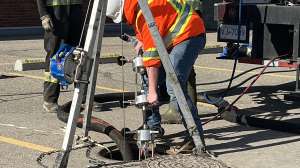
After that plan has been submitted and approved, “We go inside and we inspect the pipe; basically give it a rundown to make sure that the design is right,” O’Sullivan says. This process relies on measuring the sewer every 6 1/2 feet.
“We measure from point to point around the whole pipe to figure out the biggest pipe we can fit inside there,” O’Sullivan explains. “That’s the key thing about GRP pipe relining: You have to measure the pipe you’re fixing accurately first, to come up with a design that’ll make the maximum interior diameter inside the pipe and the maximum exterior diameter so it will fit in there snugly, and we can make it around every curve and corner.”
This data is then sent to PW Trenchless’ GRP source in Dubai, United Arab Emirates.
“It can take anywhere from two to four months to get here, depending on how fast the cargo ship travels,” O’Sullivan says.
While the pipe is at sea, the company starts work on the actual job site. This includes more intensive cleaning of the existing pipe, site preparation and digging necessary access holes to get to the sewer and reline it.
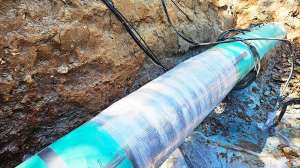
In the case of the Victoria relining project, each access hole above the pipes to be fixed was 12 to 16 feet long and 8 feet wide. In each case, “We had to dig down to the top of the old brick sewer pipe,” O’Sullivan says. “Then we have to cut into that brick line and remove the top section so that we could fit our GRP pipes in there. These GRP pipes were 6 1/2 to 8 feet long. We had to cut open a section in the sewer large enough so that we could lower the GRP pipe down into it, and then slide it up or down either way — connecting one GRP pipe section into the next like Lego pieces clicking together.”
Keeping people happy
As a company with a 25-year history, PW Trenchless’ people know a lot about interacting with the public. This is why they chose to move the proposed location of one of the access holes from a narrow street (which an engineer had specced out using Google Maps) to a wider one.
“Had we used that original site, we would have needed to shut down the whole street for all the residents,” O’Sullivan says. “We know in our line of work that if the city starts getting complaints from residents, it kind of gets messy. That’s when people start getting mad.”
Meanwhile, PW Trenchless opted to store the premade GRP sections on the parking lanes near the job site. Again, it made this site selection to minimize issues with local residents.
“One of the challenges with GRP is you have all this pipe that’s pretty darn big, and you have to find a place to put it while you’re installing it,” O’Sullivan says. “So we usually try to find parks or somewhere around there where they have a curb lane that we can take up for a couple months and the residents don’t get too angry. That’s the joy of working in Victoria: Everyone’s very opinionated when your government legislature is right there in town.”
Despite its best efforts, PW Trenchless did manage to run afoul of the municipal government.
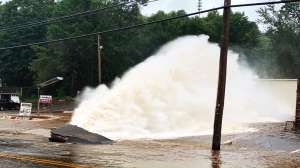
“We cut out a water main and just capped each end,” O’Sullivan says. “As it turned out, Victoria did not like us touching their water mains, because they want to ensure that everyone has clean drinking water, which I can appreciate. So when you fix a water main there, they make you run every possible test to make sure that everything’s safe. And we did.”
So how did O’Sullivan deal with the back-and-forth with city officials during this problem, to ensure that everything was handled to everyone’s satisfaction?
“Charm,” he says.
A successful outcome
The severed water main notwithstanding, PW Trenchless’ relining of Victoria’s sewer with GRP generally went as planned.
“It was done within schedule,” O’Sullivan says. “It was done under budget. And it was done in a way that we didn’t get any complaints from the residents. So I chalk it up to a job well done.”
Continue reading for free