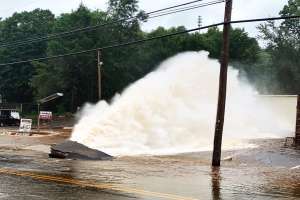
One of the most dramatic moments for Waterbury’s aging drinking water system came when water from a pipe break was so forceful that it launched large rocks into the air, damaging a garage a hundred feet away when they came down.
Other frequent near-tragic events led to the fast-tracking of an improvement program. In September 2025, a break in a transmission line cut water along a 10-mile stretch of pipe to nearly half of the city, causing 24 schools to close, flooding homes and businesses, and triggering a boil-water order. The city of Waterbury Water Department had to use a payloader’s bucket to flatten this geyser.
Now, this Connecticut city of 125,000 started a program that will use minimally intrusive technology and heavy-duty pipe to eventually replace nearly 9 miles of its high pressure Third Water Supply Transmission Main installed in 1968. Critically important, it carries potable water from the city’s primary water treatment plant through Thomaston into Waterbury.
“The city was interested in analyzing the problems that they were having with the transmission main coming from their Wigwam treatment plant going down into Waterbury along the river,” explains Andrew Morosky, P.E., senior project manager at the Connecticut-based engineering design firm Tighe & Bond. “They had numerous breaks, at least two significant ones and wanted to prevent future catastrophic failures, especially where the transmission main was in heavily congested urban settings. The city was concerned that the pipe was going to be an ongoing maintenance nightmare, and especially with the pressures down on Thomaston Avenue, which were in the neighborhood of 200 psi. A main that large with that kind of pressure is a dangerous mix when the leak is involved.”
City leaders, including Mayor Paul K. Pernerewski, understood that maintaining and modernizing Waterbury’s infrastructure is essential to the continued growth and safety of the community.
“This project represents a smart investment in our future and ensures residents and businesses can count on safe, reliable water service for generations to come,” Pernerewski says.
Analyzing options
The Waterbury Water Department supplies an average of 14 million gpd of drinking water to residents and businesses in Waterbury, Watertown, Prospect and Wolcott. There are nearly 400 miles of water main and more than 26,000 water service connections.
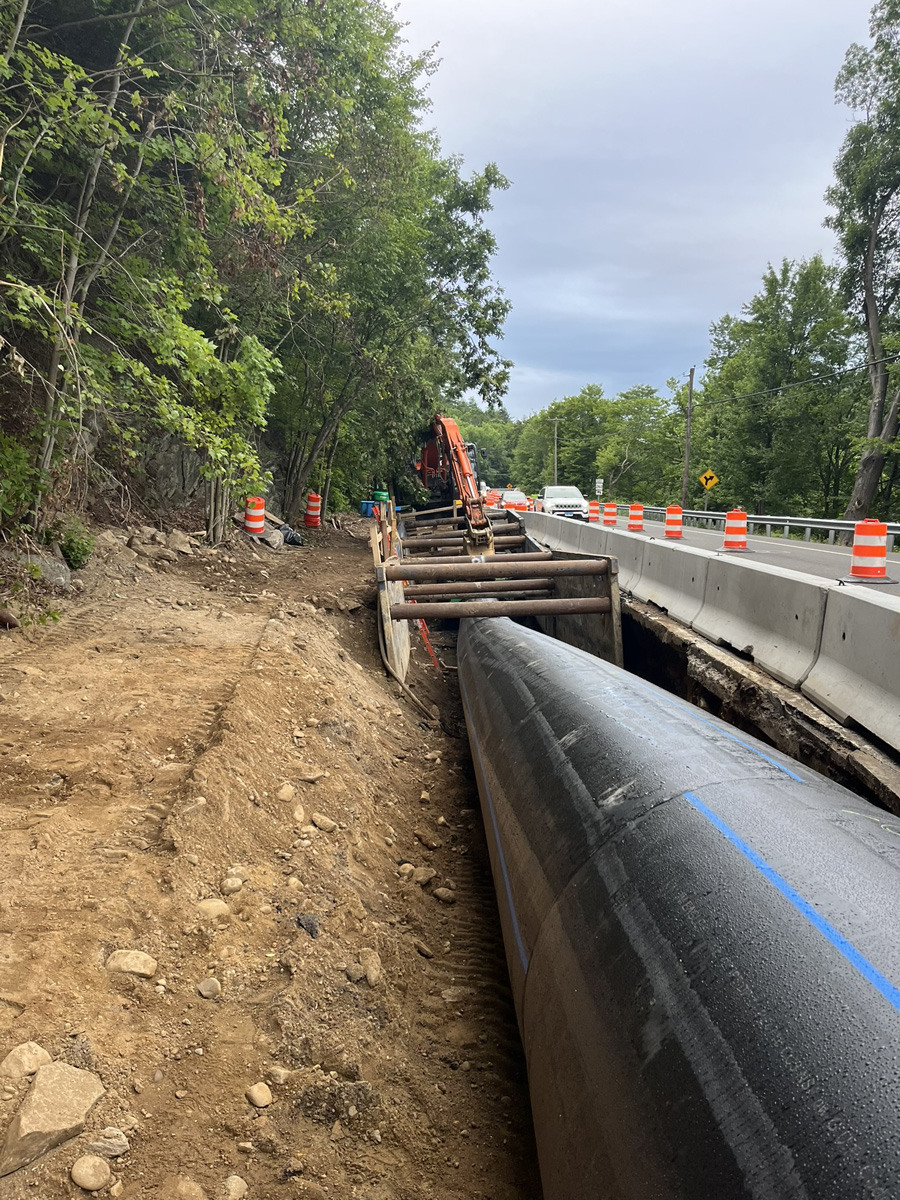
The rehabilitation project, called the Third Water Supply Transmission Main, is being done in phases. The first and second phases were combined and completed in a few months during the summer and fall of 2025 that saw 1.5 miles of pipeline fitted with new high-density polyethylene from JM Eagle between state roads STA 337+54 and 420+95. This area was prioritized due to past failures and high-risk conditions.
With several major breaks during the past several years, the city was open to suggestions for repairing the 42-inch prestressed concrete cylinder pipe system. Morosky and his team conducted an analysis that included traveling the route of the system from the treatment plant.
“As part of our study, we looked at rehabilitating the pipe in several ways including open-trench replacement of the concrete pipe, spray-on lining, cured-in-place, sliplining it with PVC or high-density polyethylene pipe,” Morosky says. “And we also included the CompressionFit method that uses the HDPE pipe. This was very appealing to the city because it would mean less intrusive construction projects, less disruption to the residents and the businesses nearby. We originally indicated there would have to be as many as 22 pits to cover about a mile and a half of main on Thomaston Avenue that was critical to them, and they wanted to get done with this phase.”
“What ended up happening is the contractor is now installing far fewer pits and they’re doing longer runs of anywhere from 500 to 1,000 or more feet at once,” he adds. “And it’s pretty amazing that they can lay out that much pipe on the side of a pretty busy state road and still maintain traffic.”
Maximizing flow
Developed by Florida-based Murphy Pipeline Contractors, the method pulls a new HDPE pipe that has been “compressively fit” inside the existing host pipe. Governed by ASTM F3508, the CompressionFit HDPE pipe lining technology specifies an HDPE pipe with an outside diameter larger in size than the inside of the host pipe to be renewed. After the HDPE sections are fused together to correspond to the pull distance, the pipe is pulled through a reduction die immediately before entering the host pipe. This reduces the HDPE pipe temporarily below the inside diameter of the host pipe, allowing it to be inserted.



While the towing load keeps the HDPE under tension during the pull, the pipe remains in its reduced size. The HDPE remains fully elastic throughout the reduction and installation process. After installation, the pulling load is removed and the HDPE pipe expands until it is halted by the inside diameter of the host pipe. The effectively natural compression fit is accepted as exchanging an existing failing pipeline with a composite pipe in its place.
“Due to the high pressure required for the system, one of the thickest-walled HDPE pipe options was specified,” explains Camille George Rubeiz, P.E., F. ASCE, co-chair, HDPE Municipal Advisory Board, and senior director of engineering for the Plastics Pipe Institute’s Municipal & Industrial Division. “This 42-inch DR11 pipe has nearly a 4-inch wall thickness to provide a pressure rating of 200 psi. To be able to compress that heavy, thick pipe into a die that enables it to be pulled through the old pipe is possible only with HDPE pipe because of its inherent flexibility and ductility. These attributes also allow the pipe to return to its original diameter, thereby maximizing the flow rate of the renewed pipeline.”
PPI is the major North American trade association representing the plastic pipe industry and is the foremost technical, engineering and industry resource.
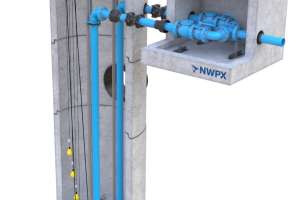
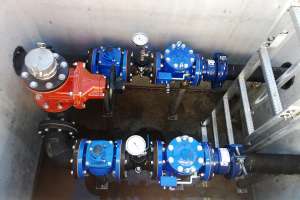
The thickness of the pipe wall was calculated using the pressure of the line. “We went down into a pressure relief valve chamber and saw that the pressure gauges were, in fact, very close to 200 psi, which is significant pressure in this main,” Morosky says. “The SDR11 HDPE PE4710 pipe was selected based on its rated capacity or rated pressure rating for pipe that size. It is extremely thick. I put my hand next to it, and it was about the thickness of my hand going sideways.”
The pipe in 50-foot-long sections was fused together into one string and dropped into the pit and pulled back through the Murphy Pipeline die. Lengths varied from 700 to 900 feet using 205 tons of pull force. There were multiple downhole fusions, pull-through pits, butterfly valve installations and emergency bypass operations to maintain uninterrupted service.
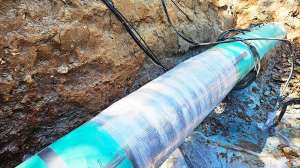
Once the new HDPE pipe is pulled into the existing PCCP pipe and released, it expands until it tightly conforms to the host pipe’s interior, creating a continuous, fully structural, leak-tight renewal pipeline. This tight fit eliminates annular voids, minimizes the need for grouting and maintains nearly the full flow area of the original 42-inch main — an outcome not achievable with conventional sliplining.

Managing constraints
According to Murphy, the use of CompressionFit technology delivered a strong balance of technical, financial and community benefits for the city of Waterbury.
“This method is capable of pulling up to 5,000 linear feet in a single installation, significantly reducing surface disruption where corridor conditions allow,” says Bill Fusser, P.E., director of technical projects for Murphy. “For this project, actual pull lengths ranged from 500 to 900 linear feet, reflecting site-specific constraints in a challenging corridor that included narrow roadways, heavy traffic, dense underground utilities and multiple stream crossings. Even with shorter pulls, this trenchless approach minimized environmental impacts, avoided continuous trenching and mitigated disruptions to residential, commercial and industrial stakeholders along Thomaston Avenue.”
In late 2025, a mile and a half of the old concrete transmission main was rehabilitated using CompressionFit with HDPE pipe downstream of the Naugatuck River crossing.
Continue reading for free