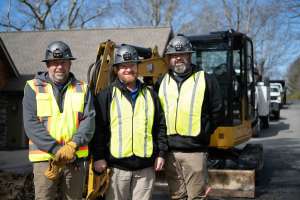
When there aren’t 100 mph winds bearing down on him, Chad Eggers spends his days with colleagues maintaining water and wastewater systems in two counties on the western edge of North Carolina. In 2024, he followed pretty much the same work routine after Hurricane Helene struck the region — even though it destroyed his home with him and most of his family inside it.
For exhibiting such conscientious concern for his community in the face of personal disaster, Eggers was presented the Living Water Award by the National Association of Water Companies in a presentation in Miami in September 2025, one year after Helene made landfall.
“To put community service above such personal loss is a testament to his character and speaks volumes about his profound commitment,” says Rob Powelson, association president. “His dedication ensured vital services continued when they were needed most, and we are honored to present him with the Living Water Award.”

Preparing for the storm
Eggers is a field technician for Carolina Water Service of North Carolina, which is a part of Nexus Water Group. The group provides water and wastewater services to more than 1.3 million customers in 20 states and two Canadian provinces. Carolina Water Service serves 39 North Carolina counties, including Avery County, where Chad Eggers lives with his wife and three children on one of the region’s rolling hillsides outside the county seat of Newland.
Rain fell heavily for two days in advance of Hurricane Helene’s arrival. Eggers and other utility employees spent those days buttoning up the systems, ensuring emergency generators were ready to keep pumps running in the event of a power outage, and otherwise readying for a big blow.
About 8:30 in the morning on Sept. 27, with Helene wailing outside, Chad, his wife Brittany, and their two sons, 7-year-old Hudson and 15-year-old Noah, were relaxing at home. Their 13-year-old daughter Addison was at a sleepover. “We have been through a few hurricanes. We were expecting some rain and a little wind,” Eggers says. Helene’s ultimate intensity surprised him. He recalls hearing the thump of a falling tree hitting the ground moments before their 2,200-square-foot modular house started disintegrating around him.
The days of torrential rain had loosened an embankment above the house. A huge section of the hillside suddenly broke loose, slid away and slammed into the structure. For the Eggers, it was a terrifying moment. Floors cracked open, ceilings fell and a sensation of movement paralyzed them. After sliding a hundred yards or more down the hill, the destroyed pieces of house finally came to rest against a rocky outcrop.
Recovering from the shocking slide, Brittany Eggers frantically searched for her youngest child, Hudson. She found him outside the house and inside the cab of a hydraulic excavator that somehow ended up nearby. Hudson, who had been asleep in his parents’ bedroom, was not sure how he came to be in the machine. Because none of the four family members in the house were injured, they counted their blessings even as they considered the destruction around them.
That disaster occurred on a Friday. The 43-year-old Eggers retrieved his daughter later that same day after driving through overflowing water on ruined roads. The following Monday, he left his family at the intact home of his father-in-law “right up the road” and returned to work in the community.
Restoring order
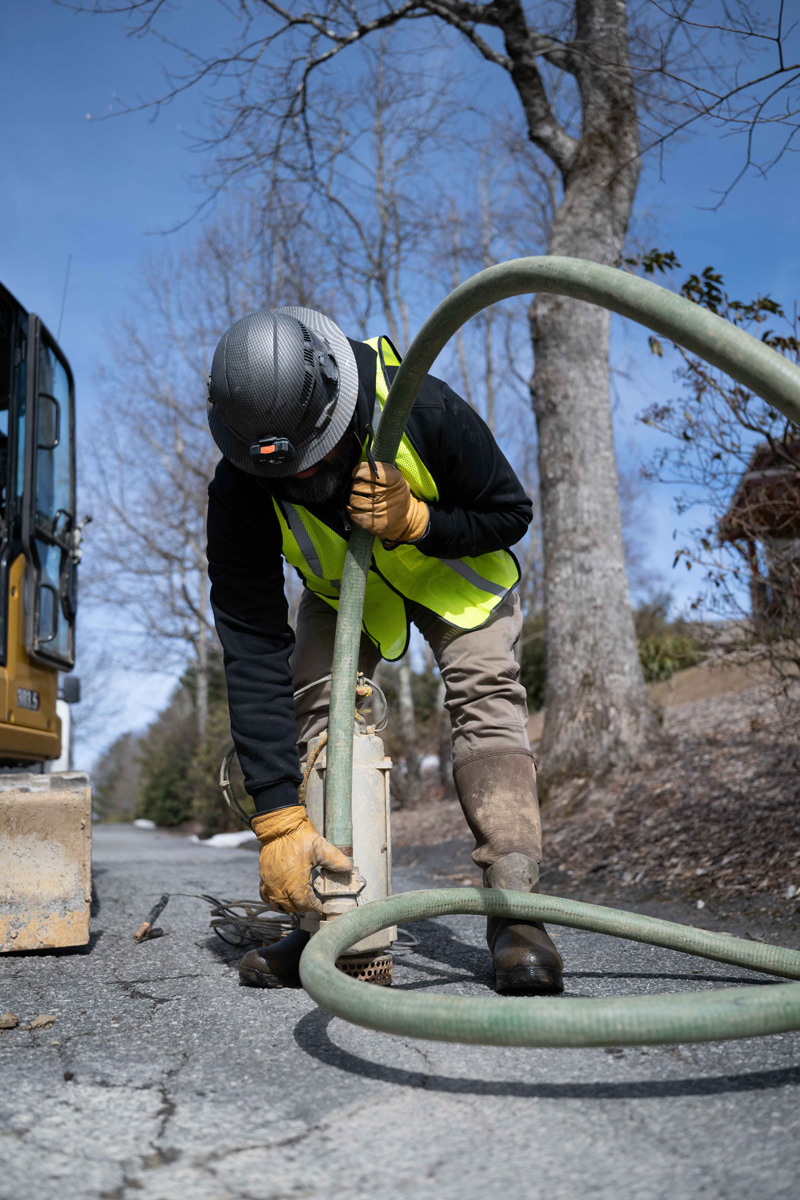
Chad Eggers is a native of Western North Carolina and has worked around heavy equipment and hand tools all his life. In fact, before joining the utility in 2017, he had helped a contractor lay some of the utility’s water and wastewater pipes. Maintaining the pipes is the focus of his daily work: finding and repairing leaks, ensuring well houses are fully functional and keeping water flowing across Avery County and parts of Watauga County.
Following the storm, he found a changed work environment. Roads were closed where surging water had undercut and collapsed pavement — 20 inches or more of rain were recorded in the area. Areas adjacent to the Elk River were piled high with waterborne debris. Water and sewer pipes were broken and missing. Poles carrying power lines were down. Some communities and mountain campgrounds were isolated and without vital services.
The Carolina Water Service vice president of operations, Gary Peacock, says he had not seen anything like it in his 29 years with the company.
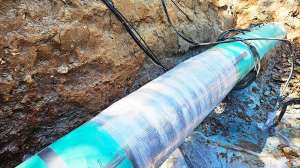
Eggers’ immediate task was to help assess the damaged systems, prioritize repair and replacement of infrastructure, deliver bottled water and otherwise begin recovery. He and others cleared rights of way to reach pump houses and other facilities. They helped restore water and sewer lines — ranging from 2 inches to 8 inches in diameter — by patching lines where it was feasible to do so or replacing them where there was nothing left to repair.
“We had one 6-inch pipe crossing Elk River that ran under the street. It was washed out. The ends of the pipe were broken on both sides of the bridge. We had to get into the river and connect it all again,” he recalls. A wastewater treatment plant near the river was totally destroyed.
The pragmatic goal was “to get water and wastewater going where it needed to go,” says Eggers. That was a regional goal, as well. The utility reported that 18 of its 76 systems in Western North Carolina were severely impacted by the storm. Specifically, Helene caused four sanitary sewer system overflows, 43 boil water notices issued in the days following the storm, and 14 Carolina Water Service systems operated using backup power for extended periods.
In the days following the catastrophic storm, Nexus Water Group crews from several states traveled to North Carolina to help restore the systems. They were welcomed, putting in some 4,100 work-hours making water and wastewater systems whole again. In addition, some major reconstruction projects were contracted out by the company.
In the end, the hurricane-affected communities fully regained the integrity of their utility systems. In fact, some facilities were upgraded in the course of restoring them, Peacock says. “Buildings or plants that were brought back had to meet current building codes.”

Doing the job right
The Eggers family’s recovery from the harrowing encounter with a hurricane is a work in progress. They are living in a trailer on a rental property. However, construction of a foundation for their new home has begun — back on the same hillside where their previous home sat until it was knocked out from under them.
Brittany Eggers says the trauma of nearly losing a child to the storm has not entirely receded. “Sometimes when I call them and they don’t answer immediately, the anxiety all comes back pretty fast. I automatically think that something has happened to them again. The first time the heat pump went on where we are living now it was pretty loud and we all woke up alarmed.”
As for Chad Eggers, he says that responding to help his community despite being in the midst of a personal crisis was an ethos implanted in him long ago. “I was told as a child that if you are going to do a job, do it right or not at all.” The work of recovering from a storm needed to be done, so he helped do it.
Even so, walking away from his ruined house to help people whose lives also were disrupted was something of a “nightmare,” he says. “There were driveways washed out and dropped trees and some big boulders that were moved to the bottom of a hill along with lots of red mud. I realized that my family and I were not the only ones that received major, major damage to property.”
In any event, he kept on working, just doing his job. As the National Association of Water Companies executive observed during the Living Water Award presentation in Miami: “Chad’s hands-on involvement, including managing individual field activities and assisting with pipe and leak repairs, was unwavering. His deep knowledge of the local area and profound commitment served as an inspiration to his colleagues and the community, demonstrating remarkable resilience and selflessness.”
Continue reading for free