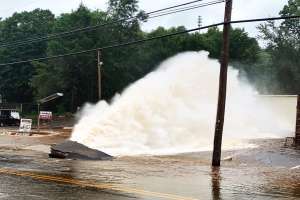
Throughout the United States, flooding produces a heavy financial and deadly toll. The Joint Economic Committee reported in 2024 that flooding costs between $179.8 and $496 billion each year. In July, 135 people died from flooding in Texas where the Guadalupe River surged 26 feet in 45 minutes. The calamity impacted 15 counties, with damage and economic loss estimated to be between $18 and $22 million.
Missouri knows all too well about the damage that can result from flooding. While the Show-Me State does not have a coastline, it consistently ranks among the top states at risk for flooding. The Missouri and Mississippi rivers flow throughout the state, snowmelt contributes to seasonal river surges, and tributaries and creeks frequently overflow during storms. Nearly 700,000 residents live in high-risk areas.
In the 2025 Missouri Budget, the state allocated $3.6 million for the Department of Natural Resources to study the state’s bodies of water and develop ways to prepare for and respond to flooding. More than 110,000 miles of river flow through Missouri, according to the Department of Conservation.
“You don’t really stop the flooding from happening, but you’re able to manage,’’ Chris Wieberg of the Missouri Department of Natural Resources told ky3.com.

The Meramec River, which flows for 220 miles through the east and central regions of the state, is especially prone to flooding. In April 2017, rivers swelled beyond capacity and crested at 36.52 feet, breaking the over-100-year record by 3 feet. Another flood in December 2015 saw the mighty Meramec crest at 31.48 feet.
In 2024, Missouri American Water invested millions to upgrade water treatment and distribution systems that serve most of St. Louis County and parts of St. Charles County. Much of the infrastructure dates back to the early and mid-1900s. Even in floods, water agencies such as MAW need to provide clean water for their customers.
“We know how critical water is to the health and vitality of a community, and this investment is key to our commitment to provide clean, safe and reliable water to our customers,’’ Rich Svindland, president of Missouri American Water, said in a press release.
Multiple projects
MAW tackled several projects simultaneously with its infrastructure investments. It launched a major project to replace large water basins at the Central Plant, the largest treatment plant operated by MAW, a subsidiary of American Water and the largest regulated water utility in the state. The basins date back to the early 1900s and replacing the basins is the first phase of a long-range plan to replace aging filtration and pumping equipment at the plant.
The utility company also upgraded treatment plants and storage and replaced the Sunset Hills water storage tank. The new elevated tank replaced one that had been installed in the late 1930s.

Another cornerstone of the infrastructure upgrade was the construction of the South Plant Intake Center. The intake station distributes raw water from the Meramec to the South Plant. The two-year project included the new intake station and equipment.
“The existing pump station was quite old,’’ says Jon Reader, senior project manager for Goodwin. “They had issues with the pumps and the elevation where the pumps were. When the Meramec River surpassed the 100-year flood level, the motors on the pumps would become submerged. We needed to get everything above the 500-year flood level so that it wouldn’t go underwater.”
Digging deep
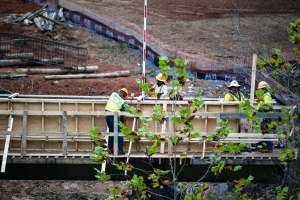
One of the most complex tasks in the construction of the new intake station was building a cofferdam, a watertight enclosure that is frequently used in water management projects near rivers.
Goodwin’s crew used 11,000 square feet of sheet piling and 3,500 cubic yards of concrete and 160 tons of rebar to help ensure the structural integrity of the building.
When the cofferdam is sealed, pumps remove water from inside it and create a dry area where workers can establish a concrete base, install pipes and other products to facilitate the operation of the pump station. The cofferdam was removed after the project was completed.

“In order to keep intake screens submerged, we realized the bottom of the pump station was pretty close to bedrock,’’ Reader says. “Rather than install a foundation system to bedrock, we elected to completely excavate down to bedrock and build it back up with concrete.”
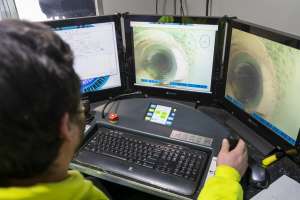
To keep the cofferdam stable while excavating to the toe of the sheets, workers needed to allow water from the river to flood the cofferdam. “We were actually digging underwater, just going by feel,’’ Reader explains. Divers were brought in to verify all the dirt had been removed down to bedrock inside the cofferdam.
Once Goodwin had excavated under water to bedrock, the next step was to pour the concrete from bedrock up to the pump station base slab. Because they could not dewater the cofferdam, the concrete needed to be placed as a tremie pour (poured underwater). After the tremie pour was complete, the toe of the sheets was secured again and grade inside the cofferdam was back up to the base slab elevation. Goodwin was then able to safely dewater the cofferdam again and begin construction of the pump station.
The station rises 45 feet above grade, keeping pumps well above flood levels. It also extends 45 feet below grade level and 10 feet below the bottom of the river.
Accessing powerful pumps
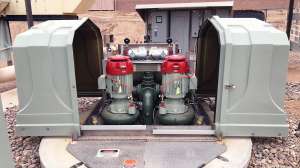
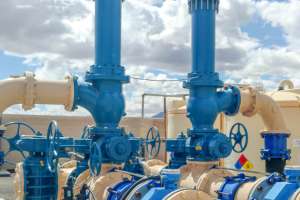
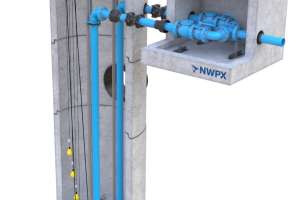
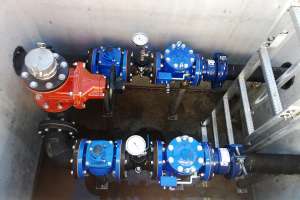
The new pumping station includes six 70-foot, 250 hp vertical turbine pumps from Sulzer that can deliver 6,600 gallons per minute of raw water to MAW’s South Plant in Sunset Hills.
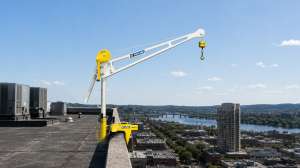
When the vertical turbines do require maintenance or replacement, workers can access them through stainless steel roof hatches from BILCO. These specialty access hatches are included in many water management projects in which the most logical entry point is through the roof.
The hatches allow the pumps to be lifted out of the building with a crane, and they include a pulley system that permits workers to open and close them easily from inside the building.
“With the pulley system, we can winch them open and closed from floor level inside the pump station. This is very convenient and doesn’t require someone to get on the roof to open the hatch,’’ Reader says. “We’ll bring a crane on site, open the hatch and hook the crane to the pump and pull it straight out of the top. It takes a very tall crane because these pumps are 70 feet long and the building is 45 feet tall. It takes a crane with a good amount of reach to pull it all the way out.”
Goodwin also included a BILCO floor door with fall protection grating in the building’s pump room. The doors are constructed with a channel frame and are used where there is concern of water or other liquids entering the access opening. Southeast Sales, BILCO’s manufacturer’s rep in the region, procured the products for Goodwin.
The amazing Meramec
The new intake station provides a critical piece of water management infrastructure for the Meramec, whose history of flooding goes back centuries. Flooding was so frequent that the Flood Control Act of 1938 authorized the Army Corps of Engineers to construct dams on the Meramec.

The start of World War II put those plans on hold, and in 1963, a new plan from the Corps called for 31 dams as part of the Meramec Basin Project. After years of political wrangling and concerns from environmental groups, plans to deauthorize the project were approved in 1981.
Still, environmental pressures threaten the health of the Meramec, which is home to nearly 300 aquatic or aquatic-dependent species. The river is an important drinking water source for the St. Louis region and is also an economic driver with its abundant recreation opportunities.
Plans have been floated for decades to enhance flood resilience along the Meramec, but many factors contribute to the problem and solutions are challenging and expensive.
“Repetitive flood damages in the Meramec River Basin are attributed to many factors, including increased frequency of heavy rainfall and severe storms, geology, topography, land use changes, increase in storm water runoff and loss of wetlands and open space,” the Army Corps of Engineers said in a 2020 Multi-Jurisdictional Floodplain Management Plan.
Flooding will be an ongoing issue for communities along the Meramec and elsewhere, but the new intake center provides an important component for residents in the area to ensure safe and clean water for their homes, even in the wake of hazardous flooding.
Thomas Renner writes on building, construction and other trade industry topics for publications throughout the United States.
Continue reading for free