There was no hesitation when the University of Louisville approached Louisville Metropolitan Sewer District for help with a wastewater program for freshman engineering students. MSD has a long-standing relationship with the university because a number of staff went to school there and maintain connections, says Daymond Talley, deputy chief of operations for treatment facilities.
“I received an email from the university’s engineering department asking us to join a partnership and build a prototype model of our three stages of wastewater treatment that they could integrate into their course,” Talley says. The model would be used as part of the university’s Cornerstone Program in which fresh- man engineering students are required to create their own models with materials made available to them.
MSD delivers 120 mgd of drinking water to one million residents and cleans over 155 mgd of wastewater at its Morris Forman and West County treatment plants.
Brian Robinson, associate professor of engineering fundamentals for the university, approached Talley asking for ideas on a project freshman could work on that would be different from the standard bridges and windmill projects used previously.
Cornerstone courses are designed to make sure engineering students learn the most important aspects of a particular subject area. The university was look- ing for new partners to help students design and build prototypes from different industries. Talley and colleagues suggested a course centered around the district’s clean-water infrastructure.
Stephanie Laughlin, infrastructure planning manager, says the Cornerstone course partnership enables the utility to reach a focused audience of future engineers who will learn what the district has to offer. That would help with the district’s workforce development.
The utility set up a prototype for the model in 2021, and the first course was launched in summer 2022. “Through this curriculum, students design, build and optimize a program model using environmental engineering principles,” Laughlin says. “So far, 480 freshmen have gone through the Cornerstone Program.”
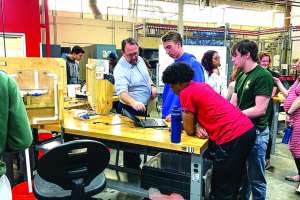
Utility team members regularly visit the freshmen while they are wrapping up and presenting their projects, asking about their takeaways from the course. As sophomores, the students are required to go through a co-op program and work with one of their project partners. Three students have interned at district facilities under the co-op program.
The Cornerstone project has been very helpful to the freshmen, according to Robinson. Their model includes a collection tank, an overflow tank, and a treatment center tank.
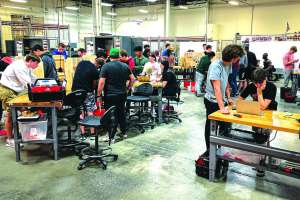
“They get hands-on experience in building their water infrastructure prototype project and they really enjoy that,” Robinson says. “They also get exposure and awareness of an industry they were not familiar with.”
The university has been through three classes of the Cornerstone water infrastructure program. After one more class, the program will be cycled into a rotation with three other industries: robotics, windmills and bridges.
“The partnership has been great,” Robinson says. “And the university has been with us all the way by first building the prototype for students to emulate. They continue to talk to the students during and after the course to find out the takeaways they enjoyed.”
Continue reading for free