Municipal sewer and water agencies usually rely on contractors to repair infrastructure or undertake new construction projects. St. Paul Regional Water Services executives concluded there might be a better way to get the work done.
Four years ago, the utility weighed the cost of contracting out pipe bursting work against the option of doing the work with in-house crews. Since then, the Minnesota utility has found that going it alone is indeed cost-effective in many cases and a better utilization of agency resources.
“We had a contractor do our pipe bursting for eight or nine years,” says Graeme Chaple (rhymes with maple), who is an assistant division manager at the utility. “Then we began to consider the challenge of always having to coordinate our crews with the schedule of a busy contractor. We decided to do a trial run of pipe bursting on our own.”
The regional water services agency learned that doing the work in-house indeed was doable under the right circumstances. “There was a learning curve. You have to get your staff trained and up to speed and learn which crews are better at it than others. But we learned it is cost-effective.”
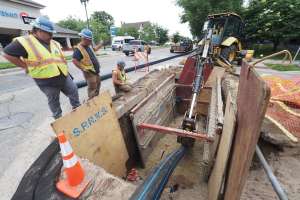
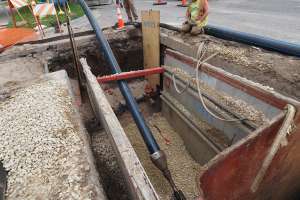
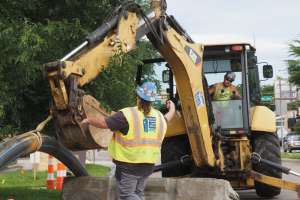
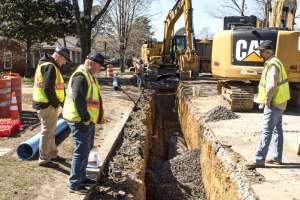
One argument for the initiative is that utility crews already were highly involved in the pipe bursting work even when a contractor was operating the bursting machine and dragging in the new pipe. Maintenance crews would excavate the street openings at either end of the pipe being worked on, be on hand as the bursting was happening, and then reconnect the pipe and close up the openings.
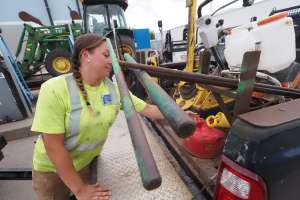
The utility rented pipe bursting equipment for a year from TT Technologies, the Illinois manufacturer that has been making trenchless tools for 45 years. St. Paul Regional Water Services also purchased HDPE pipe-fusing equipment from a local vendor and provided staff training.
A short segment of water main on a dead-end street was selected for the first attempt by the utility crews. “It was a street off the beaten path. We knew if we had an issue, we could easily dig up the pipe and deal with it. It was a good place to cut our teeth.” It was a success.
Recordkeeping
Upgrading the water main system is an ongoing project.
“Our distribution system has about 1,200 miles of main. The oldest segments are 130 years old,” says Todd Blomstrom, the water system’s assistant general manager. “We’re currently replacing 7 miles of main a year and soon will be increasing that to 12 miles a year.”
The goal is to try to get to a 100-year cycle with the infrastructure, according to Chaple. That is, the utility wants to have pipe in the ground that is no older than a hundred years. So, the work steadily moves forward. In June, 10 anticipated pipe maintenance projects were listed on the utility’s website and many of them involved pipe bursting.
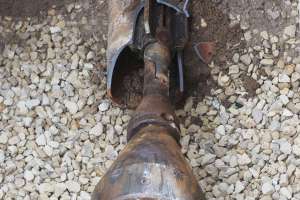
The system’s in-ground waterlines range from 4 inches to 42 inches in diameter, with most being 6 inches to 8 inches. To upgrade the system, some of the 6-inch pipe being burst apart will have an 8-inch line pulled in instead. All of the burst pipe is cast iron.
Chaple says the biggest hiccup his crews experienced in their bursting was when they encountered a segment of water main that wasn’t cast iron. “It was about a 40-foot section of ductile iron; bursting didn’t work real well,” he recalls. “So, we burst the cast iron on either end and then opened a trench and replaced the 40 feet.”
Among the lessons learned in that episode was the importance of record-keeping. “It is critical to make sure we are very accurate in our records of what infrastructure is in the ground.”
Mastering the process
The schedule for a bursting project starts in the fall for work beginning the next spring — this being Minnesota, cold weather limits the work season. About a month before ground is broken, letters are sent out to property owners along the length of pipe to be burst. Crews are selected and mobilized, the pipe is delivered and fused for dragging into place. Then pits at the ends of the selected pipe are excavated and two to three weeks of pipe replacement activity ensues.
Chaple says the biggest issue for the system’s bursting team is the sanitary sewer lines that intersect with the line being replaced. Because water pipes are usually buried 7 to 8 feet deep to avoid freeze issues, they often are laid within close proximity of sewer lines. Consequently, the pipe bursting sometimes results in nearby sewer lines being broken, too.
“They are clay pipe and if the bursting comes within about 12 inches, the clay breaks,” Chaple says. In summer 2024, a 415-foot bursting of pipe on Carter Avenue encountered five sanitary sewer lines. Two of them were broken. Because the problem was foreseen, the broken pipe was fixed before nightfall.
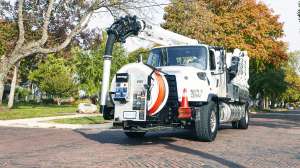
“We anticipate that we will break some of them,” Chaple says matter-of-factly, “so we have an excavator and a Vactor hydroexcavator positioned for repair work. A televising contractor is on hand and sending a camera up the sewer services line while the bursting is going on. When a break does occur, it’s immediately identified and fixed. The sewer pipe is excavated, a PVC replacement is fitted into place, and we move on.”
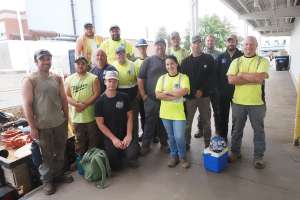
In this way St. Paul Regional Water Services is methodically pulling in new water main to replace old. Three replacement crews work through each summer construction season, with one of them specifically assigned to bursting work, though the crews are cross-trained to sub for one another as needed.
“It is kind of fun watching a new crew doing bursting,” says Chaple. Some crew members had reservations about bursting instead of open-trench replacement, but have come to enjoy the work. The utility continues to rent equipment from TT Technologies and to receive technical training as needed. All crew members are certified in fusing the pipe.
“Our staff members have been wonderful,” Blomstrom says. The assistant general manager describes the crews as engaged, doing a good job, very positive about the new technology and committed to mastering it.
Maximizing resources
Not every failing water main in the St. Paul system is a good candidate for bursting, Chaple says, because of the density of services along the route. “The older part of St. Paul is built on 40-foot lots. So, attaching all those lines, you have so many service cuts, you might as well have opencut the whole street. Bursting works really nicely on streets with larger lots or where all the properties are on one side of the street or in the suburbs where there are really big lots.”
The utility plans on completing a mile and a half of pipe bursting each working season. That is a level that fits the utility’s budget and crew size. “Six hundred feet or something wouldn’t justify the training and renting of equipment,” Chaple says. “But since we have dedicated one crew to it the entire construction season, May through November, we know we are going to get that mile and a half.”
Chaple credits utility leadership with the decision to bring pipe bursting in-house, thereby getting the most out of the construction budget and the crews. “Our management has been pretty good about promoting the idea of, ‘Let’s try something new.’ It might fail but at least we get to try new technologies and see if we like or don’t like them.”