At Naperville’s Department of Public Utilities, one of the largest municipal utility systems in Illinois, efficiency matters.
The utility oversees drinking water supply and distribution, sanitary sewer conveyance and wastewater treatment for the rapidly growing suburban Chicago community.
When team members started noticing longer pump runtimes and declining system capacity, they knew they had to address the problem. As pump runtimes increased, so did operating costs and concerns mounted about accelerated wear on critical pumping equipment.
Like many utilities, we initially focused on mechanical fixes — repairing pumps, valves and piping across all wastewater lift stations. But as system performance continued to decline, it became clear the root cause might lie elsewhere. The issue wasn’t necessarily the equipment. The real problem could be developing inside the force mains themselves.
The change in pump performance and system hydraulics suggested that restrictions might be developing within the force mains.
Pumps were taking progressively longer to move the same volume of water compared to when they were first installed. Five years ago, a pump might run for 10 minutes per cycle. Today, that same pump requires 15 to 20 minutes to handle the exact same flow. This steady increase in runtime signaled a significant decline in system efficiency.
We analyzed the data closely and saw that the pump had previously been pumping 100 gpm for five minutes. Today it was pumping 80 gpm for 10 minutes.
There were also ongoing issues with restricted flow caused by debris — primarily rags and wipes — clogging the pumps. Each clogged pump required dispatching a crew, costing more than $2,000 per incident. On top of that were the recurring expenses to rebuild pumps, service check valves and address other mechanical problems.
To see what was happening, we needed to conduct a condition assessment. Sometimes, these assets don’t get enough attention. Force mains operate under pressure and are not easily inspected, making it difficult to know what is happening.
We selected an in-line inspection tool from INGU Pipers, which worked well with small-diameter pipes and was easy to implement. A free-floating inspection ball was dropped into a check valve and later retrieved downstream at the force main discharge manhole. The inspection results revealed a significant amount of debris and reduced hydraulic capacity on two force mains:
Cinnamon Creek — 2,303 linear feet of 6-inch ductile iron revealed 10% hydraulic reduced capacity, a significant restriction for a small-diameter pipe.
County Lakes Lift Station — 1,094 linear feet of 10-inch PVC pipe revealed 16% hydraulic reduced capacity. This was surprising because the pipe was relatively new, installed in 1999.
Cleaning force mains is not always straightforward. Since they operate under pressure and often contain valves, bends and diameter changes, traditional pigging methods can be difficult and costly. Installing pigging equipment may require constructing launchers or receivers. And if a foam pig becomes stuck, the pipe may need to be excavated to retrieve it — a costly and problematic proposition.
Years ago, I read about Ice Pigging in a trade magazine. Developed by engineers at the University of Bristol, England, the technology is well-suited for wastewater force mains, where grease, biofilm, sediment and debris build up and restrict flow.
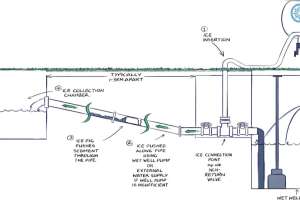
A slushy mixture of ice is introduced through the existing bypass and uses the pump’s own pressure to scour and clean the inside of the pipe. Because there’s no solid pig, there’s nothing that can get stuck. I remember thinking it was the ideal solution — if the ice mixture was to get stuck in the line, it simply melts and the system returns to normal.
Back then, I couldn’t find a single Ice Pigging contractor anywhere in the United States.
After further investigation, we discovered that, as of 2021, American Pipeline Solutions had secured the Ice Pigging rights and equipment for the United States.
APS worked closely with our team. Based on the sizes, the material and the length of Cinnamon Creek and County Lakes, they calculated that one load of ice slurry would be enough to clean both force mains.
One of the advantages of Ice Pigging is that the ice slurry can be introduced through an existing bypass connection, eliminating the need for additional equipment or construction. To keep costs down, our crews operated the lift station and handled the required traffic control.
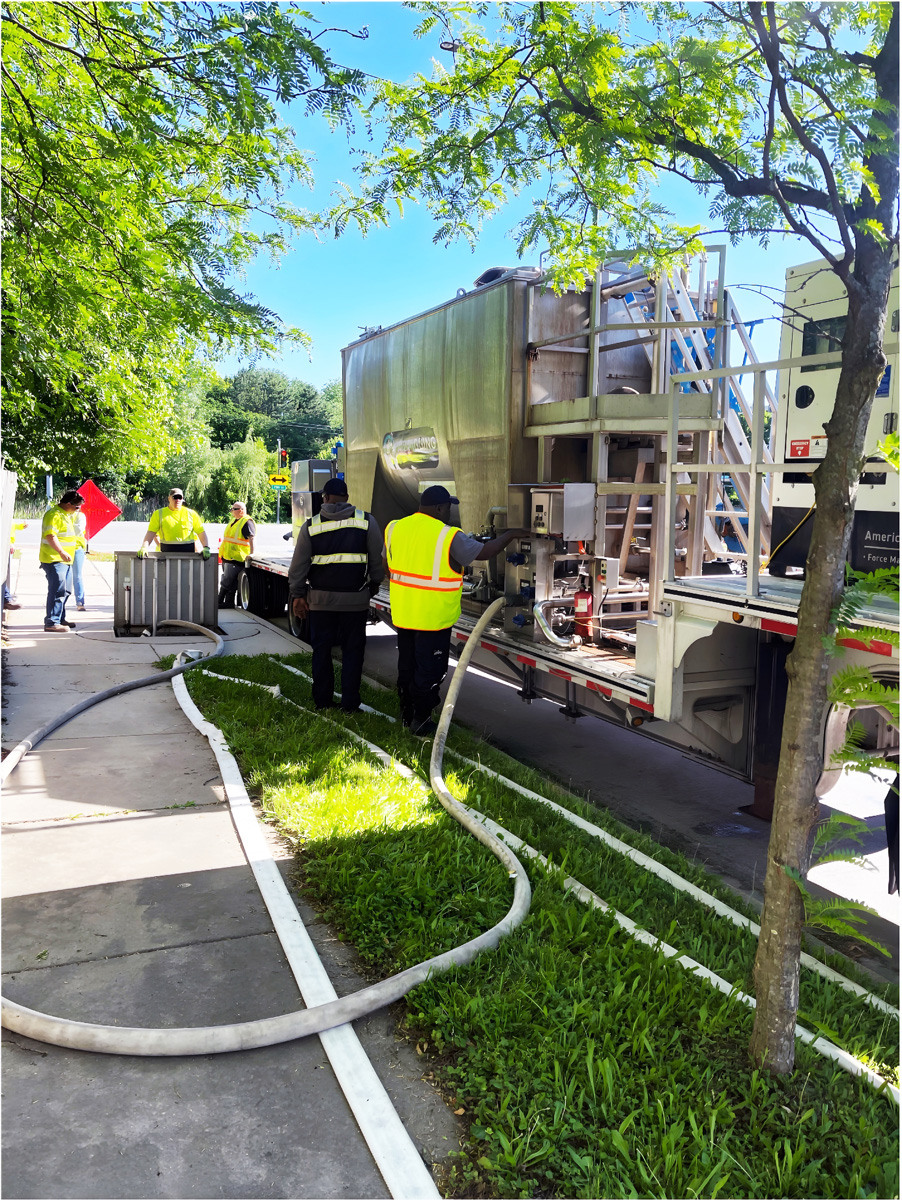
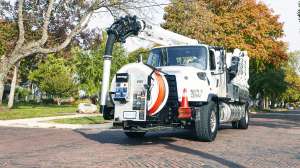
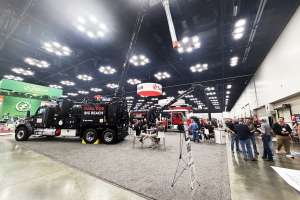
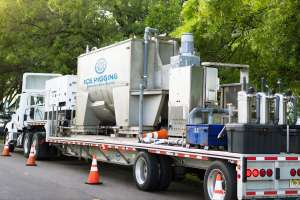
Day one was dedicated to ice production. Each load is a 10-ton batch, equal to 2,700 gallons. The Ice Generator is a large tractor-trailer with multiple cylinders that produce the ice. A separate tanker holds and delivers the ice slurry, to which a small amount of food-grade table salt is added to keep it colder for longer, providing greater scouring capability. As water circulates between the two rigs, the semisolid ice slurry is created.
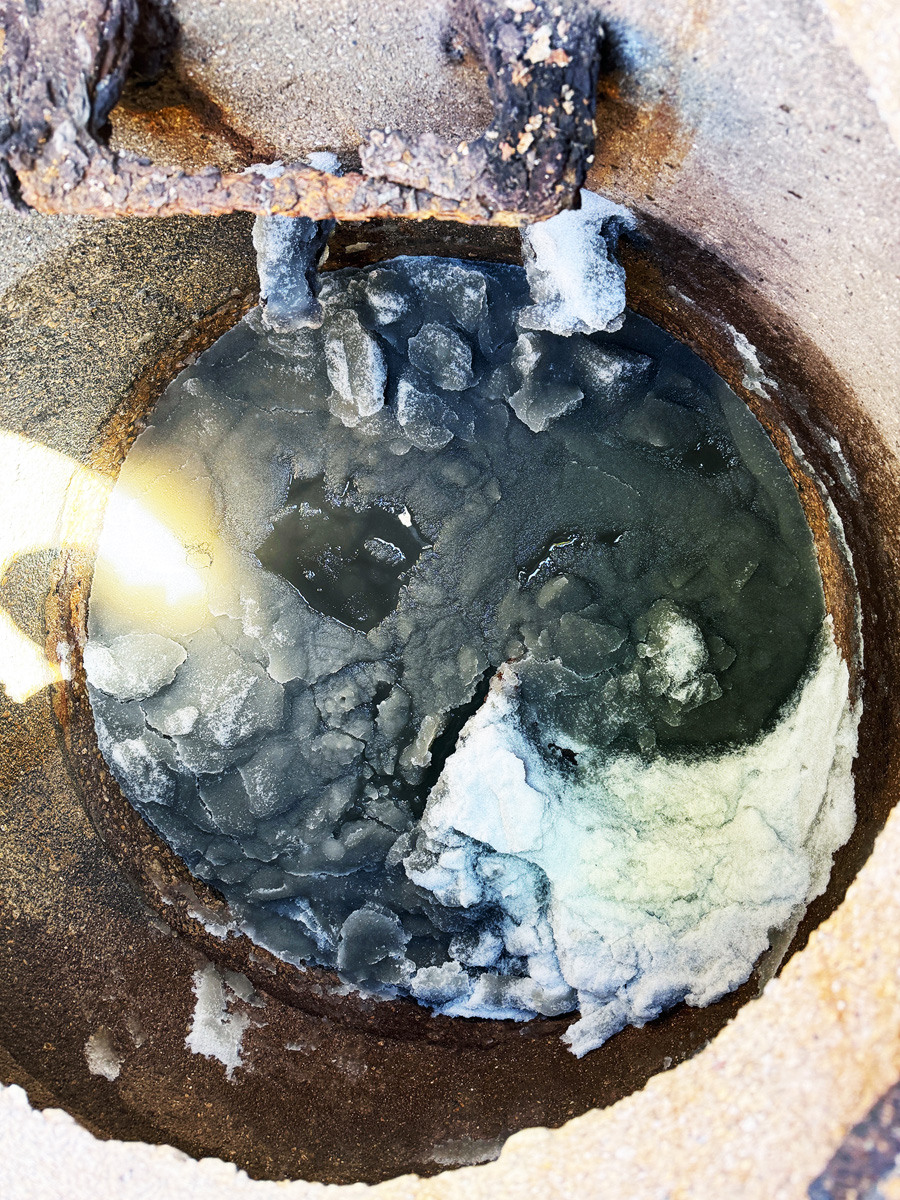
The slushy mixture of ice and salt looks like lemon-lime slush. While the mixture is pumped like a liquid, it behaves like a solid once it forms inside the pipe. The ice solution, essentially a brine, scours the pipe, pushing the debris and sludge downstream to the discharge manhole.
During each cleaning, the force main and pump station were temporarily taken out of service. The well was filled to capacity with wastewater to push the ice down the force main. Valves were opened to introduce the ice into the pipe and our crews connected the hose from the ice pigging rig to a bypass riser.
APS’s operator injected the calculated amount of ice into the line. Wastewater was pumped into the force main, pushing the slug of ice, scouring the pipe and pushing the debris and waste downstream.
Discharge from the first pump was normal brown wastewater, then black sludge mixed with the ice. Then, loads of black sludge poured out. The pumps kept running until the water returned to normal brown wastewater.
The whole process from creating the ice, preparing the sites, cleaning up and travel time was two days. The actual cleaning of each force main required only about one hour.
The day after the cleanings, the improvements were immediate. Pump performance returned to levels we had not seen in years. At Cinnamon Creek, flow increased 19% and runtimes decreased 20%. At County Lakes, flow increased 20% and runtimes decreased 2%.
Since the cleanings, we have not had to pull a pump to remove debris. Within nine months, the cost of Ice Pigging the two force mains had been fully recovered through operational savings and reduced maintenance.
We have inspected 16 of our 27 force mains. Each one shows some type of restriction.
Next, we will be cleaning five additional force mains. APS helped us to contain the costs by grouping pipelines into one load.
“By calculating the amount of ice required for each pipe, we identified five that could be cleaned with a single load of ice,” explains APS President Blake Murphey.
Force mains are often overlooked assets in wastewater systems. For Naperville, the inspection and cleaning program has revealed that even relatively new pipelines can accumulate debris and lose hydraulic capacity.
With many utilities facing similar challenges, routine inspection and targeted Ice Pigging may become an important part of long-term force main management.
In three decades, this is one of the only projects that went exactly as planned without any issues. The crew at APS took the time to explain the process and they ensured that every detail was handled professionally.
Tony Conn is the senior deputy director of Public Utilities - Water Operations in Naperville, Illinois.
Continue reading for free