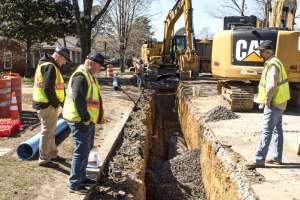
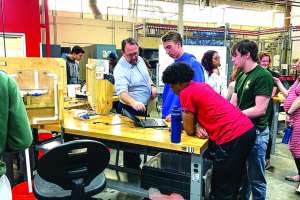
Kirt Holowachuk, town foreman for Leroy, Saskatchewan, discusses work plans at the start of his day.
Photography by Dave Stobbe

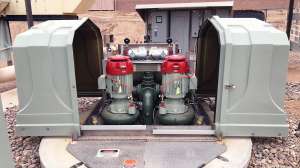
Holowachuk performs a daily maintenance check at the town’s pump station.

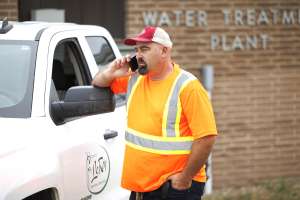
Kirt Holowachuk, town foreman for Leroy, Saskatchewan, discusses work plans at the start of his day.
Photography by Dave Stobbe
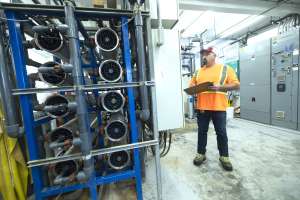
Holowachuk performs a daily maintenance check at the town’s pump station.
The small town of LeRoy, Saskatchewan, has always believed that building and maintaining critical infrastructure is a prerequisite for growth — not an afterthought. Town foreman Kirt Holowachuk, who has overseen the town’s water and wastewater systems for a dozen years, embodies that belief and is recognized in the community as an infrastructure champion.
LeRoy is located about a two-hour drive north of the province’s capital city of Regina. Its current population is more than 500, representing organic growth of more than 20% over 10 years. However, the biggest economic news in the area has been the construction of the BHP Jansen mine, which has the potential to be one of the largest potash mines in the world. Located just five miles away, LeRoy is the nearest community to the mine and stands to benefit from some of the more than 800 permanent jobs and economic activity associated with its operation.
“A community needs to be ready or a potential business or opportunity will go to the nearest community that’s ready,” says LeRoy Mayor Kurt Schreiner. “We were already experiencing growth and we anticipate further growth with BHP, so it’s been extremely important to be proactive with our water and sewer systems.”
He credits Holowachuk for being integral to driving recent improvement to the town’s infrastructure.
“With his knowledge of infrastructure and his ability to come up with and maintain a strategic plan, Kirt’s a special breed and puts his heart and soul into this community,” he says.
Holowachuk is a fixture at town council meetings, advocating for improvements to sewer and water infrastructure that he believes will add value to the community and promote economic growth.
“They get nervous when they see me on the council meeting agenda,” he says. “Will it be a quick report or will I talk their ears off for the next hour?”
The town built its first sewer and water system in 1964. Water was supplied by two shallow wells and treated by a greensand filtration system and pumped into a 50,000-gallon underground reservoir. LeRoy added a second 60,000-gallon aboveground reservoir more than 30 years ago. Wastewater was conveyed via gravity to a lift station with a small holding tank, and finally to treatment in the town sewage lagoon via force main.
While water quality was good, it was also heavily mineralized. In 2004, town council voted to replace the shallow wells with a new 500-foot well and replaced the filtration system with a reverse osmosis system that would provide softer potable water. It was one of the first RO systems in the region. The town also expanded the sewage lagoon with the addition of a larger second cell that more than doubled treatment capacity.
With infrastructure in place, LeRoy acted as its own developer for a 34-lot, fully-serviced subdivision in 2009.
Holowachuk began working for LeRoy in 2012. With the current assistance of one full-time and two casual employees, his department’s responsibilities include sewer and water infrastructure, road maintenance, urban forestry and operating the town’s ice rink in winter. The team is supported by a John Deere tractor-loader and a Caterpillar skid-steer.
“We have a shop with an office,” Holowachuk says. “But more often than not, my office is in my pickup or on the seat of whatever piece of equipment I’m operating.”
To support a gradual population increase, he first prioritized improvements to the wastewater system. The town hired an engineering firm to audit sewer usage and determine how much additional growth the system could sustain. Based on the study report, Holowachuk advocated for significant upgrades totaling CA$1.5 million, which were approved by council for 2016.
“Our aging lift station represented the weakest link in the system,” he says. “It was at capacity and any significant growth or even a high water event would test those limits. Instead of repairing and rebuilding, we felt we could get better value from a new combination dry well and wet well.”
The new, upsized lift station featured more powerful pumps, employed pressure sensors instead of floats and incorporated a backup natural gas generator. The lift station also provided easy access for maintenance work.
At the same time, a second force main was added to the system and upsized from 6 inches in diameter to 8 inches. The original force main was kept in place for use during maintenance or emergencies.
With wastewater improvements completed, Holowachuk next turned his attention to water supply. The 2017 project list, budgeted at CA$315,000, included upgrades to the water treatment plant, installation of a new fire pump, a new 8-inch stainless steel header pipe and the addition of a natural gas backup generator for the entire system.
“I made a big push for these improvements because, for me, everything comes down to making sure we have consistent, safe water,” he says. “I also made a continuing case for creating redundancies in the water system.”
That goal was realized in 2023, when the town developed a second 475-foot well with its own distribution pump. The well systems can run independently of each other and serve the town during emergencies and routine maintenance.
“When we’re doing maintenance work, you have to get the pump pulled apart, figure out what you need, and then put it back together,” Holowachuk says. “Especially since COVID, getting parts is getting harder and there’s always a long lead time for anything we order. That delay isn’t as big an issue with the backup water system.”
A regular maintenance schedule keeps the system in shape. The wastewater system is flushed on a four-year cycle, with extra attention paid to those sections where the grades on the gravity system aren’t as steep.
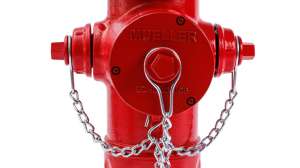
Water systems are also flushed in spring and fall in tandem with fire department hydrant training.
“During those exercises, we’re noting the performance of the older isolation valves and hydrants,” Holowachuk says. “We try to replace a couple of isolation valves every year and hydrants as necessary.”
While the town’s water mains are in good shape, service connections continue to represent the weakest point of the system. Pipe saddles installed in the 1960s were made of brass and connected with black iron bolts, which have corroded over the years. Both saddles and bolts are now replaced with stainless steel.
As LeRoy anticipates growth that could double the population of the town, Holowachuk continues to champion the expansion and maintenance of its infrastructure. At the annual conference of the Saskatchewan Water and Wastewater Association, of which he’s a board member, utilities often present seminars on their top projects.
“Large cities always have the big flashy projects with big budgets and the newest kind of water and wastewater treatments,” he says. “But the small operators don’t often get a chance to brag about what they’ve done to support their communities. Sometimes that small town guy has been fighting to get a chunk of road ripped up to get a pipe replaced. That’s his crowning achievement for four years and he’s the proudest guy in town.”
Continue reading for free