Electrical power consumption rises during the day when most people are awake, and then drops at night when they go to sleep.
This is a simple, even obvious observation. Yet it is one that poses serious problems for governments and electrical power generators/suppliers alike: How can they balance these two elements to generate and then store power in the most economical and effective way, without having to spend millions on giant banks of batteries?
In the Canadian province of Ontario, they appear to have a smart answer to this question. You don’t need batteries, but what you do need is an elevated water tank that can gravity-feed electricity-generating turbines during times of peak power consumption. And then while most people are asleep and power consumption is low, you can use the excess energy on the grid to pump the tank full of water again.
It’s a very simple idea, but that doesn’t make it any the less brilliant. And this idea is at the heart of the Ontario government’s proposed Ontario Pumped Storage Project, which is being developed in partnership with TC Energy and the Saugeen Ojibway Nation. If conducted, it would be the largest of its kind in Canada.
On demand
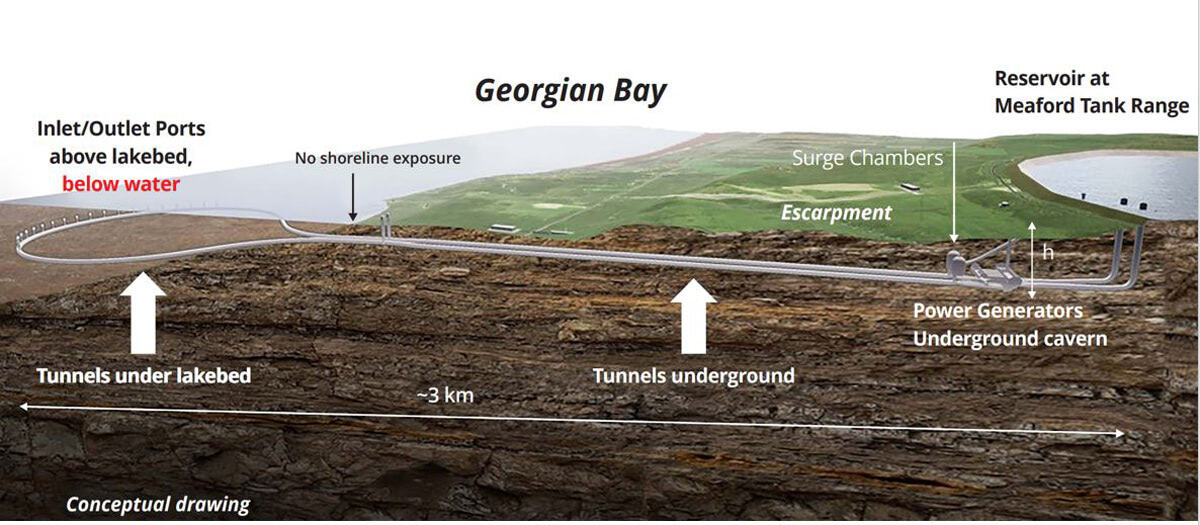
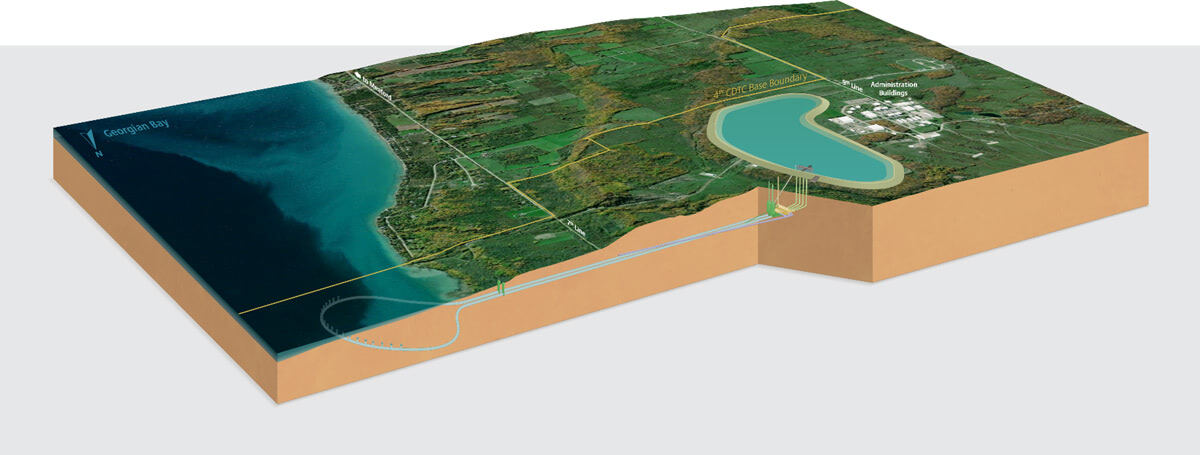
Specifically, TC Energy wants to build a 1,000 MW pumped hydro storage/generation facility in Meaford on the shores of Georgian Bay. The large reservoir would be built on elevated land located on the Niagara Escarpment, on the Canadian Armed Forces’ Base 4 Canadian Division Training Centre. Vertical water pipes would be driven underground to a power generation facility under the escarpment. After leaving the generators, this water would flow horizontally in more underground pipes flowing into Georgian Bay, which is part of Lake Huron. The pipes would be laid so that they would empty into the bay underwater, by lying on the lake’s bottom with their openings far from the shore to prevent erosion. During off-peak hours, this same piping system would be used to pump water back into the elevated reservoir, to be ready for the next round of hydroelectric power generation.
“When electricity demand rises, the stored water flows downhill through turbines to generate power,” says Sara Beasley, TC Energy’s communications lead on the project. “Using water and gravity, this project is effectively a natural battery that will provide reliable, secure and affordable electricity for all of Ontario through its power grid. The facility will store enough clean electricity to power 1 million homes for up to 12 hours, at any given time.”
This kind of clean, on-demand power is exactly what the Province of Ontario is looking for. “With electricity demand set to increase by 75% by 2050, our government is advancing an all-of-the-above approach to energy affordability and energy security,” says Stephen Lecce, Ontario’s minister of energy and electrification. “The Ontario Pumped Storage Project has the potential to store and deliver clean, affordable energy for decades, representing Canada’s largest clean energy storage project.”
Far-ranging benefits
Without a doubt, putting 1,000 megawatts of backup power on tap is the biggest benefit of the Ontario Pumped Storage Project. The fact that this is hydroelectric power is an additional bonus: Compared to all other forms of power generation, hydroelectricity is simple to operate. Robust in design and difficult to screw up. And given that “hydro,” as it is known in Ontario, is at the root of this province’s power-generation history, it is a form of power that is both popular and acceptable to most Ontarians.
This being said, the Ontario Pumped Storage Project offers other benefits.
“The project is a made‐in‐Ontario infrastructure opportunity, and it will have significant economic and social benefits not only for the region, but for Ontario and Canada,” Beasley says. “During all phases of design, construction and operation, the project will support Ontario‐based companies, and much of this investment will be enjoyed in rural communities. By relying on Ontario’s domestic construction and hydro industries to advance the project, Ontario is not reliant on uncertain global supply chains.”
According to an April 2024 report by the Canadian Centre for Economic Analysis — funded by TC Energy, but issued with a statement that “CANCEA does not accept any research funding or client engagements that require a predetermined result or policy stance, or otherwise inhibit its independence” — the “Project” will be good for the provincial economy. This is because it will create roughly 41,000 direct and indirect jobs (66% of them being full-time positions) plus 1,700 construction jobs during its four-year peak construction period. In addition, 61% of the project’s total employment benefits and 65% of its GDP benefits will occur in rural parts of the province.
Another big benefit, according to CANCEA’s findings: “The project will be built with Ontario supply chains,” Beasley says. “Of the total capital investment in the project, 83% will remain in Canada of which 92% will stay in Ontario. More than 90% of the economic activity will occur in Ontario, with 30% of the total remaining in the local regions of Grey, Bruce and Simcoe.”
If this isn’t enough to sell the Ontario Pumped Storage Project to the public, a third of the jobs it creates are “anticipated to be filled by those under 35 years old,” she says. “This demographic is the most likely to be facing housing affordability pressures. As most jobs created will be in skilled sectors with generally higher incomes, these jobs have the potential to improve the affordability of affected households.”
Winning public support
At this point in time, the Ontario Pumped Storage Project isn’t yet a done deal.
“The protection of Georgian Bay is a threshold issue that must be achieved before we are granted permission to build and ultimately operate the project,” Beasley says. “The redesigned project incorporates robust measures to safeguard the aquatic environment and the natural beauty of Georgian Bay. We understand the urgency of protecting fish and their habitat and have made significant changes to the design of the project’s inlet/outlet system through which water flows into and out of Georgian Bay.
“The project can only proceed after receiving required permits and approvals,” she adds. “Through comprehensive regulatory processes, the project will be evaluated on its environmental, social and economic impact. The established regulatory processes provide for extensive engagement with residents, rights-holders and key stakeholders — providing opportunities for these parties to review and test TC Energy’s project plans in a public forum.”
In order to win that support, “TC Energy has conducted an extensive community and Indigenous engagement program to seek early input into the project,” Beasley says. “By design, we introduced the project at the conceptual stage with the goal of gathering feedback and input from community members. With the feedback we received, we undertook a comprehensive redesign of the project.”
In doing this redesign, TC Energy did its best to ensure that the project addresses fundamental societal needs that could be supported broadly.
“First, the project supports the need for significant energy and energy-balancing resources to address imbalances between supply and demand, and to meet the expected demands the government of Ontario has forecasted,” Beasley says. “Further, through long duration energy storage, the project is a key enabler of decarbonization and a complement to Ontario’s ambition to become an energy superpower through nuclear power. Pumped hydro is a proven and reliable technology built with domestic content, delivering a lower cost product with fewer environmental impacts when assessed on a lifecycle basis against other storage alternatives.”
Talking to people also helps. “From the start of this project, we prioritized early, continuous and meaningful engagement with Meaford residents, Indigenous nations and community groups as a way to not only foster trust, but also to ensure that the project aligns with the values and needs of the community,” says Beasley. “When we first introduced the project, we received concerns about the preservation of Georgian Bay and the local environment. We used that feedback to make significant project design changes to maximize protection of the ecosystem, the local environment and Georgian Bay.”
This being said, not everyone in the area supports the project. Save Georgian Bay is one group opposed to the project. On its website, the group says, “Save Georgian Bay supports efforts to combat the climate change crisis with renewable energy sources and electricity storage solutions. But we believe that TC Energy’s proposed Pumped Storage Project in Meaford is not the best way to decarbonize the grid. It threatens irreversible harm to both the Niagara Escarpment, a UN-designated World Biosphere Reserve, and the fresh water resource of Georgian Bay, as well as to its fish and entire aquatic ecosystem on which residents depend. A handful of municipalities around the Georgian Bay basin agree and have voted to oppose the project.”
Pumped storage is a proven technology used around the world, with as many as 270 such facilities in the U.S. alone. The difference with this project is that normally these pump/generating systems use artificial reservoirs for sourcing and storage. As a result, the closed loop system doesn’t have as much of a potentially detrimental effect on the environment as using a natural body of water.
Beasley notes that the protection, sustainability and long-term health of Georgian Bay are threshold issues that must be achieved before the project can be approved.

Next steps
On Jan. 24, 2025, the Ontario government announced an investment of up to $285 million in the Ontario Pumped Storage Project. This money will allow the project to advance critical development work, including the completion of a detailed cost estimate, the commencement of regulatory assessments, advanced design and engineering and continued community engagement.
“With the Ontario Government’s support for go-forward development work, the project is now advancing critical activities including detailed engineering, site assessments and community engagement activities,” Beasley says.
“We anticipate the regulatory process to commence in the latter part of 2025. Subject to receipt of regulatory and corporate approvals, we anticipate that construction for the project would begin in the latter part of this decade with commercial operation in-service anticipated in the early 2030s. It will only move forward in partnership with Saugeen Ojibway Nation, who will have a significant ownership position on the project.”
Given the known pro-development stance of the Ontario government, the very real need for more power generation capacity in Ontario, and the apparent low environmental impact of the Ontario Pumped Storage Project compared to other options, it seems reasonable to assume that the project will get the green light going forward. If it performs as promised, similar projects may be built in the future, because the need for more power in Ontario is very real.
Continue reading for free