Aboveground pump stations are gaining acceptance in wastewater collections systems because they locate pumps away from exposure to corrosive and hazardous sewage, protect mechanical and electrical components, and keep maintenance workers safe.
Locating these stations above ground makes the equipment more accessible for service and eliminates confined-space entry. It also reduces wear and tear, minimizes breakdowns, improves pump efficiency and enables decades-long service life. It all adds up to low total cost of ownership.
Essential function
Pump stations are crucial for effective wastewater management and for preventing sewage backups and overflows. They consist of a receiving wet-well equipped with pumps, pipes, valves, power supply and control systems. Some include a screen or other device to capture heavy clogging materials and systems for odor control and ventilation. Stations typically employ at least two pumps that provide redundancy and alternate between lead and lag roles.
Reliability is vital as pump failure can result in sewage backups, odor issues, overflows, severe flooding, health risks, environmental harm and property damage. Pump stations must also be designed to provide easy access for regular inspection and maintenance.
Operational efficiency is also essential because pump stations consume significant electricity. Performance optimization begins with pump selection based on the station’s flow and head conditions. Manufacturers publish pump curves that demonstrate pump models’ range of efficiencies. Selection of pumps for optimal efficiency translates to lower energy cost.
Operator safety during inspection and service is also paramount. Pump stations that require access to the wet wells and associated valve vaults are often classified as confined spaces that require strict OSHA-mandated protocols for entry such as permitting, multiple personnel, proper ventilation, gas monitoring, harnesses and protective gear, along with thorough training.
Reducing exposure to wastewater helps minimize accidents and health risks and boosts worker morale and satisfaction — increasingly vital as wastewater utilities seek to recruit and retain team members to replace those retiring. Statistics indicate that in some areas up to 30% of the wastewater operations workforce may retire within the next five to 10 years.
Pump station evolution
A century ago, pump stations were typically designed with pumps in a dry well or dry pit arrangement. The pumps were located in a separate chamber next to and isolated from the wet well that collected the wastewater.
These stations were custom designed, constructed and assembled on site; the contractor was responsible for procuring all necessary components from specialized suppliers. The process was susceptible to delays due to supply chain issues and adverse weather.
The first major innovation in pump stations occurred in the late 1940s with the introduction of complete prefabricated pump stations. This streamlined construction and operation as the vendor assumed single-source responsibility and support throughout the product’s lifespan.
These factory-built and factory-tested systems featured a steel structure containing all pumps, controls, valves, piping and other components, expediting installation by contractors. They reduced project costs and saved time by eliminating the need to design and build subterranean spaces; the pump station was shipped virtually complete and dropped into place.
Submersible wastewater pumps, developed in Europe, were introduced to the United States in the 1960s and gained widespread adoption in the 1980s. These stations’ sealed pumps operate while fully submerged in the wet well. They are periodically lifted to the surface for maintenance and reinstallation via guide rails and a hoist.
Submersible lift stations require only a single underground chamber to house the pumps, minimizing excavation and construction costs. However, they still require a separate valve vault, usually placed a few feet away from the wet well.
Being smaller and much shallower than underground pump room chambers, they are often classified by OSHA as confined spaces. Inside the wet well, the pump components including the motor and electrical connections must be sealed for protection from moisture and corrosion.
Aboveground systems
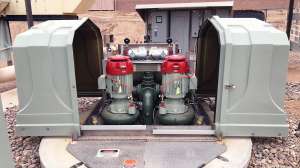
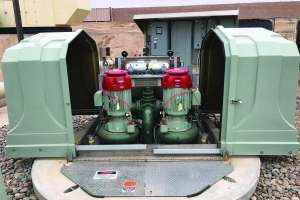
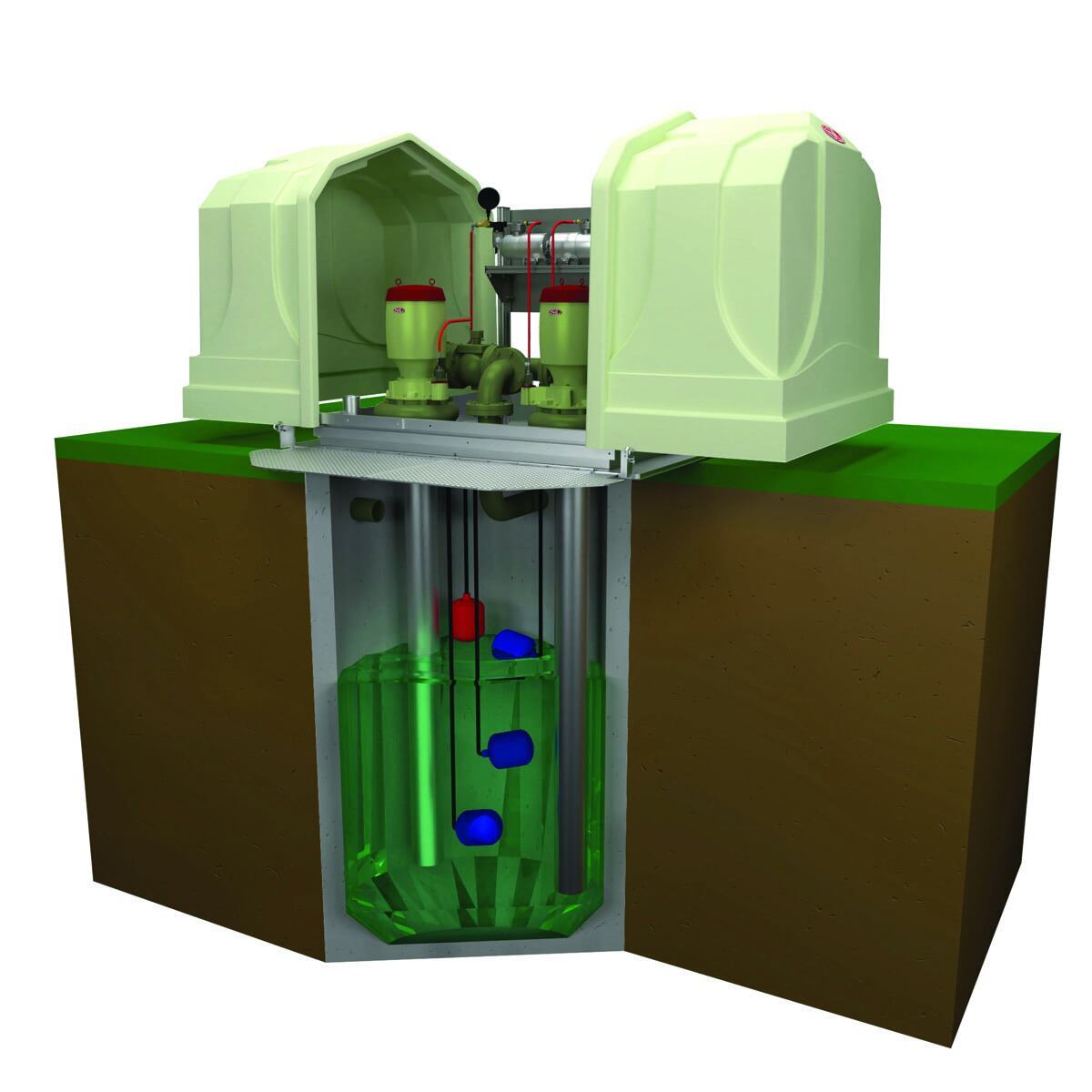
The latest significant advance in lift station design came with the development of aboveground wet-well-mounted pump stations. This configuration strategically positioned all the mechanical equipment outside and above the wet well, usually at ground level. This eliminates the separate valve vault, further reducing excavation and eliminating confined-space entry.
It also situates the pumps in a dry environment, significantly increasing reliability and longevity and simplifying inspection and maintenance. Pumps in state-of-the-art aboveground lift stations can operate reliably for 20-30 years or more with basic maintenance.
Operations and maintenance are greatly streamlined. After opening the enclosure, a single operator can visually inspect all components in seconds and can access the pump impeller or mechanical seal in a few minutes, without having to clean sewage off the equipment. Because of the vertical construction, there are no sewage spills when the pump is opened since the wastewater falls straight back into the volute and into the wet well.
Economical operation
Aboveground packaged lift stations have proven economical because of long service life and lower costs for installation, operation and maintenance. They are fully preassembled and rigorously tested before shipment; this significantly reduces time and labor for on-site piping, electrical work and testing.
Procurement expenses are lower because the systems come with many components that would otherwise have to be acquired separately. There is no need for guide rails or pump lifting equipment, or for separate suction pipes, power cables, control panels and wet well cover. On the operation and maintenance side, routine tasks like pulling a pump to change a seal or impeller can be completed in minutes by a single operator.
A 12-year study by one municipal utility demonstrated the life cycle cost advantages of aboveground lift stations. Using asset management software, the study recorded all maintenance and repair expenses for 21 submersible pump stations and 32 aboveground packaged systems in the wastewater collections system in Wyandotte County, Kansas.
The findings revealed that the aboveground systems yielded nearly 56% total savings — an average annual saving of more than $2,700 per station, totaling almost $400,000 in savings over the span of the study. Over the 12-year period, not one pump in the aboveground stations required replacement, while 40 pumps in the submersible stations were replaced.
A sensible choice
Factory-built aboveground lift stations offer low installation cost, high reliability, economical performance, a long lifespan, ease of inspection and maintenance, safe conditions for operators. The single-chamber design provides a compact footprint, minimizing excavation costs. For all these reasons, the technology makes sense for many small and medium-size pump station applications.
Rich MacGregor is a senior technical writer with Smith & Loveless.
Continue reading for free