Roger Lah is the technical sales engineer at Cla-Val, with over 20 years of experience and a deep technical understanding of valves in waterworks applications.


Roger Lah is the technical sales engineer at Cla-Val, with over 20 years of experience and a deep technical understanding of valves in waterworks applications.
Motorized valves are typically used to control a single function and offer limited or no capabilities to provide multiple electronic functions with hydraulic backup functions. On the other hand, hybrid electronic and hydraulic control valves can reduce the number of valves required in a system and can offer useful “insurance” against power failures and costly line breaks.
Below are three scenarios where this combination proved to protect systems during power outages.
When a power failure occurs, there is an arduous and lengthy process that water treatment plant operators need to perform quickly in order to prevent water from overflowing onto the plant floor. It involves manually closing several motorized valves for influent and effluent. Backwashing a filter occurs when a filter starts to clog with entrapped sediment, so water is pumped back up through the filter to expand the filter bed and that water is run to waste. The flow rates are ramped up and then back down during the varied backwash cycle before the filter is brought back online, so the flow rate is important for correct cleaning.
The valves are usually controlled by a programmable logic controller to control flow into a filtration backwash process utilizing Venturi flowmeters. These flowmeters operate on the principle of differential pressure, utilizing the Venturi effect where a fluid’s velocity increases as it passes through a constricted section of the pipe, resulting in a pressure drop. This pressure difference is measured and used to accurately calculate the flow rate.
These butterfly valves are susceptible to cavitation problems and therefore a hydraulic pressure-reducing valve is normally installed upstream to reduce the pressure and prevent cavitation. This traditional arrangement requires significant piping space for two valves and a Venturi flowmeter. Furthermore, power failure to the motor-operated valve can cause significant problems.
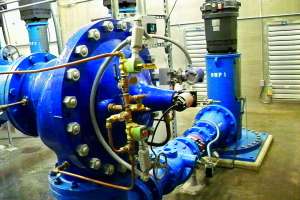
Another approach is to replace the hydraulic pressure reducing valve with a hybrid multifunction electronic and hydraulic metering valve. This valve is capable of measuring and controlling flow based on valve position and differential pressure sensors installed on the valve. It also incorporates anti-cavitation trim to prevent cavitation due to the high pressure drop into the filtration process.
The electronic metering function utilizes dual solenoids and simply changing the upstream closing solenoid from “normally closed” to “normally open” will result in hydraulic valve closure when a power failure occurs. This allows the plant operator to handle other important duties when loss of power happens. The single metering valve replaces the previous lengthy piping arrangement, saving significant space. As the replacement valve discharges directly into the filtration process, a hydraulic pressure limiting function can be added to provide a “hydraulic guarantee” against over pressurizing the system.
In another treatment plant application, utilizing prefabricated treatment equipment, a hydraulic pressure reducing valve was used to limit the pressure in the process. A relief valve was used to provide protection for a long 10-mile pipeline feeding into the plant, with a fast closing butterfly valve to shut down the process during a power failure. However, this sometimes resulted in a surge. The engineer’s surge analysis determined that the pressure reducing valve was required to close in 12 minutes when this occurs and a standard closing needle valve is incapable of controlling these long closing times.
The simple answer was to modify the pilot control system to perform a switch between the normal pressure reducing function and electronic controlled closing of metering flow to zero flow, in a programmable period.
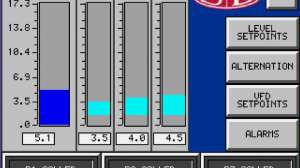
In addition, a third solenoid was installed to switch between the normal hydraulic control to electronic control in the event of a system shutdown. Operators can easily see on the valve controller screen the status of the closing sequence. They can also adjust closing times if the required closing time requires amendment. This valve therefore accomplishes two very important functions. A hydraulic pressure reducing function during normal operation, and an electronic “time of closure” function to prevent surging in the long upstream pipeline.
In a recent new treatment project startup, an electronic flow control valve began to open but was barely able to crack open. A check of the downstream pressure gauge revealed that downstream pressure had already reached the setting of the pressure limiting pilot control. It transpired that the water district had forgotten that an isolation valve had been closed some distance downstream.
In effect, the hydraulic control system prevented a pipe break from occurring. The electronic control system is capable of multiple functions such as flow control and pressure reduction. In this instance, the hydraulic pilot was used as “backup insurance” where the pilot control adjustment was set to not interfere with normal electronic multi-function control. The normal operation consists of electronic flow control and electronic pressure reducing control and seamlessly transfers between functions with specialized software. In the event of power failure, or solenoid malfunction, the hydraulic pilot will take over and limit downstream pressure, preventing pipe breakage.
Up to four modulating electronic functions are possible, including flow, pressure sustaining, pressure reducing and level control. Reservoir level control, for example, can include flow control and pressure sustaining control. Conversions of existing altitude control valves often include the hydraulic altitude control pilot for backup control to prevent the overflowing of a tank. Often there is a long pipeline upstream of these valves which is susceptible to surging during valve closure. A hydraulic “surge relief override” pilot control will prevent surges in case of faster than normal valve closure.
There are many other hydraulic and electronic functions that can be combined into one valve, which can reduce the number of valves in an installation, protect aging and sensitive pipes, or prevent overflow of tanks and reservoirs. A particularly popular combination is an electronic flow control with a hydraulic pilot control to limit downstream pressure. This example of hybrid electronic and hydraulic control allows normal electronic flow control unless downstream pressure exceeds the limit of the hydraulic pilot setpoint.
Problem-solving with the valve manufacturer can help provide you with the best option for your unique situation to protect your treatment plant and water distribution network in the event of a power failure.
Roger Lah is the technical sales engineer at Cla-Val, with over 20 years of experience and a deep technical understanding of valves in waterworks applications.
Continue reading for free