The coastal South Carolina region served by the Grand Strand Water & Sewer Authority is blessed with abundant sources of drinking water.
But getting that water where it needs to go can be a challenge, due to the region’s expansive wetlands, swamps and waterways.
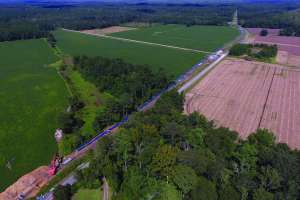
A good case in point is a recently installed, roughly 5-mile-long, 48-inch-diameter water transmission main needed to transport water from one of the utility’s two surface water treatment plants to the city of Conway and two unincorporated communities in the southeastern portion of Horry County. The county is one of five in which the utility, based in Conway, provides water and sanitary sewer services in northeastern South Carolina and southeastern North Carolina.
The new line replaced a 36-inch-diameter line that was converted into a sanitary sewer force main.
“In order to keep up with growth and demand in the area, we had to improve capacity in the transmission system that carries water from our Bull Creek Surface Water Treatment Plant,” says Christy Everett, the utility’s chief executive officer. “To provide that additional capacity, we upsized from a 36-inch transmission line to a 48-inch transmission line that connects to the distribution systems in Conway and unincorporated Socastee and Carolina Forest.
“The additional capacity is a quite significant addition,” she adds, noting that Horry County — which includes the cities of Myrtle Beach and North Myrtle Beach — is one of the fastest-growing counties in the United States.
“This is the largest-diameter transmission line in our system and this project was one of the largest infrastructure projects we’ve ever tackled,” Everett says.
The project cost $26.2 million and was funded by a low-interest loan from a state revolving fund that, in turn, was funded by the federal government.
Heading underground
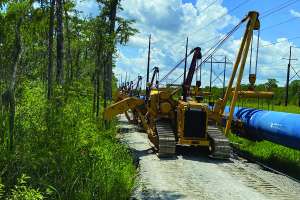
To avoid contending with the Waccamaw River, which flows along the east side of Conway, about a half mile of the transmission line was installed via horizontal directional drilling. The pipe was made of spiral-welded steel from AMERICAN SpiralWeld Pipe, coated inside with polyurethane.
The boring was done by Laney Directional Drilling Co., with the deepest section bored about 80 feet underground, Everett says.
A few other smaller sections of the pipeline — including one stretch that passes under a major state highway — also were installed by horizontal directional drilling. The rest of the pipe was either installed underground or anchored to the bottom of swampland to keep it in place during periodic tidal flooding from the nearby Atlantic Intracoastal Waterway.
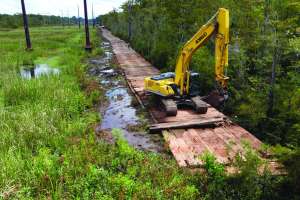
Tidal wetlands in the Waccamaw National Wildlife Refuge on both sides of the river posed a construction challenge. As such, the general contractor, Ruby-Collins Inc., had to build about one mile of “mat” access roads, following a route that was already cleared for overhead, high-voltage transmission lines.
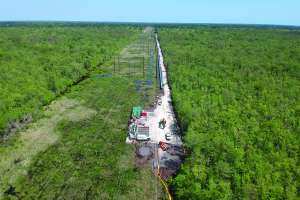
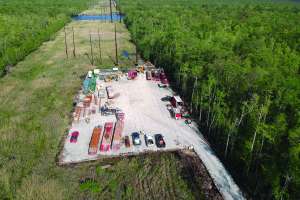
One section of the road provided access to a large construction pad for the HDD equipment on the west side of the river and the other stretch led to another construction site on the east side of the river.
Obstacles emerge
Work was halted at one point when heavy rains led to major flooding on both sides of the Waccamaw River, covering the construction pads with several feet of water.
“It took several days for the water to recede,” Everett notes. “The project was delayed by a few weeks.”
Pockets of pyrite rock, which is very hard, also slowed progress at times.
Because the HDD was performed in an uninhabited area, the contractor was able to weld together, lay out and test the entire section of pipe headed under the river before it was pulled into place from the east side of the river.
“We were very fortunate that most of the lay-down area was in wetlands and tributaries off the river, so it didn’t impact any residents,” Everett says.
The project was finished in spring 2022.
Plentiful water sources
The utility gets most of its water from Bull Creek, an arm of the Great Pee Dee River, and the intercoastal waterway. The Bull Creek treatment plant supplies water for most of Horry County and the Myrtle Beach Surface Water Treatment Plant provides water for the cities of Myrtle Beach and North Myrtle Beach in the eastern part of the county, Everett says.
Each plant has a treatment capacity of 45 million gallons a day.
In addition, the utility operates 15 wells that pump water from an aquifer. The pumping capacity of the wells is about 15 mgd.
“We’re located downstream of North Carolina’s Great Pee Dee Watershed, so we’re kind of the last user in the watershed, if you will, because what passes through us goes into the ocean,” Everett explains. “So we certainly have an abundant source of water here in the coastal region of the Carolinas.
“We’re also in a tropical storm area, so we often have tropical storms and hurricanes from June through October,” she continues. “We get a lot of rain from those events, which keeps our water sources well-supplied.”
Furthermore, the utility has built a network of nearly three dozen water storage tanks that store a total of 37 million gallons of water.
“The South Carolina Department of Health and Environmental Control requires us to keep a certain percentage of our water capacity in storage so that if a treatment plant goes down, we still would have water available,” she explains.
Well-positioned for growth
Planning for the project began back in 2016, and the new water main well-positions the utility to handle the region’s explosive growth.
“This pipeline should provide adequate capacity to other areas well into our 20-year comprehensive plan and beyond,” she notes. “It’s a critical piece in our infrastructure that will provide enough water for residential and business growth.
“Without it, we wouldn’t be able to continue to provide quality service for water demand as well as for fire protection for residents and businesses.”
More projects lie ahead. Along with a planned $38.6 million expansion of the Bull Creek plant that will expand its capacity to 60 mgd, a 36-inch-diameter, approximately 9-mile-long water transmission main is in the design and permitting phase. The line will carry water to the northern part of Horry County and provide additional water capacity, operating flexibility and redundancy within the utility’s water system.
“Keeping up with growth here is always a challenge,” she says. “But we like to look at challenges as opportunities.”