Why line an entire sewer pipe when grouting the pipe’s joints will stop the inflow and infiltration? That was the question Orange County (California) Sanitation District Senior Engineer Dickie Fernández first asked himself and then the utility’s engineering managers.
“The pipe segments were in great shape. I saw minimal cracking,” Fernández says about his engineering condition assessment of two sewer trunk lines and a sewer interceptor pipeline targeted for repair in OC San’s 380 miles of sewer main. “I proposed that if we just performed chemical grout injection on leaking joints, we would control the existing inflow and infiltration and could extend the life of the pipe another 50 years. They agreed.”
That was in 2019. After work actually began on the rehab project in 2021, the decision to rely on chemical grout for the bulk of the repair work looked better and better. While there were some unexpected outcomes — mostly stemming from the variety of pipe in the rehabilitated sections — the bottom line was a $3 million savings in the cost of the project.
Alternative solution
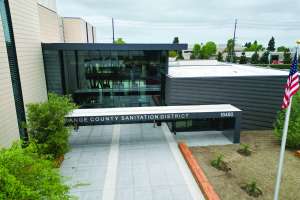
OC San is a public agency that provides wastewater collection, treatment and recycling services for approximately 2.6 million people in central and northwest Orange County. OC San is a special district governed by a 25-member board of directors composed of 20 cities, four special districts and one representative from the Orange County Board of Supervisors. OC San has two operating facilities that treat wastewater from residential, commercial and industrial sources, treating approximately 180 mgd of influent. In cooperation with the Orange County Water District, OC San provides secondary treated effluent to OCWD for advanced filtration and production of 130 mgd of potable water, the largest operation of its kind in the world.
OC San has moved in recent years from an emphasis on expansion and building out of the system to rehabilitation and maintenance, according to Andrew Brown, OC San’s engineering supervisor. “Now the core assets are in place and we just need to keep them running,” he says, adding that a more systematic inspection program has been implemented. “Some of the lines are nearing the end of their useful life, so we’re ramping up rehab and replacement. About 80% of our capital improvements budget next year will be for that.”
Much of the collections system is more than 50 years old, Brown says. In the three rehabbed pipelines — two trunk sewers and one interceptor sewer — two of the lines date from 1959, another from 1976. After an initial assessment of the segments in 2018, the decision was made to rehabilitate the pipelines using a cured-in-place technology.
That would have involved lining 40,000 feet of vitrified clay pipe, which ranged from 21 inches to 39 inches in diameter. Another 600 feet of pipe was in such poor condition that it needed to be replaced entirely. In addition, about a hundred manholes would be repaired or replaced.
Then, Fernández offered his alternative solution and the project headed in a different direction. “Cured-in-place pipe lining is a great product and I’m a great fan of it,” the senior engineer says, “but given the pipeline’s great structural condition, I did not see a need for CIPP, but a need to stop inflow and infiltration.”
OC San engineers were familiar with chemical grouting, though not as the grout would be used on this project. Grout can also be employed in conjunction with cured-in-place projects when there’s a need to seal off areas of a pipe experiencing active infiltration, which would jeopardize curing of the CIPP liner.
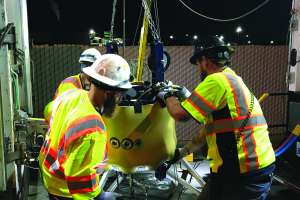
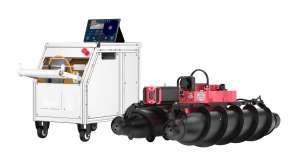
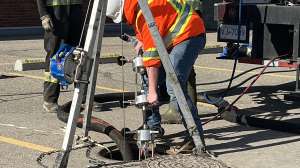
Wholesale chemical grouting of joints using a sophisticated remote-controlled packer was something new for OC San. It scouted around for contractors who are experienced with the technology in the immediate Orange County area and in the San Francisco Bay Area. The project eventually was awarded to Steve P. Rados Inc. as the prime contractor. Performance Pipeline Technologies (subcontractor) ended up performing both the grouting and the approximately 3,000 feet of CIPP installation.
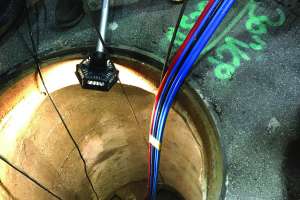
The project began by putting each joint under 10 psi of air pressure, with the requirement that the joint sustain the pressure for at least 30 seconds. “If the joint passed, it received no grout. If it failed, we injected grout and retested,” Fernández says of the process.
If a joint failed to hold pressure after being grouted, more grout was injected until it passed the air pressure test. Overall, the 1959 pipe had far more joints failing the air pressure test — 2,043 to the newer pipe’s 336.
Defying expectations
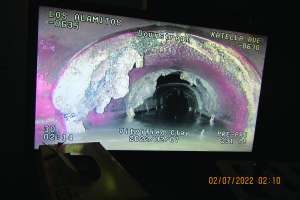
Surprises experienced in the course of the project began almost immediately. When Performance Pipeline Technologies started cleaning the pipe and removing the calcium deposits prior to injecting grout, it didn’t go as planned. The contract stipulated “the work shall be performed through the use of a CCTV-operated robotic system capable of traversing up to 600 linear feet and removing the obstruction through the use of a high-pressure water stream.”
The specifications also stated, “The use of lumberjacks, chain knockers, rotary cutters or mechanically driven systems are not acceptable.” However, this restriction was later relaxed and the subcontractor employed a combination of a CCTV-operated water stream and mechanical cleaning methods, mainly a robotic cutter.
Another surprise: Fernández presumed more chemical grout would be injected into joints of the 1959 sewer pipe than into joints of the newer pipe. That seemed logical. After all, the National Clay Pipe Institute had informed him that joints in the older pipe probably employed field-applied oakum rope seals, whereas the 1976 pipe had more effective factory-installed polyurethane seals.
“I naturally assumed the older pipe would require more grout per joint,” he says. “What I found was completely the opposite.”
As measured by the amount of grout injected into failed joints per inch of pipe diameter, the results defied expectations. The 1959 pipe joints required an average of 5.8 gallons of grout. The failed joints in the newer pipe needed an average 9.5 gallons of grout — about 80% more! However, as expected, the 1959 installation had significantly more failing joints; approximately 60% of them failed while the rate of failing joints in the 1976 installation was approximately 10%.
How could that be? Calcium. When the older pipe joints failed dramatically, calcium deposits clogged the joints and protruded into the interior of the pipe. Though precleaning of the pipe had removed the visible buildup of calcium inside the pipe, the jetting or robotic cutting did not extend into the joints themselves. Consequently, the same calcium that announced failure of a joint also partly filled the joints and became part of the sealing solution.
“We needed to inject less grout into the cracks to seal them because the calcium already was there,” Fernández says. The reverse was true in the newer pipe: There, the absence of calcium buildup meant that some failed joints required quite a lot more grout. In fact, 28 of those joints each needed 20 gallons or more to seal. Seven of them required 40 gallons or more.
Though that surprised the engineers, the bottom line for the project did not disappoint anyone. With all the variables included, approximately 15,000 gallons of chemical grout were injected into the joints to make them whole again.
By project’s end, instead of spending $7 million to line the sewer pipe, OC San expended about $4 million for grouting.
Working upstream
OC San is continuing its rehab and repair of sewer infrastructure this year. It’s working on upstream portions of the same trunk and interceptor sewers grouted previously. Chemical grout again will be employed and Fernández and other OC San engineers are hunching over computers and calculators attempting to come up with good numbers to guide them.
“It is difficult to estimate the volume of grout,” Fernández says, which at this point seems like an understatement. “We don’t know how many joints will fail, but the presence of calcium deposits or visible infiltration confirms the joint is not sealed. We don’t know the condition of the trench hosting or the potential voids in it. We’re flying in the dark a little bit.”
If the next “flight” is anything like the last one, the betting is it will be a smooth and successful one, if not totally unsurprising.