For the last 20 years, the Sonoma Valley County Sanitation District has been methodically replacing the system’s sewer trunk main. The trunk line was, to put it simply, old and leaky. By the end of the summer, the district will have refurbished some 6 miles of the main with less than a mile of repair work remaining.
One might say you can see a light at the end of the tunnel because some of the trickiest parts of the project have been tunneling, or boring, through backyards and under streams. Jimmie Griggs has been there to watch it. Griggs is the district’s project engineer for the sewer main replacement and has been a design engineer for the district’s capital improvement group since 2016.
The district took over management of the sewer system in 1995. Forty-six years earlier, the “special district” was formed by the legislature to manage the water supply services of Sonoma and surrounding unincorporated areas. So, it is an independent agency that nevertheless operates under the auspices of the Sonoma County board of supervisors.
“When we inherited these districts, they were all in very poor shape,” Griggs says. “The treatment plant has since undergone major upgrades to operate within a permitted range. There has been a whole laundry list of upgrades at the plant.”
The old trunk main is a reinforced concrete product ranging downward in size from the 42-inch-in-diameter line where it enters the treatment plant. The line was cracked and corroded and nearing the end of its life expectancy. And it leaked.
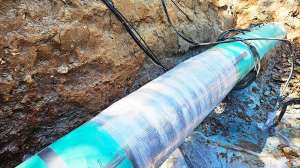
“Because of I&I, we were experiencing huge increases in flow during rain events,” Griggs says. Beginning with the large-diameter line nearest the plant, the concrete line is being replaced with PVC pipe with gasketed fittings to better seal the line at the joints. For increased capacity, the new pipe generally is of larger diameter than the pipe it is replacing.
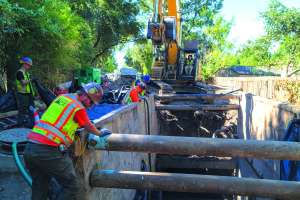
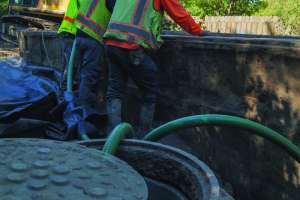
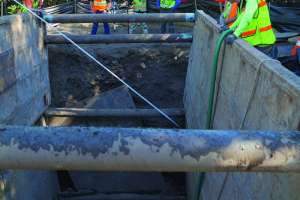
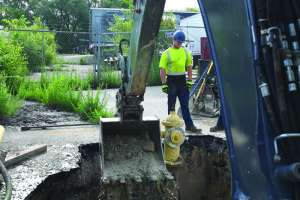
For the most part, the new main is being installed using traditional open-trench construction methods. As much as possible, it is being laid parallel with the old pipe except in tight places where the new line has been squeezed into the footprint of the old one.
Typically, the pipe rests at the bottom of a 16-foot-deep trench. At its shallowest point, the pipe might be 10 feet deep, at the deepest, 28 feet, Griggs says — always deeper into the earth than the old pipe. At a crossing of a stream, for example, the new pipe will be inserted in an augured tunnel somewhat below the level of the old one so that it will have more separation from the rushing water in the streambed above it.
Meeting challenges
Where the pipe work becomes especially interesting is at chokepoints. Three such areas are part of a 1.6-mile leg of the project. One leg was completed in 2022, the second is being undertaken this summer. The third is in the planning stage.
In both the first two segments, the pipe was routed between houses 20 to 25 feet apart. The 2022 segment had the pipe coming within about 4 feet of a house foundation horizontally, but considerably below the level of the foundation. There was no impact of any sort on the structure.
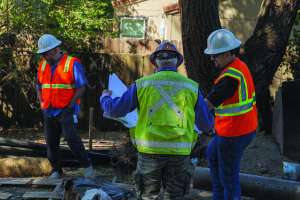
“Our standard practice when installing pipe near a structure is to survey the surface of the ground before, during and after the installation process to verify that there is no displacement of the structure or damage to it,” Griggs says. “That’s a standard operating procedure.” He adds that there also is potential for the ground to heave or soil to settle if a void has been created and a collapse occurred. Any such events are detected and addressed in real time.
Vibrations created by the auger bore are minimal and of little consequence, Griggs says, partly because the boring is occurring considerably below any structures. Also, the rate of advance of a boring auger is “not superfast. It is more of a slow churning process” that creates less disturbance in the surrounding material than if the advance were more aggressive.
The bore in 2022 was 106 feet from entry shaft to receiving shaft and was completed in three or four days. However, that excludes time spent excavating the shafts and installing boring and case-jacking equipment. The auger itself can crawl some 60 feet through subsoil in a typical workday.
The first bore was performed by Golden State Boring & Jacking of Chino, California. This summer’s between-houses bore in a densely populated area just northwest of Sonoma is by West Coast Boring of Bakersfield. That contractor employs a Barbco Model 36-48-630 boring machine, a 2-ton unit with a 100 hp engine.
Oversizing
One slightly unconventional element of the district’s trenchless work is use of an oversized steel casing for the pipe. In the 2022 project, an 18-inch line was replaced with a 27-inch pipe. In this summer’s job, a 24-inch pipe is going in the ground. In each case, the pipe is inserted into a 42-inch casing. Why the rather loose fit?
“A 36-inch casing would have been satisfactory,” Griggs acknowledges, “but we opted for the 42-inch diameter in the event that we ran into a blockage requiring removal of the auger head. We knew it would be a lot easier to get someone into a 42-inch casing than it would a 36-inch casing.” As it turned out, the oversizing paid off: Roots were encountered in the 2022 project and had to be removed by hand. Doing that work in a 42-inch space proved optimal.
The bore in the cul-de-sac in 2022 also was notable for what didn’t happen. Griggs explains that the team knew there was a buried electric line in the path of the auger but didn’t know how deep it was. The assumption was made that it was just a few inches under the surface of the soil.
“We didn’t pothole the line because it was under a sidewalk and we said, ‘Oh, well, we’ll have plenty of clearance.’ It turned out the electric line was 3 1/2 or 4 feet deep. We came in right under the line. It was kind of cool to watch, actually,” Griggs says. “A tip of the hat to those auger operators. They are really good at what they do.”
A third segment of the trunk replacement project — the Pequeño Creek crossing — doesn’t have houses to squeeze between. Rather, it has volcanic rock to bore through. “It will be interesting to see how our machines get through that material,” Griggs says. “We’ll meet with some trenchless experts and have further discussion about it. It’s not an unachievable task.”
Important work
An upgrade of a sanitary system of this magnitude typically is subject to public bidding to ensure the work is done by qualified contractors at a competitive cost. The district is, in fact, required to bid out any capital projects costing more than $60,000. These projects clearly qualify — this summer’s work including the trenchless segment from Happy Lane to Orchard Avenue, for example, has a price tag of $6.3 million.
Meanwhile, the sanitation maintenance crews are busy with more routine tasks — including inspecting lines with video cameras and cleaning and clearing lines. Their peers on the water side of the agency stay busy keeping pumps running and valves functioning, among other tasks. “They have fires to put out,” Griggs says of the district’s maintenance crews’ response to emergencies.
The bottom line, the design engineer says, is that all of this is important work — maintaining and operating a sanitation system. He calls it “a really important and often forgotten field. It’s one of the things you need for survival.”
Griggs cites the absolute necessities of food and water and shelter for any society. “But you also need sanitary conditions and hygiene. The more urban and dense a community becomes, the bigger the sanitation problem can become. A good sewer facility is vital to maintaining the health of a community.”
People shower or flush a toilet without any thought of what happens to the waste and water they send down the drain. This general unawareness of a sewer system leads people to ignore the infrastructure when it begins to age, says Griggs.
“People came home after World War II and built these wonderful systems that are getting some age on them now. It’s our time to pick up the flag and carry it forward.”