Every public works director eventually has the same budget conversation. A main fails, a crew works a weekend, the emergency repair line takes another hit, and a council member asks why nobody saw it coming. In a lot of systems the honest answer is that nobody could see it coming, because nobody has looked. The EPA estimates there are at least 23,000 to 75,000 sanitary sewer overflows a year in the United States, and the systems reporting them are overwhelmingly the systems running on failure history instead of condition data.
Building a sewer inspection program from that starting point does not require a capital purchase or a new crew. It requires three things: a defensible order of work, a contractor scope narrow enough to attract competitive bids, and one consistent coding standard applied to every foot of footage the program ever produces.
How do you prioritize sewer inspections with no inspection history?
Build a risk model from data the utility already owns, then inspect in that order.
A utility with no CCTV record still has six usable data layers, most of them sitting in other departments. They fall into two groups, and the difference matters.
Four of them point to how likely a pipe is to be in poor condition. Pipe age and installation era, from the sewer atlas and parcel data. Tree canopy, from a GIS layer or aerial imagery, because roots follow trees. Restaurant and food service density, from business licenses or health department records, because grease follows kitchens. And emergency repair and work order history from the CMMS, because pipes that have failed once tend to fail again.
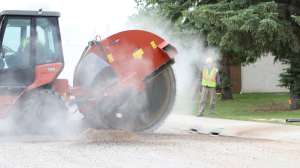
Two of them point to what a failure there would cost you and bypass the scoring entirely. A pipe under a street scheduled for resurfacing in the next one to three years gets inspected before the paving contractor mobilizes, because cutting new pavement is the most avoidable cost in the program. A basin with a recent overflow gets inspected because the regulator is already watching it.
None of these measure condition directly. Together they estimate both halves of risk, which is what lets you rank the network without a single inspection on record. Set the weights with engineering, GIS and the collections system superintendents all in the room, because the data and the field knowledge answer different questions. The paving schedule and the SSO log say where the risk is. The people who run the crews say which of those segments have locked manholes, live traffic, or access that will eat a day. Score every segment against the agreed weights, and the output is a tiered inspection order an engineer can defend line by line and a crew can actually execute.
Should the CCTV contractor code the defects?
No. Keep the contractor's scope to clean footage and accurate metadata, and centralize defect coding in one place.
This decision quietly determines whether five years of inspection data is comparable or not. When the contractor codes, the grading follows the contractor. A Grade 4 in the second basin, filmed by one crew in year one, does not mean the same thing as a Grade 4 in the ninth basin, filmed by a different crew in year four. Reviewer-to-reviewer variance gets written into the permanent record, and it never comes back out.
A CCTV-only scope solves three problems at once. The field work stays simple, so more contractors can bid it and the unit price comes down without the coding work included. The metadata requirements stay clear: manhole IDs, GPS, observed diameter and material, direction of travel, footage counter, continuous manhole-to-manhole video, uploaded within five business days of fieldwork. And the coding happens once, the same way, on every inspection the program ever collects.
That is the role AiDetect plays. Contractor footage gets uploaded to the cloud, AI detects and codes defects to NASSCO PACP v6, v7, and v8, NASSCO-certified reviewers verify the low-confidence segments, and the finished inspection publishes into CoreVision, where it can be queried, reported, and pushed out to Esri ArcGIS, asset management systems or other business intelligence tools being used for planning. The contractor never touches a defect code, so the record stays consistent no matter how many different crews the utility hires over a decade.
Structure the contract to match. Unit price per linear foot, tiered by diameter. A mobilization fee per site visit, which discourages fragmented scheduling. Heavy cleaning billed separately as a defined adder. A 10%-15% Q/A holdback retained until the footage is confirmed usable. And a 3%-5% access contingency for locked manholes and traffic control, because that work happens on every project and pretending otherwise just produces change orders later.
There are two ways to put this work under contract, and the right one depends on how much of the program your budget and your procurement code will let you commit to at once.
One solicitation for the whole program. Write the RFP to cover the full multiyear effort at unit prices, award a single contract with a term and a not-to-exceed amount sized for the first-pass baseline, then authorize each year's work as a task order under it. Tier 1 becomes the first task order, so the contractor mobilizes as soon as the contract is signed. Every later tier is a work authorization at prices already set, which takes days instead of months. The crew also learns your system, your manholes, and your access problems, and gets faster each season. The cost is commitment. You are holding a unit price for several years, so the contract needs an escalation clause and a termination for convenience provision to stay fair to both sides.
A separate solicitation for each tier. Bid Tier 1, run it, then bid Tier 2 when you are ready. This fits utilities whose funding is approved one year at a time, and utilities whose procurement code makes a large multi-year ceiling hard to get through council. It retests the market every cycle and gives you a clean exit from a contractor who underperformed. The cost is time. Advertising, pre-bid, evaluation, and council award typically run three to six months, which is most of a season, so the procurement calendar rather than the risk model ends up setting when crews are in the field.
If the budget will support it, procure once. Year two then opens with a task order and a schedule instead of a bid opening. If it will not, bid tier by tier and start the next solicitation while the current tier is still in the field, so the gap between seasons closes.
What does the first objective baseline actually tell you?
It tells you which pipes need money now, which need it within three years, and which can wait, in a form a council will accept.
Once coded inspections start publishing, PACP structural grades map to capital actions cleanly. Grade 5 means failure is imminent and the repair or rehabilitation is immediate. Grade 4 sets a rehabilitation window of one to three years. Grade 3 goes on the monitoring list. Grades 1 and 2 are routine, no action.
That is the first working version of a condition-based capital improvement plan, and it does something a failure log never could. It puts a date on the work before the failure instead of after it, which is the foundation of EPA's asset management framework for water and wastewater utilities.
The baseline also closes the loop on the risk model. Compare what the model predicted against what the camera actually found. If tree density drove a segment's score and roots showed up where predicted, the weighting holds. If pipe age scored a segment high and it came back a Grade 2, dial that factor down. Do that annually and the prioritization model sharpens every year while the cost of running it stays flat.
How long does it take to build a sewer inspection program, and how do you prove it is working?
Plan on inspecting 10%-20% of the system per year, which puts a full first-pass baseline five to 10 years out. Year one carries the most new work: assembling the data layers, setting the weights, issuing the CCTV RFP, awarding the contract, and getting the first tier in the ground. Years two through five are the same annual loop, each pass better informed than the last. Refresh the data, re-rank everything not yet inspected, issue the next task order, repeat. Once the full system has a first-pass baseline, the program shifts to cyclical reinspection on 10 to 20 year cycles, with shorter cycles for higher-risk assets.
Five numbers describe the shift, and directors should report them quarterly from the first year:
- Sanitary sewer overflows, year over year, in inspected and rehabilitated basins
- Percent of system inspected, cumulative
- Emergency versus planned repair spend ratio
- Average pipe condition grade and its trend
- Cost per linear foot inspected
The third one is the proof point. A collections system program is working when planned spend climbs and emergency spend falls, and that ratio is the single figure most likely to hold up in a budget hearing. Tuscaloosa, Alabama, cut annual sanitary sewer overflows from 102 to 48 working this way, with a stated goal of zero. Charlotte Water drove spills down 72%.
The budget move that makes it permanent is the least glamorous part of the plan and it matters more than any of the technology. Move a defined share of the historical emergency repair line into a standing annual CCTV and assessment line, reviewed quarterly with public works, engineering, asset management, and GIS at the table. Emergency work gets funded by default, because it has to be. Assessment only gets funded if someone puts it in the budget on purpose, every year, and keeps it there after the overflow numbers start improving.
Start with the phase you are on
Most utilities reading this are somewhere in the middle. Some have the paving schedule and the SSO log but no scoring model. Some have a drive full of uncoded footage from a contractor who came and went. Some have coded inspections nobody has turned into a capital plan.
ITpipes published the full six-phase roadmap, including the risk factors and weighting approach, the CCTV-only scope of work that can be used as an RFP starting template, the PACP grade to CIP action mapping, and the five-year implementation timeline. Get the complete guide to building a sewer inspection program, or tell us your system size and what data you already have and we will walk the phases against your network on a 30-minute call.