The U.S. Environmental Protection Agency recently hosted its first-ever public demonstration of promising, emerging technologies to help combat lead exposure at EPA’s Lead Service Line Identification Test Bed in Edison, New Jersey. The technologies on display have the potential to identify lead service lines faster, cheaper and with less disturbance than traditional methods.
EPA Region 2 Administrator Michael Martucci and Office of Applied Science and Environmental Solutions (OASES) Associate Administrator Teresa Booeshaghi witnessed the technology demonstrations from researchers at Dartmouth College and Drexel University.
“EPA’s Lead Service Line Test Bed provides researchers with a dedicated space to evaluate innovative technologies under controlled conditions and assess their potential to address a critical public health challenge,” says Booeshaghi. “By advancing the science behind lead service line identification we can help more reliably address the issue while reducing the need for expensive excavation.”
“You can’t replace what you can’t find. Giving water systems better, less labor-intensive ways to locate lead pipes could make a tremendous difference for communities across the country,” says Martucci. “This is EPA putting gold-standard science to work on a serious, costly problem that cities across America have struggled with for decades.”
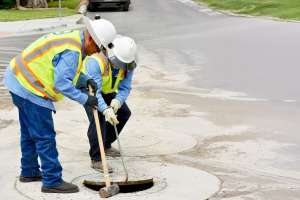
EPA opened the Lead Service Line Identification Test Bed at the Edison Environmental Center in 2025 to advance the evaluation of accurate, reliable and minimally invasive methods for locating lead service lines.
Dartmouth University researchers demonstrated their electromagnetic induction technology, which uses electromagnetic fields to induce and measure responses from buried metal pipes. Researchers analyze these responses to help distinguish pipe materials, including lead and copper, without exposing the pipes. Drexel’s team demonstrated their stress wave technology, which uses mechanical vibrations to help locate lead service lines. The researchers generate the vibrations by striking an extension rod connected to an accessible service line valve. The ground sensors capture signals traveling through the pipe and surrounding soil to help distinguish lead from non-lead service lines.
The vast majority of water systems — more than 97% — have completed initial inventories. Technologies like those developed by Dartmouth and Drexel are making it easier and more cost-effective for water systems to identify exactly where those lead service lines are located. EPA’s Test Bed provides an important platform for researchers and businesses to test their technologies and demonstrate proof of concept.
While not a certification program, the test bed provides a stable location with controlled conditions to evaluate potential technologies. Learn more about EPA’s Lead Service Line Identification Test Bed.
Continue reading for free