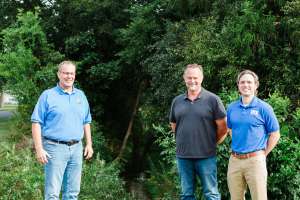
I went for a mountain bike ride the other day on the Hidden Lakes Trail. It’s a trail I’ve only ridden a couple times, and both times I got lost. This time I was with a few friends, one who knows the trail system quite well.
The trail is on the Nicolet side of the Chequamegon-Nicolet National Forest in northeast Wisconsin. The Nicolet National Forest, now managed in conjunction with the Chequamegon, was established on 970,000 acres of primarily cut-over and fire-scarred land in 1933. Since then the white pines and hemlocks have grown back big and tall. They’ve drowned out the understory in most areas, offering sharp contrast to the more actively managed forests that cover much of northern Wisconsin.
Maps and stats of the trail differ. The friend who showed us the way had it clocked at about 17 miles with 1,200 feet of climbing. And lots of rocks and roots. Along the way the trail winds past a dozen different lakes. Most are completely undeveloped.
I don’t ride mountain bikes for the scenery, but some places make you stop and look around. With five people and a bunch of trail intersections, we stopped more than usual, and every stop offered beautiful views — dark hemlock stands, remote campsites, moss-covered lowlands that looked liked something out of Jurassic Park, and the unbroken shorelines of all those lakes. Aside from all the work it takes to keep the trail clear, nothing felt managed or manufactured. It felt noble and majestic.
Even though the trail is only 40 minutes from my house, it felt like I’d gone somewhere completely foreign, or at least somewhere that offered distinctly different views of things that can fade into the background when they’re part of your everyday surroundings.
But there’s art in the everyday. Water is a basic necessity of life, yet it can still inspire awe in its natural beauty and power.
The day after that ride, I got an email from Franklin Electric announcing that its corporate collection of environmentally minded Edward Burtynsky photographs would be shared in a special exhibit titled “Water” at the University of Saint Francis’ Rolland Center Weatherhead Gallery.
The Burtynsky collection, which is permanently displayed throughout the company’s Fort Wayne headquarters, features photographs of major water infrastructure resources, hydroelectric projects, aquaculture operations and agricultural irrigation systems.
“We hope they serve as a catalyst for meaningful conversations about stewardship, sustainability and responsible water use,” said Joe Ruzynski, CEO of Franklin Electric.
We talked about those pristine lakes on our ride, of the impossibly green moss blanketing pockets of lowland, and of the power of nature on full display in twisted piles of timber where a tornado had gone through sometime prior. It’s good — necessary — that places like this be preserved. It offers perspective, and views we often fail to see in our daily lives.
Here’s hoping you keep those perspectives and the appreciation for our natural resources alive in your daily work.
Enjoy this month’s issue.
Continue reading for free