The encroachment of urban areas onto previously rural land can lead to a host of problems, particularly with surface drainage. In many cases, developers simply count on existing drainage systems to pull water from new subdivisions, without checking if they are actually up to the task.
The Baughman Drain in Allegan County, Michigan — located in the southwest part of the state near Grand Rapids — is a prime example of this situation.
Back when the drain was dug in 1875, this area was entirely farmland. Its purpose was to carry runoff from a 970-acre watershed in Otsego Township and the city of Otsego to Pine Creek.
Naturally, the original engineering of the Baughman Drain was anything but high-tech. “This was a ditch that was dug by farmers by hand or with horses back then, to get drainage for the farmland so that it could actually be farmed,” says Chris Machiela, Allegan County’s drain commissioner. “It’s a long-established drain that is still in service today.”
Unfortunately, a drainage system sufficient for farms was nowhere near adequate for the modern houses built within this watershed. The result was chronically flooded basements and saturated properties. Finding out exactly why this was happening led to a few surprises — and called for a creative engineering solution no one expected.
An invisible barrier
By the early 2010s, the suburban watershed served by the Baughman Drain was facing a community-wide crisis. Due to inadequate drainage, homeowners in the area were dealing with chronic property damage, flooded basements and saturated lawns — even during dry weather.

To cope with the problem, desperate residents spent tens of thousands of dollars on floodproofing and sump pumps. But while this technology helped in some circumstances, it didn’t solve the underlying issue; the water just kept getting in.
“People had been installing their own dewatering systems in their basements, but all it did was circulate the water back out to the ditches, allowing it to go back into the ground,” says Christine DeVries, project inspector and biologist at Land & Resource Engineering. “Once the water was back in the ground, it came back up into their basements and the whole process started again.”
By the mid-2010s, the residents were fed up. They formally petitioned the drain commissioner for a solution, prompting Machiela to hire LRE to investigate. Using field monitoring wells, piezometers and hydrogeologic modeling, the engineering team finally found the real culprit underground: clay lenses.
Clay lenses are localized, underground layers or pockets of dense clay that can’t be seen from the surface. They serve as impermeable barriers to groundwater, preventing it from draining naturally through nearby porous soils and forcing it to accumulate in place within the area’s coarse sandy soils.
Having clay lenses under farmland hadn’t been an issue when the Baughman Drain was built in 1875. But once the area became suburban, the impaired drainage became too much for the landscape to bear.
The discovery of these clay lenses finally explained the localized flooding, especially when paired with regional weather patterns. When nearby Lake Michigan experiences high water levels, it raises the overall regional groundwater table, making it harder for inland water to drain away. When that rising water met the clay lenses under the Baughman watershed, it was trapped.
Christine DeVries explains this “Aha!” moment: “They built based on the conditions at the time, not considering the flux of groundwater and how when Lake Michigan is very high, it affects everything. There are these clay lenses that they ended up finding. The reason why the water stacked up specifically in that area is that there were barriers that were sometimes vertical, holding the groundwater back.”
Permitting and design
Once the mystery of the accumulated water had been solved, the next step was to design a solution that would deal with the clay lenses.
It wouldn’t be easy. Both Allegan County and LRE realized that a standard surface drainage solution wouldn’t address the problem of the lenses. Something else had to be done — like creating pathways for the groundwater to get through the lenses and out to Pine Creek.
“They realized that it’s not just going to be a simple ditch cleanout,” says DeVries. “Instead, they needed to punch holes through these lenses by putting underdrain in to provide relief. If you just dug out the ditches, you’re not getting deep enough to put the groundwater back under their home foundations.”
Making this approach work required a combined groundwater and stormwater management system — something rarely done under Michigan’s drain code. Because the solution required putting in new drain sections and underdrains, the state permitting process was intense.
“The state fought back,” DeVries says. “They made them do some really extensive groundwater monitoring that ended up keeping the project in the permitting, design and monitoring phase for almost 10 years before it could be constructed.” This included close coordination with the Michigan Department of Environment, Great Lakes, and Energy and the Department of Natural Resources Fisheries Division, resulting in a five-year review process with multiple design refinements.
Broken lenses
The final design tackled the underground blockages head-on. The project team improved the Baughman Drain by adding five new branches, which included installing more than 2,700 linear feet of perforated underdrain beneath roads like Elm Street and Prairiewood Court. Instead of trying to route water around the subterranean clay lenses, the crew essentially punched holes straight through them to place the 18-to-24-inch pipes and give the trapped groundwater an escape route.
“They installed an enclosed storm sewer that was set below the finished floor elevation of all the basements in that area,” says DeVries. “It was a perforated pipe wrapped in stone and then geotextile fabric. When the groundwater gets high enough that it would start flooding those basements, instead, it accesses the pipe and flows down to the open channel portion of the drain and provides relief to all those people.”
Thanks to LRE’s extensive hydrogeologic modeling, the engineering team was able to place the underdrain to draw down the trapped water while avoiding adjacent wetlands. This precise targeting eliminated the need for costly wetland mitigation, saving the project significant time and money.
Executing this complex underground installation fell to the contractor, Quantum Excavating. Despite the tight working conditions, their expert construction crews managed to safely navigate dense residential settings, limited easement corridors and existing utility conflicts to get the massive pipes perfectly positioned underground.
Two-stage channel
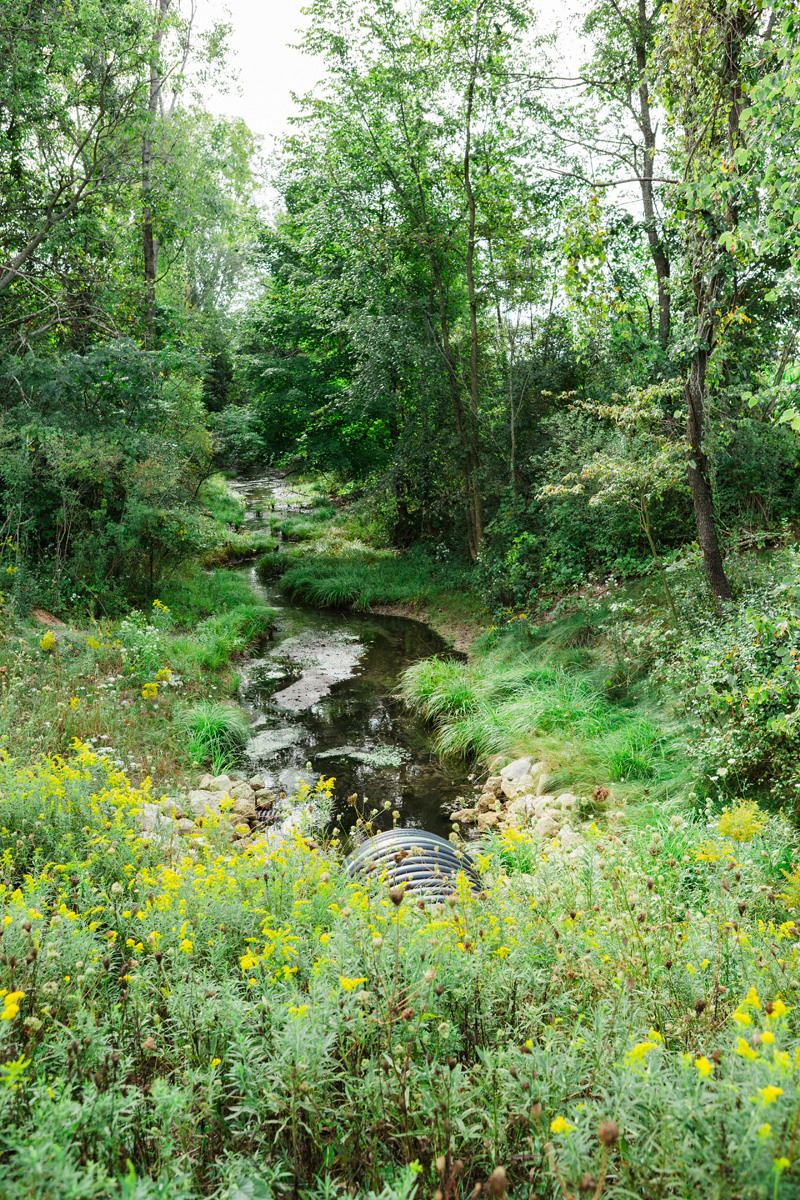
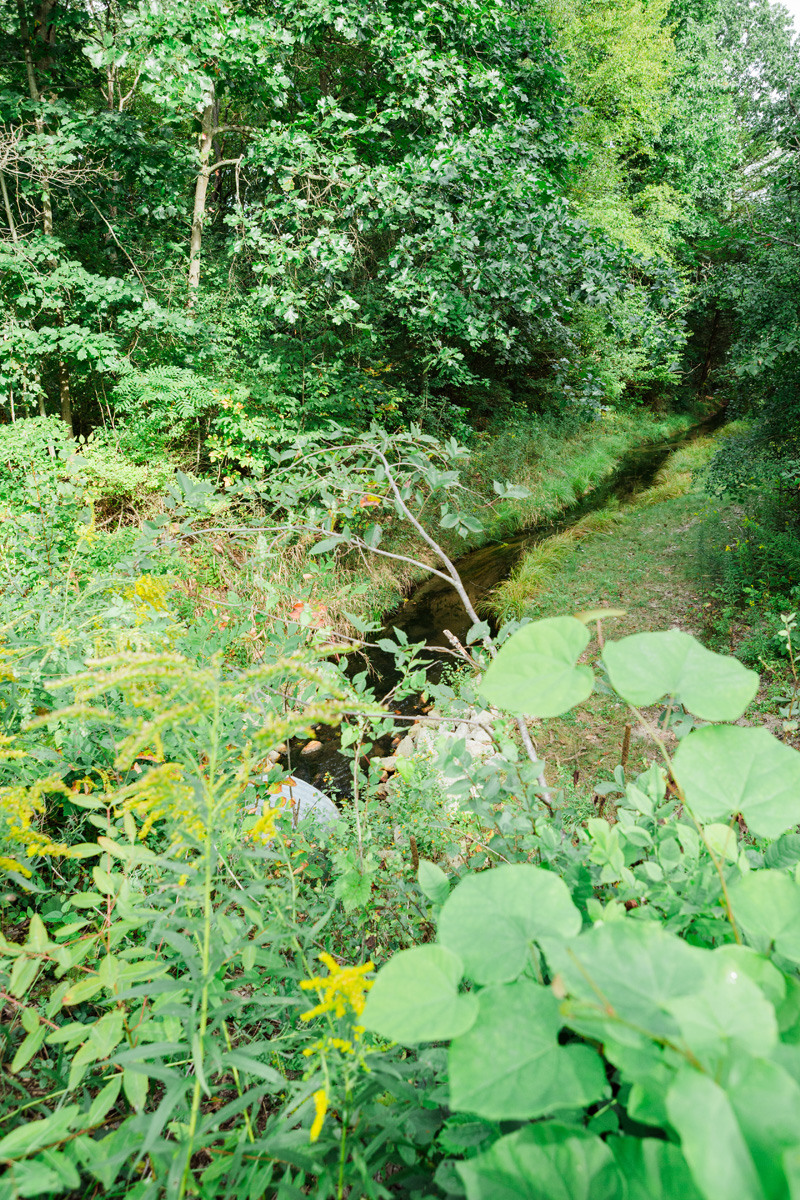
Fixing the Baughman Drain wasn’t just a matter of underground work; they also had to modernize the surface ditches. To do this, the project team moved away from the old-school, constructed agricultural trapezoidal ditches and implemented a “two-stage channel” design instead.
“Instead of just hogging out a trapezoidal channel, you dig a pilot channel through the bottom, but then you leave a little bit of a natural flood access bench,” DeVries says. “If the water comes up, it will spill over into that bench. Because that bench is vegetated, it’s better for water quality, and it’s better for animals and reptiles rather than just having one big deep channel.”
The surface renovations went beyond just reshaping the banks. The work also included adding native vegetation, replacing undersized and perched culverts, and installing rock riffles to improve sediment transport and reduce long-term maintenance needs. Essentially acting as constructed rapids, these stone structures break up the water’s flow to prevent soil erosion while naturally aerating the stream to improve water quality.
Beyond simply moving water, these aboveground upgrades delivered a major ecological bonus.
“Some of the culverts were perched in the open channel sections and some of that ditch was in pretty bad shape,” DeVries says. “This work actually restored fish passage, which is pretty cool. People in the neighborhoods did say that they’ve seen fish in these drains before, so it acts much more like a natural system now.”
Award-winning solution
Despite its complexity, the Baughman Drain renovation was completed for just under $2 million and provided immediate relief to dozens of homes. And the residents aren’t the only ones breathing easier.
“We are very happy at the Drain Commission,” Machiela says. “We’ve had zero complaints of high groundwater over there, or of flooded basements. Pretty much we’ve eliminated all the issues that were brought to the forefront.”
The best part? Long-term maintenance requirements for the renovated Baughman Drain are minimal. The enclosed underground pipes are protected from silt by their stone and geotextile fabric wrapping, while the open-channel system only requires occasional deadfall tree removal and brush mowing.
In recognition of their innovative fix for the Baughman Drain, the Allegan County Drain Commission and the project team won the 2026 Innovation & Excellence Award from the Michigan Association of County Drain Commissioners.
“It means a lot that considering all the different projects, ours was picked,” says Machiela. “It shows through the engineering and the team collaboration we had to get this off the ground, and provide something highly functional that helped the general public.”
Continue reading for free