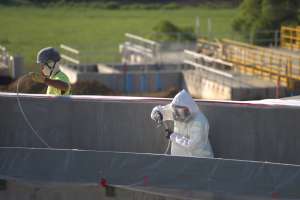
When a city invests $215 million in infrastructure designed to last decades, precision and collaboration are nonnegotiable.
That was the case for the South Dakota city of Sioux Falls as it undertook the largest construction project in its history: expanding and rehabilitating its 23-acre regional water reclamation facility and collection system.
The project’s success hinged on close coordination involving the city, McCarthy Building Companies, MVP Painting and Sherwin-Williams Protective & Marine. A shared commitment to specifying, applying and testing long-term protective coatings helped make sure the facility will serve the region’s growing population for the next 20 years and beyond. The project received the 2025 Sherwin-Williams Wastewater Impact Award.
Looking long-term

The expansion marked the first major upgrade since the facility was built in the 1980s. Designed to increase capacity by 43%, from 21 mgd to 30 mgd, the project will support 100,000 more residents in a population projected at nearly 300,000 by 2036.
The scope included a new headworks building, new generators, an electrical systems upgrade, expanded chlorine storage and additional aeration basins and final clarifiers. To protect these assets, the team chose robust coatings and linings to minimize wear and reduce maintenance.
Sherwin-Williams began conversations with the city before the public bid, encouraging engineers to consider high-performance coating solutions. “It was highly important for us to get the coating selections right,” says Mark Perry, wastewater superintendent. “We relied on our contractors and suppliers to help us understand the best options for each application.”
Sherwin-Williams worked closely with MVP Painting and the city to refine specifications, balancing longevity and budget. That included opting for especially durable systems for exterior piping exposed to aggressive conditions.
McCarthy Building, as construction manager at risk, ensured that the specifications were followed and worked directly with MVP Painting and Sherwin-Williams to navigate unfamiliar materials and optimize application practices.
“There’s usually a longer loop from us to the coatings supplier,” notes Michael Korus, project manager with McCarthy. “But this project welcomed direct communication, which helped us make better decisions and make the entire scope move quicker.”
Protecting pipes
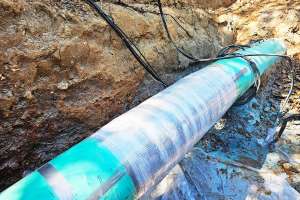
Exterior piping presented challenges. Operating in damp, exposed environments, the pipes, especially those above the aeration basins, needed coatings that could withstand hydrogen sulfide and salts.
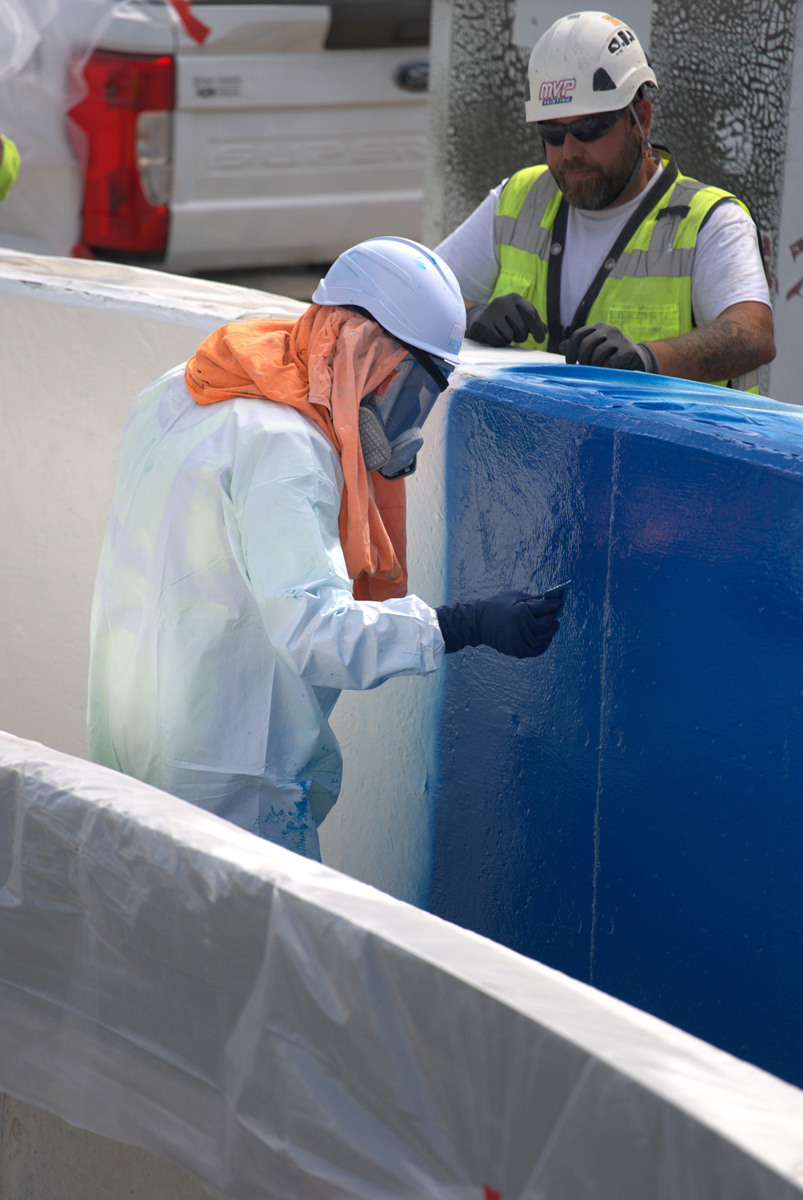
The team selected a high-performance polysiloxane system for its chemical resistance and longevity. Sherwin-Williams recommended Sher-Loxane 800 as the topcoat, combining the durability of epoxy with the flexibility of polyurethane. Its gloss retention and UV resistance also made it well suited for the exposed piping.
“With long-term performance and minimal maintenance being a primary goal, we wanted to use something higher-end than a typical urethane,” says Perry. “Because the polysiloxane coatings are protecting the pipes, we shouldn’t have to touch them for a decade or more.”
Applicators first blasted the pipes to SSPC SP-10 Near-White Metal Blast Cleaning standards. Then they applied a primer coat of Epo-Phen FF, a flake-filled epoxy phenolic novolac. The micaceous iron oxide flakes in the primer create a robust layered water barrier. Over this, they applied Sher-Loxane 800 at 4 to 6 mils dry-film thickness.
MVP Painting also lined the concrete aeration basins with Dura-Plate 6100, a high-build, 100% solids epoxy that protects the concrete from severe wear and chemical exposure.
Careful selection
Another collaborative choice was the coating for the plant’s four new final clarifiers. The team first considered coal tar epoxy for the sludge troughs, but while viable, that material would not withstand the corrosive solids and contaminants collected in the troughs over the long term. Sherwin-Williams therefore proposed a three-coat system with high resistance to chemicals and corrosion. The system ensures durability by building protection one layer at a time.
“Careful selection of the protective system for the sludge troughs proved to be a major win for the plant on two fronts,” says Korus. “First, the facility has a more robust system that will last longer and require less maintenance. Plus, they saved on application costs as applying coal tar is more labor-intensive than building up the three-coat system.”

The system began with Sherwin-Williams Dura-Plate 2300 cementitious resurfacer troweled onto the prepared surface of the concrete to fill voids and bugholes and to promote adhesion of the other layers.
Next came a spray-applied intermediate coat of Dura-Plate 235, a modified epoxy phenalkamine designed for immersion and atmospheric service. It provides high performance in corrosive environments and is formulated specifically for the kind of environment service the troughs experience.
During application, hot summer weather caused outgassing, prompting Sherwin-Williams technical representatives to help the painters monitor substrate temperatures and adjust the spray equipment. They even chased the shade at times to avoid spraying when temperatures were too high to ensure proper adhesion.
“This project represented the most help I’ve ever had from a paint supplier,” observes Dallas Cox, MVP Painting project manager. “Sherwin-Williams really made the job flow smoothly and helped to resolve all the issues.”
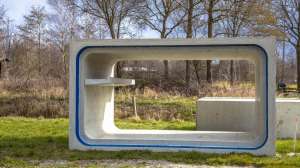
The final layer was a deep blue topcoat of Sherwin-Williams Poly-Cote 115, a flexible polyurethane applied at 80 to 150 mils dry-film thickness in a single pass. Its flexibility accommodates temperature fluctuations and UV exposure, sealing the system for long-term durability. The complete system resists effects from weather, extreme temperature shifts and UV exposure.
“The chosen system is designed for the long term by plugging up voids with the resurfacer, sealing up the concrete with the intermediate epoxy build, and protecting everything below with the flexible topcoat,” Cox says. To ensure quality, the team used wet film gauges during application, followed by holiday spark testing and ultrasonic testing to confirm that the final dry film thickness of all coatings met the specifications.
Built to last
In addition to the new construction, the project included rehabilitation in the original headworks building. MVP Painting prepared surfaces on filters, pipes and equipment, containing debris during the process. They then applied Macropoxy 646, a fast-drying polyamide epoxy mastic, in a single high-build coat.
The American Rescue Plan Act and a low-interest state revolving fund loan primarily supplied funding. The city made strategic decisions to protect its investment. “Going into a project of this size, you don’t always realize how important coatings are in the whole grand scheme of things,” says Korus.
“But they can really make or break the long-term performance of assets and affect future maintenance cycles. We’re glad we made time to meet with Sherwin-Williams and bring them into the fold.”
Casey Holter (casey.l.holter@sherwin.com) is asset protection manager specializing in water infrastructure, and Tyler Day (tyler.day@sherwin.com) is a project development manager, both with Sherwin-Williams Protective & Marine.
Continue reading for free