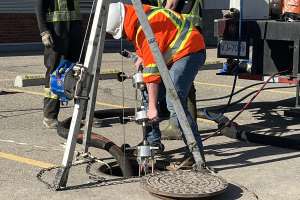
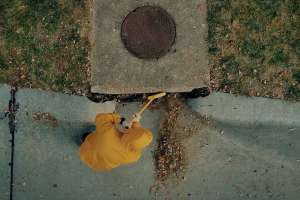
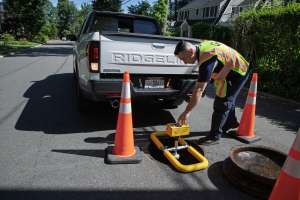
At McMahon Stadium in Calgary, Alberta, a proactive approach to underground infrastructure rehabilitation helped facility managers avoid a potentially disruptive and costly failure. Faced with aging stormwater infrastructure exceeding 60 years in service, project stakeholders elected to rehabilitate a structurally compromised 750 mm reinforced concrete storm line using UV-cured glass-reinforced plastic lining technology.
The project, executed by Stray Cat Industrial Services in coordination with TerraBurst, demonstrates how trenchless methods can extend asset life, reduce risk and minimize operational disruption, particularly in high-traffic, high-visibility environments.
The storm line in question runs beneath private property adjacent to McMahon Stadium, ultimately connecting into the municipal system. While not yet collapsed, the pipeline exhibited clear signs of structural deterioration.
“Most of the line was still perfectly circular,” says Quinn Kernaghan, superintendent at Stray Cat Industrial Services. “But there were multiple fractures around the circumference. It was at the point where, within five to 10 years, it would probably collapse, if not sooner, because of the heavy loads from vehicles parking above.”
The issue came to light during adjacent work performed by TerraBurst, which had already completed a dig-and-replace operation on a collapsed sanitary line nearby. Recognizing the condition of the storm line, the team recommended a proactive trenchless rehabilitation before failure could occur, particularly given the risk of disruption during stadium events.
At approximately 98 meters (321 feet) in length, the pipeline was structurally viable for lining, making trenchless rehabilitation a practical and cost-effective alternative to excavation.
Finding solutions
Several environmental and logistical considerations influenced the project approach.
One key factor was the management of styrene emissions, commonly associated with traditional cured-in-place pipe processes. UV-cured GRP liners offer reduced styrene exposure compared to steam- or hot water-cured systems, making them more suitable for stormwater applications.
“Most areas want to keep styrene out of their storm drains,” Kernaghan explains. “The minimal amount present in UV liners versus something like a steam cure is likely why they went with UV.”
Access conditions also introduced challenges. While the pipeline had manhole access at both ends, a midline catch basin required the liner to be installed continuously through an intermediate structure. Additionally, the downstream manhole featured a 20-foot vertical drop, necessitating custom scaffolding to be constructed to safely support personnel and equipment.
The presence of the intermediate catch basin added another layer of complexity, requiring a solution capable of maintaining liner integrity and pressure control through an open structure during installation.
The rehabilitation utilized a UV-cured GRP Alphaliner 500 series liner from Reline America, with an approximate wall thickness of 7 mm. The liner was selected for its structural performance and suitability for installations requiring continuity through intermediate structures such as manholes and catch basins.
Preinstallation work included cleaning and inspection, along with removal of an intruding service connection. “We had to grind back an intruding tap connection to make it flush,” Kernaghan says. “Other than that, it was mostly flushing and standard prep.”
Given dry weather conditions, flow management was simplified. The upstream line was temporarily plugged, eliminating the need for bypass pumping.
Navigating the catch basin
A glide foil was first installed to protect the liner during insertion. The liner was then pulled into place using a 6-ton winch system. However, the site topography required a deliberate and carefully controlled installation process. The downstream access point was located on a steep grade with constrained working conditions, necessitating additional coordination during liner insertion and positioning. Once in place, the liner was inflated to approximately 3.5 psi in preparation for UV curing.
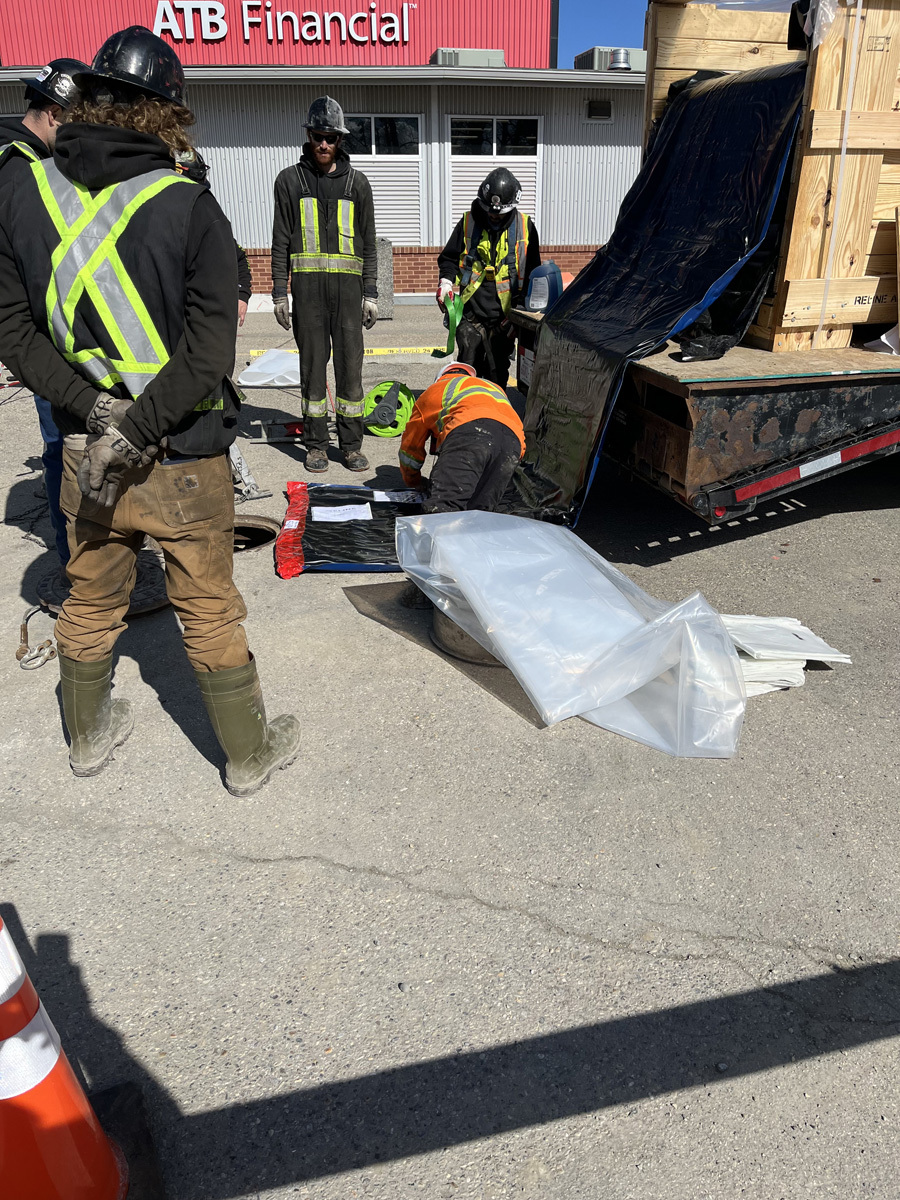
A key technical challenge was lining through the midline catch basin. In this case, the crew utilized a containment sleeve system from Reline America to maintain internal pressure during curing.
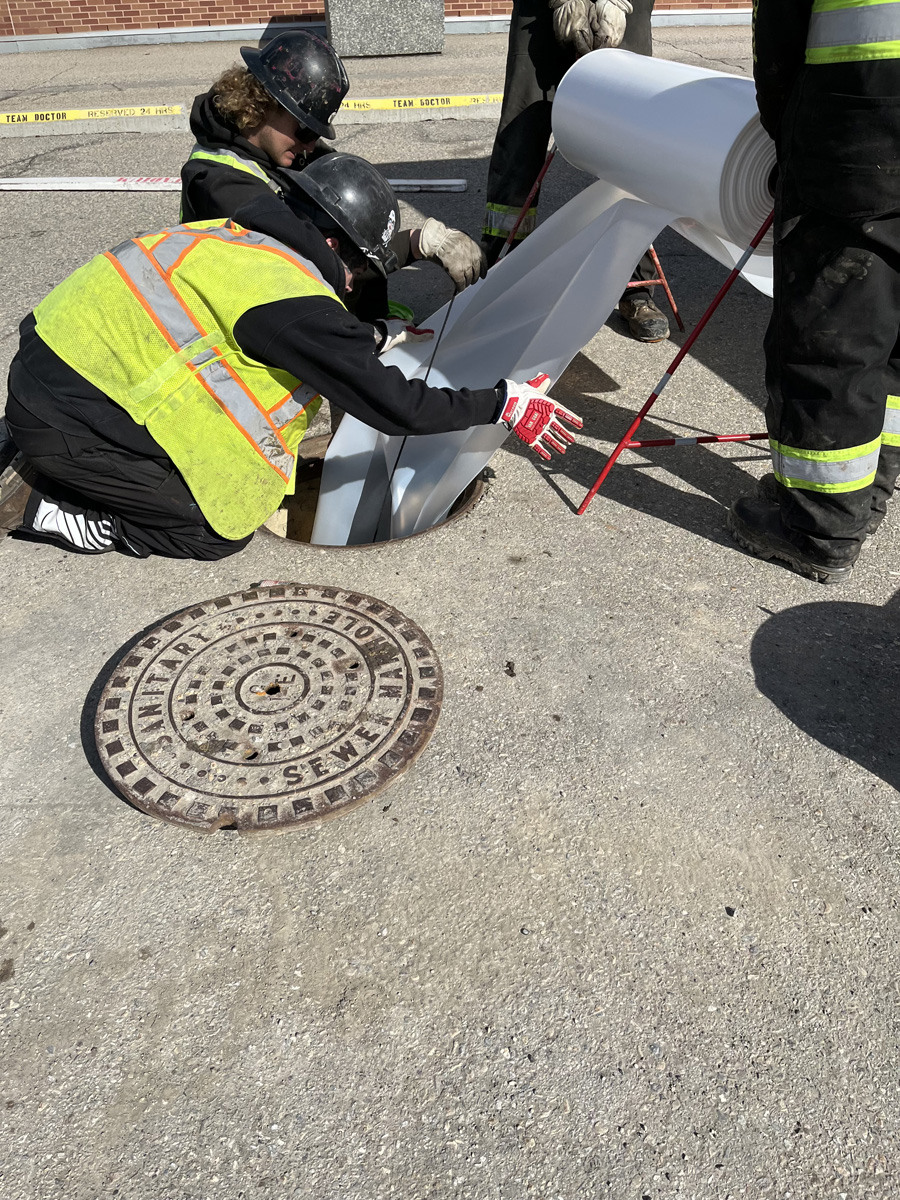
“Reline America has a really nice feature with their containment sleeves,” Kernaghan explains. “The installation leveraged Reline America’s integrated containment sleeve system to address the intermediate catch basin condition. When we’re lining through something like a catch basin, it makes it much easier compared to other systems.”
The sleeve provided confinement during inflation and UV curing, maintaining internal pressure as the liner traversed the open structure. Following cure, the contained section was removed to reinstate the catch basin opening, with the cured liner forming a new, continuous channel through the structure.
This method enabled a continuous installation while preserving the hydraulic function of the catch basin — an approach not always feasible with traditional systems.
The UV curing process took approximately one hour and 40 minutes, though it included an interruption due to a slipped endcap. “We were about an hour into the cure when a cap slipped,” Kernaghan says. “We stopped, fixed it and restarted. That’s one of the advantages of UV — you can pause and correct issues without losing the liner.”
Real-time monitoring systems tracked internal pressure, temperature and curing progress. “I could see the pressure dropping and the blower increasing output almost immediately. That’s how we knew something was wrong before it became a failure.”
Minimal disruption
The completed liner restored structural integrity to the aging pipeline while avoiding the cost and disruption of excavation. “It saved them a lot of money from digging that section,” Kernaghan says. “A dig like that could run $80,000 to $100,000 or more, especially with a pipe that size.”
In addition to cost savings, the project minimized surface disruption. With the stadium closed for only a short duration, the trenchless approach reduced impacts to operations and surrounding infrastructure. “There was very little disruption,” Kernaghan says. “We’re there for a day or two, compared to weeks or months for a dig-and-replace project.” Hydraulic performance was also improved. The smooth interior surface of the GRP liner enhances flow efficiency and reduces debris accumulation, offsetting any minor reduction in pipe diameter.
For contractors and asset owners evaluating rehabilitation strategies, the project underscores the importance of selecting the appropriate technology for site-specific conditions.
“Keep an open mind on what product you’re using,” Kernaghan advises. “Look for the best product for the job rather than trying to force one solution into every situation.
“A lot of people think GRP is heavier, but because of the fiberglass reinforcement, you can achieve the same structural strength with a thinner liner. That helps maintain capacity while still improving performance.”
Ultimately, the McMahon Stadium project highlights how proactive rehabilitation — combined with thoughtful technology selection — can extend infrastructure life, reduce life cycle costs and maintain service continuity in demanding environments.
Continue reading for free