The area served by the Great Neck (New York) Water Pollution Control District dates to the very earliest days of American history. It comprises part of a peninsula jutting northward into Long Island Sound, which sailors from the Dutch West India Company first mapped in the early 1600s. The wastewater utility isn’t quite that old, though it is the oldest sewer system on the island and dates from the early 1900s.
“Basically, we handle about 75% of Great Neck Peninsula, including several villages,” says Christopher Murphy, superintendent of the district. In all, the sewer system serves some 25,000 peninsula residents.
While the utility by the bay is old, it is not a technological backwater. Murphy and his elected board of commissioners are of a single, open mind about operating efficiency, utilizing technology and cultivating innovation. They have awards to prove it.
Commitment to process
Murphy is a native of the area. He earned a business degree at a local college and worked for local engineering firms for about five years before leaving the last of the firms to become acting superintendent of the pollution control district, which was a client of the engineering firm. That was 23 years ago. “What intrigued me at the engineering companies was process,” he says, looking back. “That was my forte.”

That is, he was fascinated by the formulation and oversight of engineered solutions. As superintendent, his commitment to process has shaped the entire organization and its responses to environmental and engineering challenges.
An example of this can be summed up in one word: grease. The coagulated byproduct of rendered animal fat and vegetable cooking oil is a sewer system nemesis, and there are some 180 restaurants and commercial kitchens in the Great Neck district. Together, they produce more than enough grease to choke a sewer. While avoiding such blockage is always paramount, the abundant grease also represented opportunity and the district seized it.
Grease is the central component in fueling district microturbines, which generate electricity. The first turbine was installed in the district system some years ago, essentially a jet engine powered by methane gas produced from grease through an anaerobic digestion process. To take full advantage of this synergy, the district board and engineers two years ago secured approximately $13 million in grants to upgrade the entire system. A new grease receiving station was created so the district could handle greater quantities of commercial grease and more effectively feed the anaerobic digesters, which now produce enough methane gas to power a third turbine.
“There is a lot of energy in waste,” Murphy says. In Great Neck today, there is far more grease being removed as an environmental risk to the peninsula, more biowaste gas [methane] being efficiently consumed in the production of more electricity for district operations — fully half of needed electricity now is produced in-house — and all of this at an annual savings to taxpayers of roughly $300,000.
Though the district’s tax base is sufficient for operating and capital improvement costs, Murphy says he and his team are very aggressive in seeking grant money to supplement the base funding. “The things we are doing are definitely ‘green’ and innovative, so our grant applications do fit a lot of different programs.”
Not only did the grease receiving station appeal to grantors, it also was lauded. The American Council of Engineering Companies, for example, cited the project for both originality and execution of the idea.
“It always is good to be recognized for things that you do well, but we spend our time focusing on operations,” Murphy says. “We fill out a lot of applications for grants. We don’t fill out applications for awards.”
Be that as it may, another award-winning initiative is the district’s pharmaceutical drive called “Shed the Meds,” begun in 2017. Twice a year, residents line up in their cars to drop off unwanted medications at a district location. “Not too long ago, even the EPA recommended we flush medications to keep them away from children and pets,” Murphy notes. Now, instead of being flushed, the meds are incinerated or otherwise destroyed. To date, the district has collected and destroyed nearly 4 tons of prescribed and over-the-counter medicines.
A tight ship
The sewer treatment plant has a capacity of 5.3 mgd and the system is handling much less, about 2.8 mgd. Murphy hopes to increase the volume of users and sewer flow. “We always are looking to bring in more sewer users,” he says, noting that the peninsula still has various locations that are served by septic tanks. “We are like a bus driving around with empty seats. The more customers the district has, the less everyone pays for that bus ride.”
As with biogas production through grease processing, Murphy continually looks for opportunities for more efficient operation.
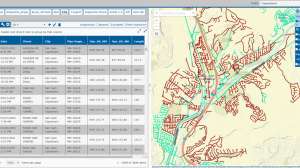
“We always are looking to make the operation as efficient as we can. Sewer treatment plants are really good at collecting data — we keep logs, fill out forms, note runtimes — and everything goes into a file cabinet. We are really focusing on how we can analyze that data and make our plant more efficient. You know, either make more electricity or reduce electricity usage. It is a matter of operational change versus capital costs. We are trying to run a tight ship.”
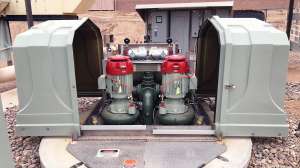
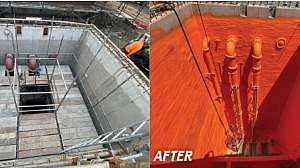
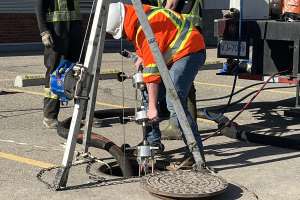
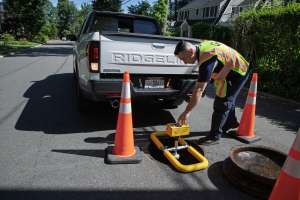
Considering the age of the Great Neck district, maintaining the infrastructure is a big focus of leadership. Over the last two decades, eight of the district’s 10 pump stations have been upgraded and standardized. The current focus is on the collections system, including its 1,900 manholes. After district employees inserted several hundred sensors in the system to track flow levels, “We determined that a lot of the existing inflow was coming through the manholes, not joints in the pipe,” the superintendent says.
The upshot is that money was budgeted for grouting and other manhole repairs. As a result, over the last two years, average annual flow has been reduced from 3 million gpd to 2.8 million. “For a 110-year-old system, it is in very good shape,” Murphy says.
The 72 miles of sewer line in the system is primarily vitrified clay and asbestos cement pipe with a few cast iron segments. Murphy says the clay pipe is aging satisfactorily.
“When clay pipe is installed well, it looks just as good today as the day it was put in, if it hasn’t been disturbed,” he says. “It’s impervious to sewer gases. We replace a line as needed but not in a preventive move. If it isn’t broken, we don’t fix it. There is some pipe that was put in in 1908 and still looks brand new.”

A major fix happening this summer is the replacement of a total of 11,000 feet of 18-inch and 16-inch force main running from pump stations. The new pipe will replace pipe installed in the 1960s. And typical of the district, it was able to save significant time and money on the $30 million directional drilling contract by piggybacking the contract for the with a contractor that was already working in the area.
Homegrown solutions
When the 50-year-old superintendent began with the pollution control district, “It was a different district,” he says. More traditional approaches to problem-solving were the rule. He obviously changed that but he says he didn’t do so by himself. “It also was a different board. I am very, very blessed to have a board of commissioners that is open-minded and trusts my suggestions. I give them the same respect. I would never suggest something I wasn’t sure needed to be done.”
He says the board has been willing to try new technologies and Murphy always tries to evaluate such investment in terms he understands as a business major. “We look at a project and determine it will cost X amount to implement but will save us Y amount in operation.”
Many of the ideas and projects the district has successfully undertaken have been “homegrown,” almost by necessity. Being on the leading edge of technological applications or the pursuit of innovative wastewater operating ideas doesn’t lend itself to looking at similar projects elsewhere. Murphy says he would have loved to have seen some of his ideas already executed in other places, but that hasn’t happened with any regularity. As a consequence, he says he always stands ready to share his project experience with anyone else wanting to replicate it.
Murphy characterizes his work with the board as a phenomenal working relationship.
“We also benefit from being a good-sized governing body, big enough to enjoy economies of scale but not so big that we get into diminishing returns and bureaucracy.”
Continue reading for free