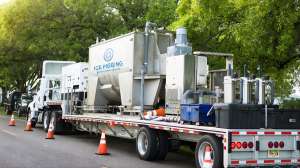
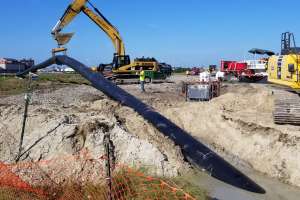
Northern Divers’ high-velocity cleaning system was set up along the shore of Lake Winnebago near the Oshkosh Water Filtration Plant.

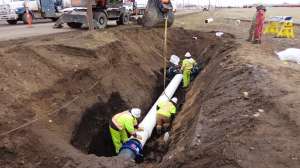
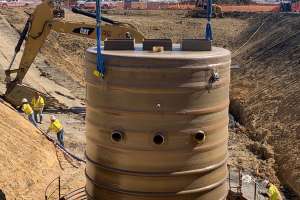
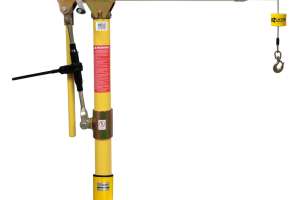
A custom-built 48-inch pneumatic bypass plug is lowered into place.


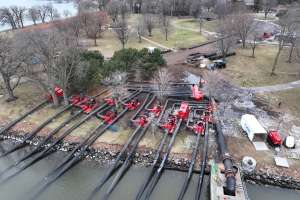
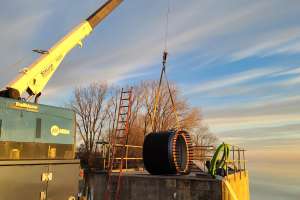
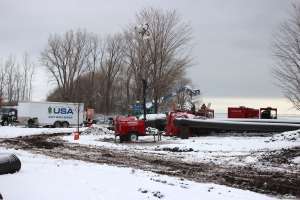
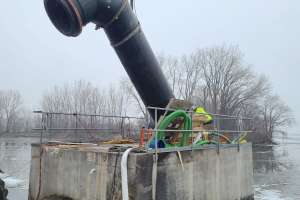
Northern Divers’ high-velocity cleaning system was set up along the shore of Lake Winnebago near the Oshkosh Water Filtration Plant.
A custom-built 48-inch pneumatic bypass plug is lowered into place.
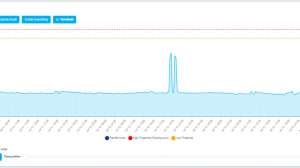
From 2019 to 2022, the average raw water turbidity at the Oshkosh Water Filtration Plant increased from 6 to 7.4 NTU while the maximum rose from 9.8 to 12.8 NTU.
In August 2022 Mike Harris, a diver with Northern Divers USA, visually inspected the 2,600-foot-long, 60-inch primary intake pipe in Wisconsin’s Lake Winnebago and found it 50-75% occluded with sediment, dead fish and zebra mussels.
“The blockage didn’t affect our normal demand of 6-10 mgd, but pushing operations near the plant maximum of 16 mgd would have triggered capacity concerns,” says Public Works Director James Rabe, P.E.
The obstruction also increased the pipe’s velocity, increasing the risk of pulling in frazil ice and clogging the intake. The city had suffered an ice blockage during the winters of 2015-16. At that time two 24-inch backup intake pipes supplied water to the plant, but ice shoves have since damaged one, restricting its capacity.
In light of the more recent blockage, City Manager Mark Rohloff declared an emergency to resolve the issue before winter, but city officials were unable to secure an intake flushing permit.
A second inspection by Northern Divers in May 2023 found the occlusion had progressed to 75% throughout much of the primary pipe. Approval to clean it arrived on Dec. 5, by which time turbidity averaged 7.3 NTU and peaked at 14.9 NTU.
Northern Divers went to work and, not counting the two weeks off for Christmas and New Year’s Day, crews set up the piping and high-performance high-head pumps in 18 days, then cleaned the primary pipe with high-velocity water.
Built in 2005, the concrete intake pipe runs from a depth of 16 feet to a 30-foot-deep concrete diversion vault in Menominee Park. From there the 60-inch transmission main runs to a wet well tee outside the pump house. Both pipes, at 2,600 feet, are separated by the vault and considered individual lines.
The water plant’s dual treatment trains include rapid mix, flocculation, sedimentation, dual-media filtration, ozone and granular activated carbon contactors and chloramine disinfection.
While waiting for the flushing permit Frank Frosolone, Northern Divers president, spent three weeks in his workshop custom fabricating seven 72-by-36-inch sleds, 24 inches high with flanges to help anchor the HDPE supply pipes in the lake. A D-ring attached to the front of the sleds accepted a 10-foot steel pulling cable.
“We had only seven sleds and I needed 14,” says Frosolone. “The solid sled bottom eliminates drawing sediment into our suction pipes.”
Frosolone subcontracted Mersino Dewatering to set up a dozen 18-inch diesel Global Pumps and then fuse 2,400 feet of 24-inch HDPE suction pipe and a dozen 24-inch discharge pipes of various lengths.
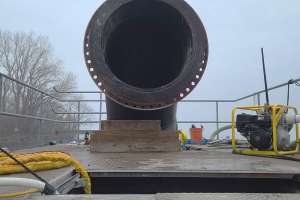
The discharge pipes fed two 48-inch manifolds, designed to send high-velocity water through a 48-inch discharge pipe and into the occluded intake pipe. A 12-inch diesel pump and piping supplied emergency water to the wet well in case an increase in demand should overwhelm the plant’s 24-inch near-shore intake.
Mersino’s bypass project manager Steve Rziemkowski and five workers arrived in the park on Dec. 11 along with truckloads of equipment. While they set the pumps and fused the pipe, divers Harris, Patrick Depass and Andrew Roades worked in the vault in 20-foot-deep water at 34-38 degrees F.
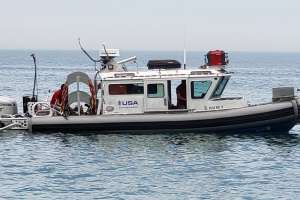
“There was ice on the lake and the shallow boat launch in the park was always frozen,” says Frosolone. “We constantly needed deicers at the vault and boat launch. We used our 29-foot workboat with 500 hp Honda engine to break through the ice to the navigation channel.”
The divers, wearing hot-water suits, spent three days removing 4 feet of sediment from the vault floor using vacuum pumps. “The plant was constantly drawing in muck, which filled the transmission main and kept turbidity readings high,” says Frosolone, who acted as the certified diving support supervisor.
The intake pipe invert was 2 feet above the floor. When contractors installed the pipe, they welded a steel plate over the mouth to keep water out as they worked inside the vault. Afterward, they rough-cut the plate to remove it, leaving uneven edges that kinked a pair of 3-inch chemical lines running to the crib.
“City officials were unaware of the damage and gave us permission to fix it,” says Frosolone. The divers cut the plate flush, ground the lip smooth and replaced the compromised lines with 3-inch HDPE pipe.
The next challenge was to lower a custom-built 48-inch-diameter pneumatic bypass plug through a 5-foot-square opening in the vault roof. Frosolone, controlling the Stellar 7630 crane on his truck, flew the suspended plug, guided by radio directions from the divers in the vault. “With only a foot of clearance around the hatch, there was no room for error,” he says. When the plug was in position, the crew inflated it to lock it against the pipe walls.
The 16-foot-long, 48-inch drop pipe had two 45-degree elbows on each end. Lowering it down the hatch was another nail-biter, performed with a telescoping forklift. The driver held the plug in position as the divers joined it to 44 threaded rods on the plug. When that was done, the mouth of the pipe protruded above the hatch to accept the 48-inch discharge pipe.
To move the suction pipes into the lake, Mersino workers slipped a strap with a loop over the middle of a pipe, secured a sled to the front of it and attached the pulling cable to the D-ring. The forklift driver slid the machine’s fork through the loop and waited.
Meanwhile, Frosolone piloted the boat within range for a diver to throw a 100-foot line onto shore. One end was hooked to the cable and the other end to a heavy fitting on the boat. As it slowly pulled the sled forward, the forklift driver raised and extended the boom, pushing the pipe into the water.
Frosolone communicated via radio with Rziemkowski on how fast to pull until the forklift driver aligned the rear pipe flange with the pump flange. After the driver raised the pipe, the crew joined the flanges with washers and nuts. They repeated the process 11 more times.
Next, the crews hooked the discharge pipes to the manifold supply lines through which the pumps would flush the pipe at 130,000 gpm/17 feet per second.
On Jan. 2 in below-freezing temperatures, Frosolone started a pump every 15 minutes. “Start too many too soon and the velocity could cause a blockage,” he says. “Likewise, once the first pump started, we couldn’t stop or material would fall out of suspension and plug the pipe.”’
At the crib, water and material blasted up like a volcanic eruption. From a safe distance, Frosolone’s crew tested water samples for turbidity. “We knew the pipe was clean when our testing equipment gave a reading of 0.04 NTU,” he says. “That’s because the suction pipes were collecting water inshore where turbidity was zero.” The pumps ran nonstop for three days.
Next came flushing the 60-inch transmission main from the vault to a tee outside the wet well. Prep work involved removing the cap on the tee and attaching the 48-inch discharge pipe. Frosolone started the pumps on Jan. 8 and ran them for another 72 hours. The team completed work on Jan. 11.
The 60-inch lines are on a three- to five-year maintenance schedule.
Continue reading for free