An old adage advises: “By taking one step at a time, you can achieve great things.”
That may have been on the mind of Aurora Water when it broke a costly interceptor sewer project into several phases over three years, and included alternative bids, to achieve the overall objective while saving money.
Andrea Long, principal engineer for the city’s Wastewater and Stormwater Capital Projects Division, reported on the project at the 2024 No-Dig Show in Rhode Island last April.
“When first bid, our interceptor project came in significantly over budget,” she says. Known as Senac Creek Interceptor, the project involved constructing a gravity interceptor line to serve a rapidly developing area in the eastern part of the community. “We decided to bid the project in several phases and add alternatives to allow market conditions to determine most economical materials and installation methods.”
Aurora Water estimates total savings realized by phasing the project at about $4.5 million.
A key to success was working with the developer to stay ahead of new construction. “In the first phase, we were able to prioritize the work and complete sections of the interceptor before buildings, streets and other utilities were in place,” Long explains.
Aurora evaluated PVC and fiberglass reinforced pipe, as well as tunneling and open trench construction for the project. Prime contractors and tunneling subcontractors were prequalified prior to bidding, forming effective partnerships that added to the project’s success. Contractors and their subcontractors were evaluated as teams and ranked based on years of experience with similar kinds of work.
“We found fewer change orders and issues in the field when experienced teams are working together,” Long says.
Using this alternative approach, Aurora was able to complete Phase 1 and started Phase 2 by the end of 2023. The final phase is scheduled to be finished ahead of schedule in late 2024.
Funding was secured through the city’s Enterprise Fund, supported primarily through development fees.
Aurora Sewers
The Aurora sewer system consists of sections installed in the 1940s as well as brand new networks being constructed as the city expands into new areas east of Denver. With 400,000 customers across portions of three different counties, Aurora is the third-argest and fastest growing city in Colorado.
Overall, the city’s sanitary sewer system measures over 1,200 miles, consisting of 6-to-48-inch pipe with over 31,000 manholes. Wastewater is conveyed to the Metro Water Recovery’s Robert W. Hite wastewater treatment facility and their Northern Treatment Plant. The Robert W. Hite facility can process about 130 mgd, and serves 61 different Denver-area communities including Aurora. The North Treatment Plant has a capacity of 28.8 mgd.
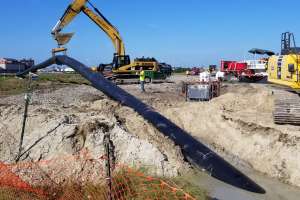
The new interceptor — 30,400 linear feet of 30-inch pipe — was designed to eliminate several older lines as well as two lift stations while delivering improved service to a number of new developments, both in the near and long term. In addition, seven separate tunnels were necessary to avoid interfering with existing infrastructure such as waterlines and roads. Tunnels ranged from 50 feet to 575 feet in length.
Aurora solicited bid alternatives for both PVC and fiber-reinforced concrete pipe.
Long says the first bids were open in August 2021 and came in at one and one-half times the budget, forcing the district to go back to the drawing board.
“We couldn’t partially award the contracts,” Long explains. “Volatile market conditions were a challenge in that post-pandemic time. [PVC costs were sky-high and supply chain issues were plaguing all of the construction industry.] We simply couldn’t do this.”
Phased Approach
Instead, Aurora Water decided to rebid the project in separate phases, and use alternative bidding in an attempt to keep costs within budget, yet complete the project in a timely fashion.
In Phase 1, 5,700 linear feet of new sewer line was installed to serve Aurora Water’s new facility known as SEAM (Southeast Aurora Maintenance Site), a consolidated facility for Aurora Water staff and equipment, providing 300,000 square feet devoted to offices and maintenance space. The Phase 1 alignment, which is located in the middle of the overall planned pipe alignment, would ultimately require future phases to tie in the north and south ends of the sewer. The piping was installed under mostly open fields, before new asphalt, roads and landscaping had been placed, saving on costs.
The project also eliminated the need for two new lift stations as well as repairs that would have had to be made on the old system and was designed to provide long-term service to at least 11 new development sites.
Phase 1 was completed in November 2022.
Phase 2
Phase 2 was more complex and required more creative thinking on the part of the Aurora Water team.
With Phase 1 under construction, Aurora Water worked to secure additional funding for the project and evaluate ways to reduce the overall cost. Phase 2 included sections at both ends of the line as well as the longest tunnel — a 575-foot crossing of Coal Creek.
After discussion with the landowners and obtaining agreement to use either opencut or trenchless methods of tunneling under the creek, Aurora Water decided to break the Phase 2 project into even smaller portions to allow for identification of bid alternatives based on development needs. With funding in hand, the city solicited a base bid for the sewers, and invited alternatives that opened bids to either trenchless construction or opencut depending on what was most appropriate for individual segments.
Despite requiring a six-month delay for additional permits, the opencut method was selected for the Coal Creek crossing, at a considerable cost savings over microtunnelling. Additional money was saved through modifying the alignment and saved an average of 7 feet of depth along the majority of the alignment.
Another tunnel had to be added to the project because of a pair of high-pressure oil and gas lines discovered during discussions with landowners. Additional costs were incurred for geotechnical borings and reports needed to inform the tunnel design.
The last segment of Phase 2 of the Senac project is under construction now. It involves just over 4,000 linear feet of pipe and two trenchless installations completing the remainder of the interceptor at the far southern end of the alignment. The team has since been able to work with the contractor to engineer one of the tunnels out of the project, saving the city additional money.
The contractor is tracking ahead of schedule and under budget and is slated to be completed in 2024.
Successful Conclusion
Utility owners are often faced with little choice but to cut scope in the face of volatile markets and escalating rising costs, Long concludes in her presentation. “However, with foresight and planning, utility owners can allow for alternative bidding of materials, alignment or installation methods — allowing the market to dictate what is most effective.”
Phasing a project — as was done in Aurora — can help utilities spread construction costs out over a period of time, reducing budget impact. In addition, phasing projects can allow for critical phases to be completed sooner or ahead of future projects which in turn provide cost savings.
Long adds that by prequalifying contractors and their subcontractors, utilities can be assured that bidders have the necessary experience to take on critical sewer line projects.
“Ultimately, no approach is without risks. It is important that utilities understand the levels of risk they are comfortable with and the various options available to them.”