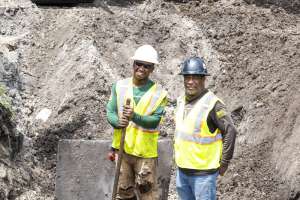
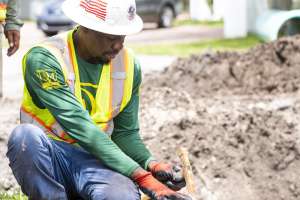
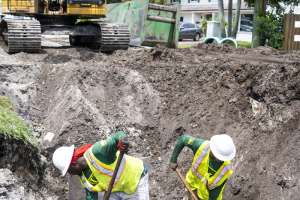
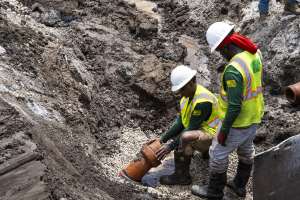
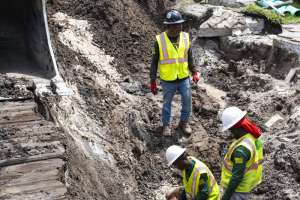
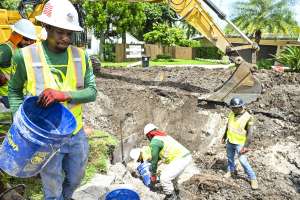
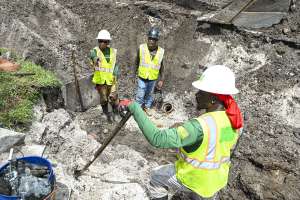
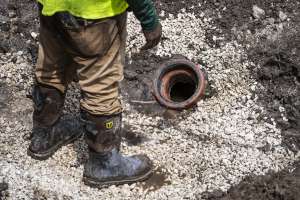
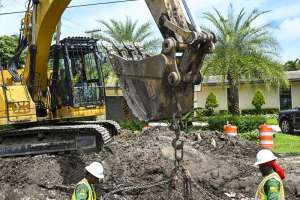
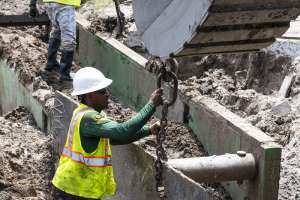
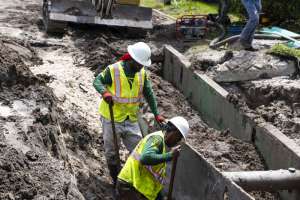
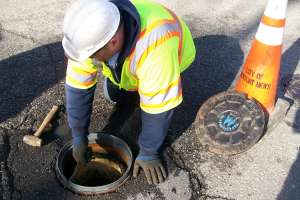
The city of Fort Lauderdale is in the midst of a nearly $28 million sewer replacement project that will remove from service an aging cast iron sewer main deemed extremely vulnerable to failure.
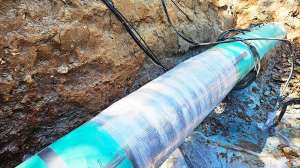
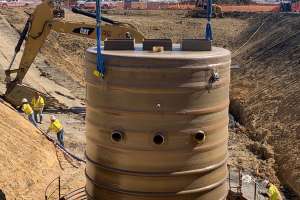
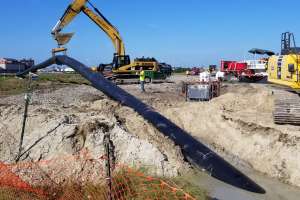
The project involves replacing a 7,900-foot-long, 42-inch-diameter sanitary force main with 42-inch, high-density polyethylene pipe. It also includes installing an additional 3,750 feet of 24-inch sewer line, also using HDPE pipe, says Alan Dodd, the city’s director of public works.
The little more than 2 miles of new force main will connect lift stations in several neighborhoods in the northeast quadrant of the city to a repump station that sends sewage to the George T. Lohmeyer Regional Wastewater Treatment Plant, located near the Atlantic Ocean, just southeast of the city’s downtown district.
“This force main is critical to our operations,” Dodd says.
The project began in April 2024. As of early August, it was about half finished. Completion is expected in mid-fall 2025.
But the project is just the tip of the iceberg for the city’s public works officials. During the last several years, they’ve been busy quarterbacking the installation of roughly $100 million worth of sewer force mains. The 13 projects totaled 17.25 miles in length — nearly 5% of the city’s sanitary mains.
Those projects included installing nearly 9 miles of 30-, 42-, 48- and 54-inch-diameter force mains that transmit sewage from a repump station in the northeast part of the city to Lohmeyer plant, at a cost of about $63 million; and the installation of about 3.5 miles of 30-inch force main that transmits sewage from a repump station in the western part of the city to the Lohmeyer treatment plant, at a cost of roughly $13.1 million, Dodd says.
“In the last year alone, we awarded more than $157 million worth of projects [including the aforementioned force main replacement],” he says. “We find there’s value in doing larger segments instead of breaking the projects into smaller pieces. It creates a more coherent project and allows us to better manage the impacts on neighborhoods.”
Another significant project currently underway is the replacement of 4,200 feet of 54-inch effluent force main that connects the Lohmeyer treatment plant to a deep-injection wellfield. There the city disposes the fully treated effluent by pumping it approximately 3,500 feet below ground via five 24-inch-diameter deep-injection wells, Dodd says.
The effluent flows into a mineral rock formation known as the boulder zone, well below the region’s water aquifers. The project cost is about $53.3 million and the project is slated for completion in September 2026.
Massive Rehab Effort
The projects are among many prioritized in a 20-year master plan of sewer-related capital improvement projects approved in 2017 by the city’s board of commissioners. The plan also determined high-growth areas that need additional sewage-line capacity.
“Like just about every other community in the country, we’re playing a little catch-up when it comes to improving sewer infrastructure,” Dodd notes. “Demand for sewer services keeps growing and our infrastructure is getting older, so we’ve made a decision to invest heavily and get our infrastructure up to A-plus status.
“Infrastructure resilience is our top priority.”
To underscore the situation, Dodd points out that out about 168 miles of the city’s approximately 368 miles of sewer lines are 60 years old or older.
To fund this large slate of projects outlined in the 20-year master plan, the city commission approved the issuance of two water and sewer revenue bonds worth $200 million each, one in 2018 and the other in 2024.
A Confluence of Threats
A perfect storm of factors is the city’s sewer line problems: Cast iron pipes that are subject to corrosion; a high water table with salty water; and sand that enters the sewer lines due to inflow and infiltration and scours the bottom of pipes.
“We’ve had a number of failures caused by the bottom walls of pipes getting eroded away,” Dodd says.
In some instances, sand had scoured portions of 1-1/2-inch-thick cast iron pipes’ walls down to a quarter of an inch thick, Dodd says.
“That’s why we’ve been on this very aggressive program to replace mains with pipes that are better suited for the ground conditions and that can handle the flows we have now versus what they were required to handle years ago,” he says.
In one particularly significant incident in 2017, breaks in a cast-iron main that handles about a third of the city’s sewage inundated some neighborhoods with sewage more than a foot deep. Faced with a public health emergency, the city hired Murphy Pipeline Contractors in Jacksonville to rehabilitate a little more than 4 miles of sewer force mains in just nine months.
Speed Drill
The company deployed two different technologies — horizontal directional drilling and compression-fit pipe lining, to complete the massive project. Speed was of the essence because sewer line breaks threaten local intracoastal waterways and other environmentally sensitive marine areas.
The nearly $15 million project involved installing approximately 8,600 linear feet of new 30-inch force mains via horizontal directional drilling and rehabilitating another 11,500 linear feet of existing 30-inch force mains with compression-fit lining technology, which uses HDPE pipe.
In compression-fit lining, powerful winches pull long runs of HDPE pipe through custom-made steel dies that are slightly smaller than the host pipe. As the pipe passes through the dies under extremely high force — anywhere from 70 to nearly 100 tons of pressure, depending on the length of the pull — it gets compressed to a smaller diameter than the host pipe.
When the pull is complete, the pipe — no longer under extreme pressure — slowly expands to its original diameter and tightly conforms to the host pipe’s interior, typically within 48 hours.
No Easy Job
The force main project posed several challenges. Its route traveled through a densely populated area with a lot of underground utility lines, narrow roads and residential homes. As such, about 60% of the main was installed via horizontal directional drilling that passed under the lines, Dodd says.
“There’s also a cost savings [with HDD] compared to opencut, plus you avoid a lot of impacts on traffic and residents,” he adds. “We try to use the best technology to minimize the impact while staying on schedule and improving the value of what we deliver with the project.”
Another challenge was the high groundwater table. As a coastal community, groundwater is as shallow as 5 feet below roadways in some areas, which made it necessary to continually dewater the pits dug for the HDD operations.
Furthermore, the force main’s path passed under the driving range of a private golf course. That required the city to work out a complex agreement with the golf course owner, even though the city owned an easement for the line, which generally follows the route of the existing force main, he says.
“It took a lot of coordination with the neighborhood and the golf course to align the project and minimize the impact on the residents and the golf course,” Dodd says.
The old line will be abandoned after the new line is installed.
Following the Plan
There’s much more work ahead as the city follows the outlines of the master plan. In the next four years, the city will embark on eight more projects that will involve replacing/rehabbing about 11 more miles of force mains.
For example, the city recently awarded a $53.4 million contract for the rehabilitation and replacement of 23,370 feet of 48- to 54-inch force main that connects the wastewater collection system in the central part of the city to the Lohmeyer treatment plant. Work on that project is expected to start in September 2024.
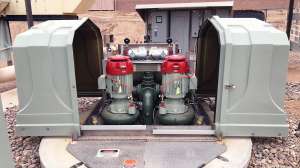
“We’re doing a lot of rehab on lift stations, too — replacing pumps and motors and elevating control panels to avoid damage from flooding,” Dodd explains. “We have extreme challenges in south Florida from heavy rainfalls and high-tide flooding.”
The work outlined in the master plan is being performed in five-year increments. By the end of the 20 years’ worth of work proposed by the plan, Dodd estimates the city will have replaced or rehabbed approximately 40 miles of sanitary sewer lines, mostly large-diameter force mains.
“We have plenty of work to keep going for many years,” he says. “Our main focus is prioritizing projects based on risk and vulnerability and to stay ahead of sewer line breaks.
“We have a very active program, but that’s what makes it fun.”