Post-pandemic blues
Since the 2020 pandemic, another common characteristic has come to be shared by Watsonville: a shortage of long-term employees. In the wake of this disruptive global event, the city finds itself struggling to compete with outside forces — who lure potential workers with better salaries and benefits — to attract and retain operators and CDL drivers. This has made training an ongoing nightmare, since new people are constantly coming aboard to cover these departures.
Watsonville had never had a documented training process that kept messaging and techniques consistent across disciplines, and this only complicated matters. Collection Systems Manager Ruben Tellez noticed through interaction with different staff that there was a wide enough variation in the operational knowledge base to become a significant problem.
Tellez was also challenged by another familiar scenario: needing to develop greater operational efficiencies within increasingly limited budgets and tighter staffing.
Brain Drain
“As you start moving up, you notice that there’s a lot of legacy knowledge that leaves, when someone who’s been here longer than you moves on. Even during the day-to-day, things get lost. We learned that a lot of information was getting left behind, as we trained new employees coming in.”
When it comes to passing on institutional knowledge, Tellez says, “There’s a comfort level, a complacency that comes with preventive maintenance, because you’re basically doing the same thing every day, to ensure no emergencies happen. It’s a routine, and human nature tends to skip some of the details.
“We wanted to get away from that. We wanted to bring back the accountability of, ‘No, we make sure we hit our foundational needs, then move forward from there.’ So, I took a step back. When I became manager, we started writing down the things we did, creating standard operating procedures for those things. Because of the turnover in our positions, we wanted to create something that would last longer than us; basically, for as long as we were using the same equipment.”
Even the creation of the SOPs has been clarifying, he says. “We remember, ‘Oh, wait, no! This needs to happen, and this needs to happen.’” So the process itself sparked valuable content, but that content needed to be delivered in a way that was both easily accessible, and likely to actually be used. Typed notes can be easily updated, but not everyone learns best by reading.
Format matters
Tellez thought about how to maintain a virtual knowledge base that could be accessed from anywhere, was engaging and immediate, and supported visual/audio learners. He considered his own applied learning experience.
“Anytime I have to do something around my house, I go immediately to YouTube. I watch a 10-minute video, then I can refer back to it as I’m working through that process. The joke is [people calling it] ‘YouTube university,’ but we use that a lot.”
As he mulled this, Joseph Blackman — a former combination truck sales representative he’d worked with — approached him about working with his new company, Vitendo Training Solutions (vitendo.us). According to its website, “Vitendo Training Solutions is a workforce development system for cities, counties, utilities and manufacturers.” The company’s mission is “to get the knowledge from the people who have it to the people who need it … with Just In Time training.”
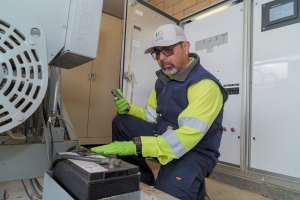
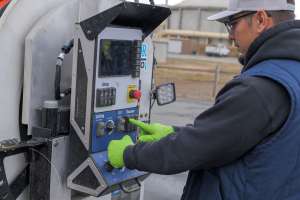
Essentially, Vitendo offers the immediacy of video that can be posted to Vitendo’s indexed, searchable servers, making it easy to access from anywhere, anytime. Blackman, whose background makes him familiar with the industry, helps clients write their scripts, choose locations and angles, shoots the video, and edits it into final form. These videos are fairly easily updated when new equipment is added, or processes change.
The process
Due to their previous business dealings, Tellez had a great deal of confidence in Blackman’s understanding of his operational needs. This gave him trust in bringing Blackman in to guide the planning process, and Blackman was thorough.
“We had around four preliminary calls to prep for the shoot,” Blackman recalls. “These calls consisted of what needed to be captured on video, how we were going to find the jobs, tools and equipment to capture, and who was going to do the training.”
That choice was fairly easy for Tellez. “It was the guys who were the most vocal and OK with doing it. A lot of people are camera shy or don’t want to hear themselves talk on video. The ones who did weren’t necessarily the ones who had been here very long. They were actually fairly new, but because they were being walked through the process, and [could refer to] the SOPs we developed, they were able to at least look like they knew what they were talking about.”
As videographer, Blackman helped Tellez create a shared “Asset List,” to make sure all parties were on the same page about what needed to be covered, and all locations that needed to be included. This allowed them to efficiently plan where each part had to be shot.
“We gave him a list of where we needed to go,” Tellez says. “He’s really good about just following along.”
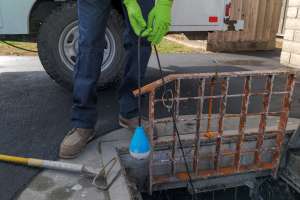
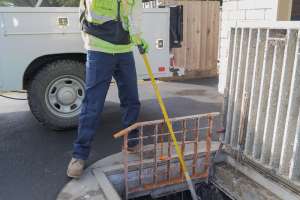
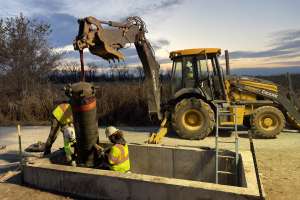
Some footage was shot at the treatment plant, especially for segments on trucks and equipment. Though the detail of the finished sessions appear as though the crew went to every external location, they didn’t. Six of the lift stations are exactly the same, so Blackman shot one of those, as well as those that had anomalies, then the footage was spliced and condensed.
End product
Blackman was able to gather all needed footage in a single-day shoot. It took two weeks to edit down to a total of 2.4 hours of content that was delivered for viewing through a proprietary portal on Vitendo’s server. The client owns the edited video.
Watsonville technicians are issued digital tablets with mobile cell service, allowing them to access the training portal through the internet. There, all training sessions are cataloged in a searchable database according to title/subject. Technicians have this site bookmarked on their tablets, providing easy access to the videos as needed.
When the portal first went live, Watsonville technicians were using the videos a lot, and management were reviewing them often. Now they get reviewed mid-year. “We’ll go through them again,” says Tellez. “We do them for both truck safety, and how to use the equipment.
“What we revisit the Vitendo videos for is, ‘Hey, remember? We’re at these stations, this is what and how we check these.’ We’re still evolving as a department. The guy that’s been here the longest besides me has six years; after that it’s three years, two years, and then we just hired a guy who’s been around since January — so the youth of knowledge is a lot, and these come in really handy with that. We’re also fairly young in the development of how we do our preventive maintenance, so this is really helping that evolution. You can pick a pool of that training whenever it’s needed.”
Extending the value
Tellez says the video training concept holds value for the department’s future, as well as its present. One of the lift stations is currently going through an upgrade, as part of a capital improvement project, including new equipment.
“We have planned on getting Joseph back out here and making updated videos, as things become obsolete. He had given us the option to add video as needed. There was an option to do our own video, but I really liked the way he came out and interacted with the guys, and the way he edited the video. Preferably, I would rather have Joseph involved.”
Tellez also has his mind even farther forward, in succession planning for department leadership.
“When I came in, there were a lot of things left out of the training that we need to cover, as far as day-to-day operations, safety meetings, things like that. We haven’t really broken down the most efficient way to do that training for succession planning. We’re trying, but it’s more outside vendors coming in and doing managerial and finance trainings, and things like that.
“I think that’d be a little harder to put on video, because you have all the finance rules and you have the regulations that come with it. But if there was something we could do to speed up at least the process of becoming a lead, that would be nice. But it would take some brainstorming.”
He’d very much like to commit as much training as possible to the video format, for some very sound reasons. “The knowledge, the notes are never lost. They’re always there. You can pull them up at any time, during a discussion or maybe a disagreement on a piece of equipment. ‘Well, now. Let’s go to the training video and look at it.’ That gets away from opinion and only deals in facts, and that’s huge when it comes to preventive maintenance.”
Embrace the change
Tellez is a big supporter of embracing new technology, despite its inevitable discomfort levels.
“Our job certification [training] talks about always trying to look for the latest and greatest, for something that’s going to help you be more efficient, more effective in management. If you’re always trying to look for that, and the way you go about it is by training your crews the best way possible, you should want to embrace things that are going to make you more effective as a department. So it’s hard for me not to sing the praises when you run into a training device like this. It’s successful, and moving forward it’s how our future training is going to be done.”
The elephant in the room, in any modern conversation about technology, is artificial intelligence. It’s something Tellez and his colleagues have looked into. Specifically, they’ve been eyeing an AI software package that can categorize types of defects that occur during a CCTV line inspection, which his department is required to do for every system assessment. He’s open to the idea, but so far, the execution hasn’t impressed him.
“Maybe I’m getting old, but I still like the human element of that. I can look at a crack and see something a little bit more than that it’s just a crack. I know to ask, ‘Well, why is it a crack?’”
He feels that perhaps AI still needs time to build up its own knowledge base before it can compete with the library of human experience. It’ll come, he says, but “I think right now, the AI system that they have, you still have to go back and review what it’s done, to make sure it’s doing it correctly.”
For now, the proven technology of streaming video posted to an Internet portal for 24/7 accessibility is sitting right in the sweet spot of the intersection of efficiency and effectiveness in Watsonville.