Hamilton Water in the industrial city of Hamilton, Ontario, treats over 342 billion gallons of wastewater per year. But the system that conveys all that wastewater is more than 150 years old.
The city’s overall sewer system has about 1,948 miles of pipes split nearly equally between wastewater and stormwater pipe, with another 19% of the system combined.
“The earliest sewer pipes were laid in 1859, and we had one of the earliest wastewater treatment plants here in Canada dating back to the late 1800s,” says Nick Winters, director of Hamilton Water.
This being the case, the documentation of this historic sewer system has gaps here and there. They make it challenging for Hamilton Water to know what’s happening underground — and to keep unauthorized releases of raw sewage into Lake Ontario under control.
To address this problem, Hamilton Water launched its Enhanced Sewer Inspection Pilot Program in December 2022. It was devised after a disturbing undocumented cross connection between the combined sewer and storm sewer systems was found by Hamilton Water staff in November 2022 at the intersection of Wentworth Street North and Burlington Street East.
“We were doing some exploratory work in one area of our wastewater collection system in the combined sewer area,” Winters says. “While reviewing an exploratory video, our staff noticed a hole that had been cut purposely in the bottom of a combined sewer pipe that ran directly over top of a large storm sewer pipe that crossed it. And they wondered why that was there: It didn’t look normal to them when they were reviewing a video. So they went out to confirm that what they saw in the video was actually what was taking place, and lo and behold — they found that, yes, there’s this hole that had been cut in this pipe.”
Digging through their records only brought more bad news.
“We learned that this combined sewer pipe had been discharging into this larger storm sewer for 26 years,” Winters says. “We know this because we went back and looked at a capital project that had taken place in that area back in the mid-1990s and saw a notation within the capital project drawings, directing the contractor to cut this hole into the top of that storm sewer.”
Owning the problem
Given today’s strict regulatory climate, Hamilton Water immediately reported this spill to the relevant authorities.
“When you report a spill that’s been occurring for 26 years to the regulator in Ontario here — that’s our Ministry of Environment Conservation and Parks — it raises a lot of eyebrows,” Winters says. “When I stood in front of our council and the media to advise our community of what we found, it raised a lot of eyebrows as well.”
Rather than dodge the issue of undocumented cross connections, Hamilton Water decided to own it. “We took this spill as a sign that if this is happening in one spot, there is a strong likelihood of other instances of cross-connected sewers that aren’t showing up in our records,” Winters says. “And so we very quickly put together the Enhanced Sewer Inspection Pilot Program to look at high-priority maintenance chambers on our combined sewer system that are in close proximity to our separated storm system, knowing that’s where these types of connections would’ve been established.”
Taking matters seriously
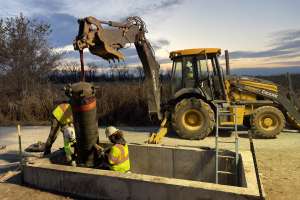
To its credit, Hamilton Water tackled the issue of undocumented cross connections very aggressively. Within four months of the Enhanced Sewer Inspection Pilot Program being launched in December 2022, Hamilton Water staff had completed inspecting 100% of its specified locations.
The target area for inspections was the city’s Ward 3, which discharges combined sewer overflows from four primary storm sewer outfalls into Lake Ontario. The city of Hamilton’s Water Pollution Prevention website notes that, “Because of the prevalence of combined sewer overflows to these outfalls, the focus of the pilot program has been to thoroughly investigate the combined and storm sewer maintenance chambers upstream of these four outfalls.”
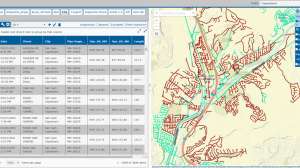
To make this happen, 288 maintenance chambers within the combined sewer system were identified for inspection so that Hamilton Water could compare their actual conditions to the data recorded within its GIS.
As might be expected in a sewer system that was initially first laid down before the start of the U.S. Civil War, the inspection process uncovered problems. A case in point: Hamilton Water staff who were checking a combined sewer maintenance chamber at the intersection of Myrtle Street and Rutherford Avenue in January 2023 noticed an unpleasant smell emanating from a nearby storm sewer maintenance chamber and discovered a combined sewer pipe was discharging into the chamber. Based on the unexpected finding, 339 storm sewer maintenance chambers were added to the inspection program.
In total, 288 combined sewer maintenance chambers and 346 storm sewer maintenance chambers were inspected during the program, and two additional cross-connected sewers were identified.
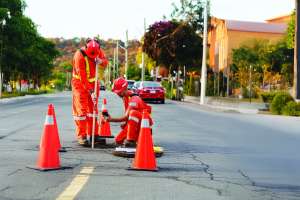
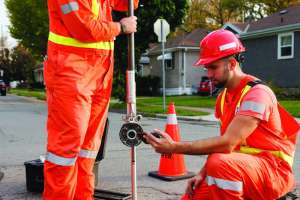
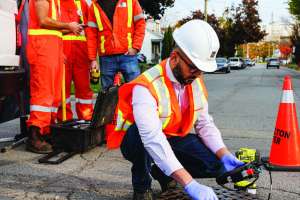
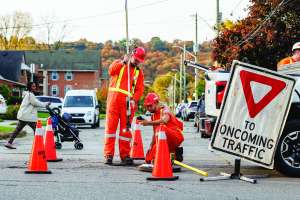
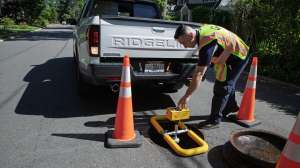
“What our staff did was to lift chamber lids and trace back every single pipe connection that was discharging in that chamber,” Winters says. “In doing so, they answered questions like do we know where that comes from? Does it look right to us based on historical records drawings? If it didn’t, they checked the connections using dye testing or camera inspections.”
The Payoff
The pilot program’s results were worth the effort. “Since the launch of the program, Hamilton Water staff have identified previously uncharted cross connections within the sewer system where flow from the combined sewer is diverted to the storm sewer during heavy rain events,” Winters says. “These connections regulate sewer flows and are necessary to prevent localized flooding and sewer backups. The city’s GIS system has been updated to capture these connections and they have also been added to the city’s maintenance inspection program. Hamilton Water staff have also identified improper cross connections, which have been corrected preventing additional spills to the environment.”
At the same time this work was going on, Hamilton Water received orders from the Ministry of the Environment and Conservation and Parks to do a thorough review of its operating practices and identify any gaps that would’ve allowed these types of cross connections to develop.
“What we found, quite frankly, is that in a lot of areas, the inspection and maintenance programs in Hamilton are leading edge in our industry, but there was certainly a gap between the accuracy of historical records and decisions that have been made based on those,” Winters says. “And so building from that, we took a report to our municipal council here in September of 2023, recommending they make the Enhanced Sewer Inspection Pilot Program permanent. And they did.”
Today, Hamilton Water’s permanent sewer inspection program has two elements. The first being physical inspections of every maintenance chamber across the combined and storm sewer system in Hamilton — “making sure we know that everything’s connected properly or identifying where things aren’t,” Winters says. The second is a dry weather sampling program where staff collect samples from the separated storm sewer system to see where any unexpected flows are coming from. In doing so, staff try to answer questions such as, “Is it only groundwater getting into the system, [either] on a dry day or on a regular basis? Is there a water main break that’s causing flow into the separated storm sewer system? Or is there a cross-connected sewer in some capacity?”
One thing is certain: Hamilton Water is determined never to be surprised by an undocumented cross connection ever again.
“We will be doing a thorough review of all of our pipes to make sure that any inaccuracies have been identified and fixed,” Winters says. “Thankfully, our city council has approved funding a team of 12 to staff our Enhanced Sewer Inspection Program into the foreseeable future.”