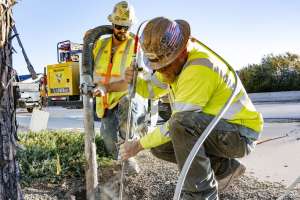
From left, David Botello, inspection technician; Brad Phillips, operations general superintendent; Rob Lankford, lead inspection tech; and Jesus Galvan, tech, on a job site in Kansas City, Kansas. (Photography by Denny Medley)


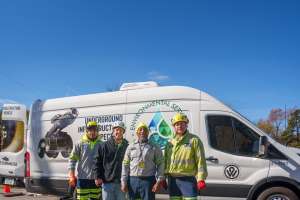
From left, David Botello, inspection technician; Brad Phillips, operations general superintendent; Rob Lankford, lead inspection tech; and Jesus Galvan, tech, on a job site in Kansas City, Kansas. (Photography by Denny Medley)
The Unified Government of Wyandotte County and Kansas City, Kansas, is under a 25-year, $1 billion consent decree with the Environmental Protection Agency to overhaul its sewer system. Even with yearly rate increases to fund consent decree requirements, money will be tight as inflation continues to impact the industry.
This is one of the reasons Kansas City, Kansas Environmental Services — rebranded from its former “Water Pollution Control” name to improve public perception — is doing everything it can to manage its assets responsibly, economically and efficiently.
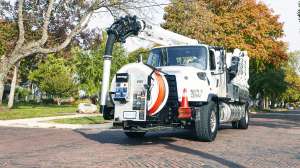
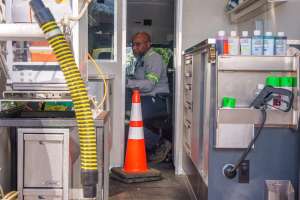
To meet its consent decree commitments, KCKES aims to inspect 40 miles of sewer pipes annually. Its three inspection vans are on the front line of these efforts. To stay on top of the workload, each van has a dedicated full-time operator. Their mission: to move KCKES from reactive maintenance to predictive and preventive maintenance so that issues don’t become costly emergencies).
The KCKES sewer system includes five treatment plants, 78 wastewater pump stations, nine flood control pump stations and approximately 40,000 manholes. The pipeline network consists of roughly 700 miles of wastewater pipe, 300 miles of combined sewer and 300 miles of storm sewer. KCKES’ infrastructure is old, with some lines dating back to the 1800s.
“The EPA consent order is about more than just separating sanitary from stormwater systems,” says Jeff Miles, the Unified Government’s Director of Environmental Services, a division of Public Works. “The consent decree touches on every aspect of this utility. This is why KCKES has adopted a professional and thorough asset management program that works hand in hand with our CCTV inspection system. We want to be able to analyze our pipes using an asset management program that allows us to invest every dollar in the most logical, cost-efficient way.”
That being said, a lot of the big-ticket items in the consent decree involve separating stormwater and sanitary lines throughout the older part of the community toward the east. “To achieve this, we have to take a systematic approach to pipe inspection, upgrades and replacement,” Miles says. “That’s where the Rovver X mobile camera systems come in.”
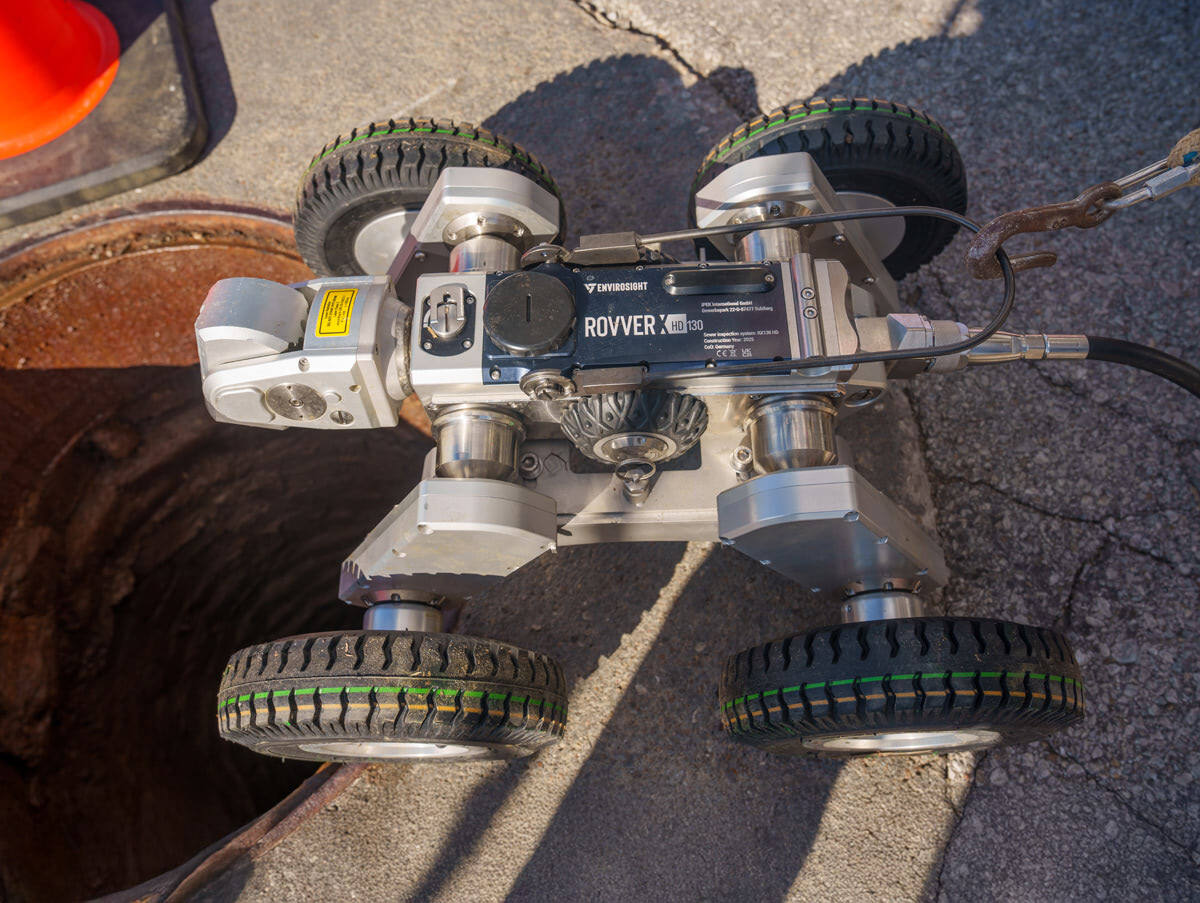
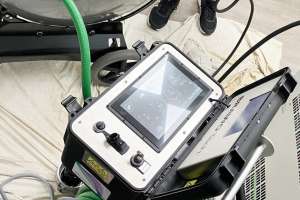
The Rovver X is a compact, cabled, self-propelled sewer inspection crawler that can navigate through sewers and storm drains with ease. Its arm-mounted SD/HD video camera allows personnel in KCKES’ inspection vehicles to view in real time and record footage for later analysis. Each Rovver X is equipped with internal pressure, temperature, incline and other sensors to keep operators informed of its operational status. The unit’s flexible design means that it can support precision measurements, sidescanning and laser profiling, which can be added in the future. The Rovver X can also be modified for various terrains using 12 sizes and treads of quick-change wheels and has access to accessories such as add-on lights and lifts.
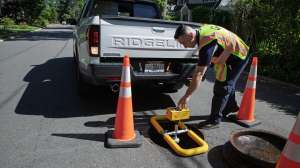
“The Envirosight Rovver X is very lightweight and easy to work with,” says Brad Phillips, the Unified Government’s operations general superintendent. Very rarely do you need two operators to lower a camera into a manhole or drop. The Rovver X’s ease of use and our team’s familiarity with the system motivated us to purchase this brand initially and continue with it during replacements. The quick-change wheels are a huge help and save time, as do the Rovver X’s onboard analytics provided through Envirosight’s inspection software, which simplifies and streamlines operations in the field.”
Deployment of KCKES’ three inspection vans follows a well-coordinated process. “On a typical day, we assign the work in the morning during a team meeting,” Phillips says. “Everyone is there: our three TV operators, our construction team of 15 to 20 individuals, and the 12 people on our collections team.”
Although sewers are the top priority, other jobs sometimes arise. “If we have the time, we’ll assign a TV crew to map a specific part of the watershed,” says Collection System Manager Kirk Roland. “They’ll go out and inspect all the lines in that area.”
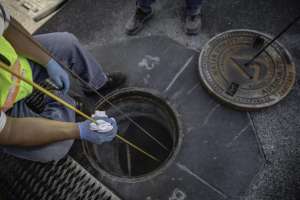
Other requests come in as well. “We often get calls from the police and fire departments when they’re investigating a crime,” Phillips says. “There have been countless times when we’ve been called after the fact — ‘Hey, we’re looking for a weapon or dumped evidence in catch basins or other underground cavities.’ It could be drugs, a weapon or a cellphone used in a crime that could help locate a suspect. Whatever it is, we’re always happy to help.”
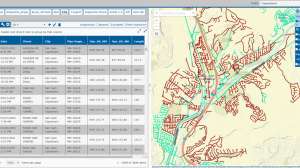
The collected inspection video is managed using WinCan software. This footage, along with observational data and identified defects, is then uploaded into Lucity (now CentralSquare Enterprise Asset Management) for assessment. “It has an algorithm that looks at those defects across the pipe and considers other factors such as the pipe’s age and material,” says Asset Manager Tanner Stark. “This allows us to assess ‘consequence of failure’ aspects, such as what type of roadway the pipe is under and how deep it is. Next, we calculate a risk score based on this data and enter it into our asset management software. This allows KCKES to prioritize all of our pipes and structures using these risk scores to plan repair and replacement schedules logically and cost-effectively.”
Footage from KCKES’ Rovver X crawlers is also used in its FOG program. This data is shared with the public to help educate local food truck operators and restaurants about the dangers of dumping fats, oils and grease into the sewer system — using graphic video evidence of clogged lines to drive the point home.
Moving to video technology has proven to be a wise investment for KCKES. “It’s made a huge impact on us in terms of saving money,” Phillips says. “There are major advantages to managing a utility based on data-driven decisions.”
The video collected by KCKES is also extremely useful as a reference source. “If a plumber calls and says, ‘I’m trying to reinstate this service or locate a customer’s service,’ we can check the TV footage we have on file and tell them, ‘Go 60 feet downstream from this manhole and you’ll find it,’” Phillips says. “If we need to patch a pipe, we can pull up the footage and tell our construction crews, ‘Install the patch 80 feet downstream from such-and-such manhole.’ We can complete the repair as a trenchless fix and save thousands of dollars compared to an excavation.”
The biggest shift for KCKES has been moving from reactive to proactive video inspections. “Years ago, we used video inspections as a reactive tool: there’s a clogged pipe, let’s send a camera down to see what’s wrong,” Miles says. “Today, video inspections are proactive: We use them in asset management to predict failures and fix them before they become expensive incidents that can cause backups or damage to other critical infrastructure — water, gas, fiber optics, streets, curbs and more. Imagine if the fire department could predict fires — they could prevent tremendous damage. That’s exactly what we’re doing: predicting the fires and saving ratepayers money.”
“As with any product, success depends on the quality of service and parts support behind it. Our local Envirosight authorized dealer, Key Equipment & Supply Co., has been an outstanding partner right here in our community. Their certified technicians provide exceptional service, and I can’t say enough about their service leader, Mike Lane. His knowledge, responsiveness and commitment to understanding our operation have been instrumental in our success with the Envirosight system. Mike consistently delivers quick turnarounds — often same-day repairs — which speaks volumes about his strong inventory management and technical expertise,” Miles says.
Given these impressive results, KCKES is replacing three older units with new, state-of-the-art inspection vans. The goal is to maintain a five-year replacement cycle to stay current with advancing technology and maximize resale value. And that falls in line with the overarching long-term goal of doing everything possible to enhance the city’s infrastructure management and operational efficiency.
Continue reading for free