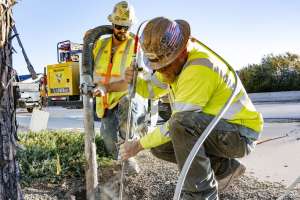
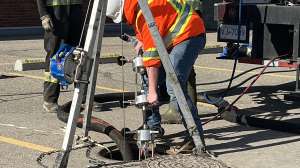
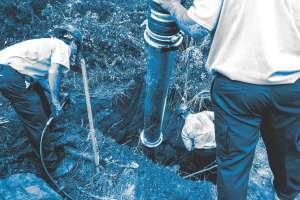
Mark Construction crew members Huck Johnson (left) and James Schave use a Vermeer LP573 XDT hydrovac trailer to spot check for utilities on a project near Grand Junction, Colorado.
Photography by Carl Scofield
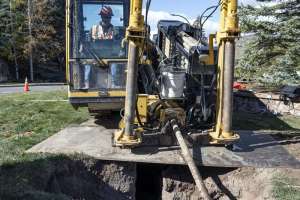
A Mark Construction crew utilizes a Vermeer D40X55 horizontal drill to excavate under a busy intersection and a creek to install a 2-inch gas line for a customer at a site in Avon, Colorado.
Mark Construction is a boring company — a horizontal directional drilling company, to be exact — but there is nothing boring about its record of performing quality work and experiencing steady growth. Now the Grand Junction, Colorado, company is looking to grow its volume of sewer and water customers.
“I would like to do more sewer and water utilities work, to be honest, and gas and electric,” says Mike D. Seriani, co-owner and general manager of Mark Construction. “The utilities are always going to be expanding as communities grow.”
Today, Mark Construction’s book of business shows that only about 10% of its projects involve drilling and pulling in lines for municipal water and sewer systems. Another 30% of its work is installing pipeline for natural gas and conduit for electric lines. It has an ongoing contract in Mesa County for installation of fiber optic lines for high-speed internet, with the Colorado Department of Transportation also regularly calling the company when the fiber lines intersect with highway right-of-way.
But utility work is where Seriani is looking to grow his company. To date, the contractor has worked with sewer and water departments in 15-20 communities in western Colorado, most of them with populations of 20,000 to 40,000. Mark Construction also has laid lines in Denver subdivisions, which is a whole other demographic. So, there is potential depth to the water and sewer market on the western slope of the Rocky Mountains and Seriani is plumbing it.
“Our sewer and water work is growing this year,” the general manager says. “We are doing more water projects than in the past.”
The underground industry estimates that buried infrastructure in the U.S. totals some 20 million miles. The trick for contractors like Mark Construction is to accomplish its underground work without chewing into any of that existing network.
When it was formed about 10 years ago, the company’s project manager — which primarily was Seriani — relied on usual detection methods to locate intersecting infrastructure. An 811 call was always made to inquire about what lay underground, followed by a walk along the path of the proposed bore using handheld utility locators and, finally, potholing with a hydrovac truck to confirm the presence of a buried impediment. The company also expanded the industry norm of staying at least 18 inches away from another piece of buried infrastructure, choosing to stay at least 24 inches away.
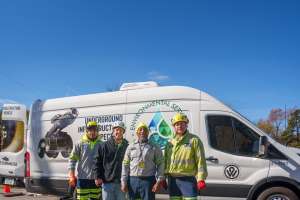
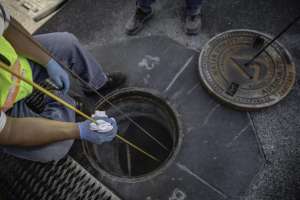
Yet all that dutiful caution sometimes failed and drill team crews would collide with undetected infrastructure. Beginning last December, Mark Construction opted for more certainty: It partnered with Sightline Solutions, a Grand Junction locating and inspection services company, to get a surer picture of what was in the ground.
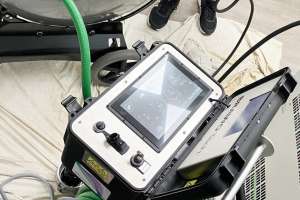
Working hand-in-glove with contractors, Sightline methodically locates any infrastructure in the path of a bore. Using RapidView IBAK CCTV cameras, Sightline inspects pipe systems to identify and report to property owners any preexisting damage to the infrastructure, then conducts post-construction work to document that nothing went awry during the new drilling. “The documentation work they submit to us is a huge benefit,” Seriani says. Sightline is certified by NASSCO for assessment of both mainline and lateral pipe systems.
“Sightline helps with all of our projects, locating lines before we can do any damage to them,” Seriani says. “Its work has caused damages to sewer costs to go down. By locating preexisting damage to infrastructure and informing homeowners about it in advance, its inspections have eliminated ‘situations’ for us. I think Sightline is better than any of the other locating companies.”
Mark Construction only offers CCTV inspection in conjunction with a bore. It doesn’t offer standalone inspection and doesn’t flush lines. A typical sewer and water project for Mark Construction is trenchless replacement of a service line running from a water meter or a sewer main to a house, scenarios where a property owner doesn’t want a driveway or landscaped lawn torn up just to replace an existing line.
Using a Vermeer D10X15 HDD unit, which is the smallest of the company’s eight Vermeer machines, a Mark Construction crew in one day can bore and run service lines to four or five houses on the same street.
For example, a project completed last September in Montrose, which is some 60 miles southeast of Grand Junction, involved replacing 25 1-inch service lines to homes, as well as placing 3,000 feet of 6-inch and 350 feet of 12-inch mains. Seriani also cites an earlier project in which 1,200 feet of 8-inch and 12-inch waterlines were pulled into place after boring paths for them.
In other words, the company’s sewer and water drilling projects vary in scope and intent. All are accomplished with critical foresight — or more precisely, Sightline sight — and all are powered by Vermeer directional drills. Besides the manufacturer’s reputation, the company has a dealership in Grand Junction. The smallest drill in the company’s fleet is the D10X15, with five tons of drilling and pulling force. The largest is a D60X90 with 30 tons of thrust. Mark Construction once employed the larger machine to pull in 3,200 feet of 18-inch waterline — the placement completed in two pulls.
The18-inch line is, in fact, the biggest the company has attempted. Another such project in a Denver subdivision involved placing 4,000 feet of 18-inch waterline.
Uncommon solutions
Customers determine what type of pipe is placed underground — plastic or steel. The choice has implications for the contractor. Since steel pipe weighs more, a larger HDD machine is required to place it. The differing manufacturing materials also produce pipe with more or less flexibility. That is, plastic pipe — typically, PVC C900 — has 5% to 10% flexibility, while steel pipe has just 2% flex.
“So, with steel pipe, you have to preplan your bores more carefully because you can’t turn as easily,” Seriani says. How about reinforced concrete pipe? “I’m sure that could be figured out, but no, we’ve never tried pulling that into place.”
Different types of soil put different stresses on a pulled pipe. The Colorado company well knows the difference, with about half of its jobs undertaken in favorable soils and the other half in river rock or shale. Also, joined shorter segments of PVC are more resistant to the stress of being pulled than is a continuous pipe, according to Seriani. The reinforced joints tend to strengthen the entire length.
Though Mark Construction has the earthmoving equipment to dig a trench and openly lay a line, it seldom resorts to it. “We nearly always figure out an underground solution,” says Seriani. “That’s our niche. We have even resorted to laying pipe inside an existing pipe. We’ve done it a couple of times.”
In October, the pipe-in-pipe solution was used again when the company agreed to insert a 1,400-foot-long storm drain in a buried pipe in Grand Junction. The HDD unit sent the working end of its cable into a 24-inch pipe and pulled a new 20-inch storm drain back through. “That’s pretty unusual. Most of the time, a pipe in the ground is damaged, and pulling in a line meets obstacles. It’s not a common solution.”
Finding uncommon solutions is a point of pride to the 33-year-old Seriani and his team. “We’re known for being efficient and overcoming obstacles. We have a great team that, together, makes it work.” The company usually has four or five drill teams concurrently working on projects somewhere on the Rockies’ western slope. While it doesn’t have specialized municipal sewer and water crews, the company maintains a designated project manager for all such work.
Mark Construction is the largest directional-drilling company on Colorado’s western slope and continues to grow. “Infrastructure is getting older,” says Seriani, acknowledging the ongoing potential of the market. “Our name and reputation have carried to where we are today as people continue to explore other options rather than just digging.”
This is true even though, in most instances, an HDD solution can be 5% to 10% more expensive than an open trenching solution, Seriani says. What offsets the slightly higher investment is the reality that a pipe buried trenchlessly is 100% more visually appealing than a pipe beneath a torn-up landscape.
For the first decade of the company’s history, the goal of Seriani and his partners was to keep improving the company’s performance in the field, to constantly monitor efficiency on the job and to cultivate its relationships with its customers. As it expands its business — including its municipal utility work — a satellite location to better serve different concentrations of customers is becoming a real possibility.
Seriani cites the partnership with Sightline Solutions as a harbinger of good things to come. “That increased our confidence that we can be safe in our drilling and not break things. I am excited to see where it all goes from here.”