Successful rehabilitation with smart light curing technology
Problem: A 4-inch drainline was consistently backing up under a vet clinic in Westminster, Maryland. It ran off of a toilet, had multiple tie-ins, then a hard 90-degree bend. The line was under several feet of concrete, so replacement was not an option.
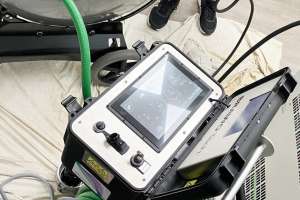
Solution: The owner of the clinic called Viper Plumbing, who was confident about installing a liner after having received on-site training on the BRAWO Magnavity sx. After Viper Plumbing shot the liner, they reinstated the three tie-ins and the line was back up and running.
Result: Without having to dig and with minimal downtime, the vet was able to maintain operations during the repair and now has a sewer line designed to last decades. 240-796-5007; www.brawosystems-usa.com

Hybrid PVC manhole system provides bypass-free rehab
Problem: Magna Water District in Salt Lake County, Utah, faced a challenge when a severely corroded 48-inch concrete manhole required rehabilitation in a location where bypass pumping was not feasible. A major highway separated the manhole from the next downstream structure, and setting up a bypass over, under or around the highway would have incurred prohibitive costs, increasing with the project’s duration.
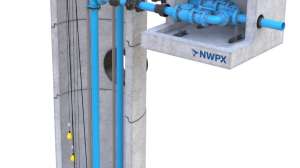
Solution: NWPX Geneva’s Hybrid PVC Manhole System provided a permanent, structural rehabilitation solution installable in a live sewer environment. The system consists of an FRP base liner, expandable pipe connectors, a PVC riser and an FRP-lined concrete flat lid. Using a 3D scan of the existing manhole, the base liner was custom-fabricated to precisely fit channel dimensions. System components stacked into place inside the existing structure with mastic creating a watertight seal between nested pieces and grout filling the annular space between the new components and original manhole. Installation follows a straightforward process that Magna Water District employees were able to self-perform in the field.
Result: The system gave the district a permanent structural rehabilitation solution with substantial cost savings. By enabling crews to work in a live sewer environment, it eliminated the need for bypass pumping, reducing expenses and streamlining installation. This approach addressed immediate corrosion concerns and ensured decades of maintenance-free service. 801-494-0092; www.nwpxgeneva.com

Coating protects valve against corrosion
Problem: During a routine test at an apartment complex on Las Vegas Boulevard, the local water district once again discovered corrosion on one of their backflow preventers. This site already had multiple replacement valves installed, but all were corroded due to the harsh water at this particular site. Further investigation conducted by Watts revealed the presence of microbial-induced corrosion at this site, which is known to cause rapid deterioration in products subjected to this condition. It was determined that the client was going to need a valve with protection that goes beyond standard coating.
Solution: The customer agreed to pilot a new backflow preventer treated with ArmorTek from Watts to address their challenge. ArmorTek is an advanced coating system made of an anti-corrosion primer, a microbial inhibitor to limit MIC and a protective epoxy-polyester topcoat all designed to control corrosion and protect the substrate layer of the valve. The iron valve is protected against corrosion due to a sacrificial element within the coating designed to corrode instead of the iron in the valve itself. Additionally, the antimicrobial agent protects the valve.
Result: Five years after installing the new valve treated with ArmorTek, there are still no signs of corrosion activity. The valve still looks brand new as compared to other similar devices not treated with ArmorTek. Additionally, periodic maintenance is much more feasible due to the cleanliness the ArmorTek coating provides. 978-688-1811; www.watts.com

Wastewater rehabilitation project a success with directional boring
Problem: Along the Indian River Lagoon adjacent to Vero Beach, Florida, officials were worried about excessive nutrient loads and pollution seeping from antiquated septic systems. Experts believed the failing onsite systems contributed to the environmental degradation of the lagoon, loss of seagrass habitat and unexplained deaths of manatees and dolphins. Unfortunately, affordable and low-impact technology eluded engineers and city officials. Their option for rehabilitating the wastewater treatment system — connecting to the city’s existing gravity sewer — was expensive and required digging up narrow residential streets, which would likely damage the neighborhood’s treasured live oak trees.
Solution: After investigating sewer system options, engineer Robert Bolton, director of water and sewer for Vero Beach, found that a liquid-only (effluent) sewer system, like Orenco Systems Prelos Sewer, was the most cost-effective and low-impact solution for the city. A liquid-only sewer treats solids in home septic tanks while sending liquids via narrow mainlines to a community-based treatment plant. The lower cost of a liquid-only sewer like Prelos is largely attributed to its use of directional boring, which allows small-diameter mainlines to be laid at a constant, shallow depth to follow the contour of the land. This less intrusive method reduces unfavorable construction impacts. Plus, compared to a gravity sewer that takes months to install, a liquid-only sewer system takes just weeks.
Result: In the end, 1,500 homes are expected to be connected to the city’s new Prelos Sewer, considerably improving water quality in the lagoon — ensuring happy dolphins, manatees and homeowners. 800-348-9843; www.orenco.com
Ranch conducts noninvasive water system assessment
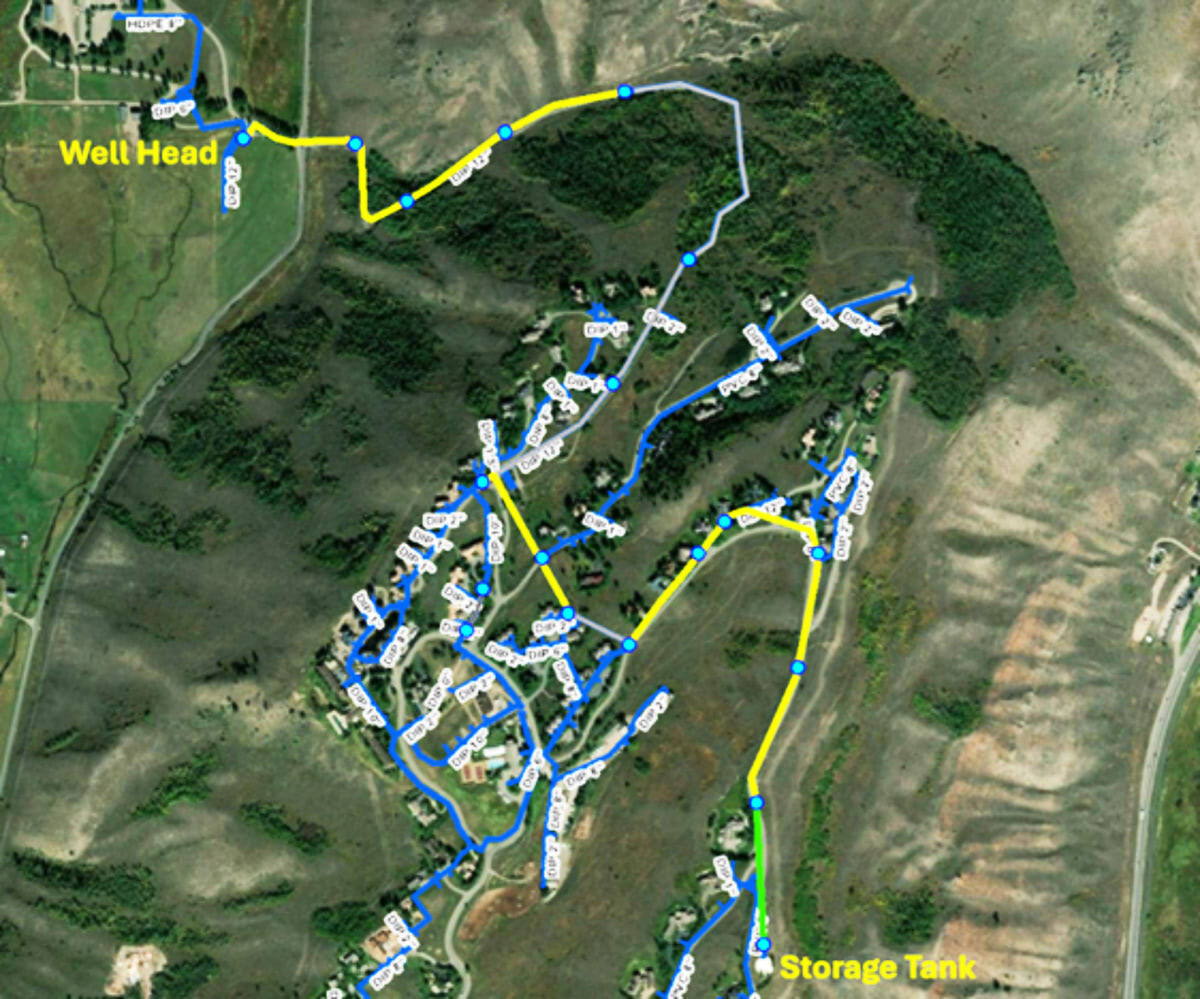
Problem: Spring Creek Ranch in Jackson, Wyoming, operates several miles of underground water pipes serving luxury lodges and residences. The resort needed to assess the condition of their 40-year-old, 12-inch ductile iron water mains without disrupting service to guests and residents to determine if and when pipe rehabilitation would be needed.
Solution: The resort partnered with Echologics to implement the ePulse noninvasive pipe condition assessment method across 1.7 miles of critical water infrastructure. This acoustic wave propagation technology measures remaining structural pipe wall thickness by analyzing how quickly sound travels through pipe segments. Technicians lightly tap on pipe appurtenances while acoustic sensors positioned at two points record the signals. The system calculates acoustic propagation velocity based on sensor spacing and time delays, then calculates average wall thickness between sensors. The technology combines acoustic data with pipe material properties including internal diameter and modulus of elasticity to determine current structural wall thickness. By comparing measured thickness to nominal specifications, the system identifies the percentage of wall thickness loss. This approach enabled comprehensive inspection of the primary water main from wellhead to the storage tank, spanning 1.5 miles and climbing 1,200 feet elevation, without pipeline dewatering, excavation or service interruptions.
Result: Testing revealed most pipe segments were in moderate condition with 10 to 30% wall thickness loss, while one segment remained in good condition at 9% loss. No leaks were detected, and the assessment was completed within two months without customer disruptions or external traffic control requirements. 470-378-7659; www.muellerwp.com
Inflatable pipe plug enables valve installation without water shutdown
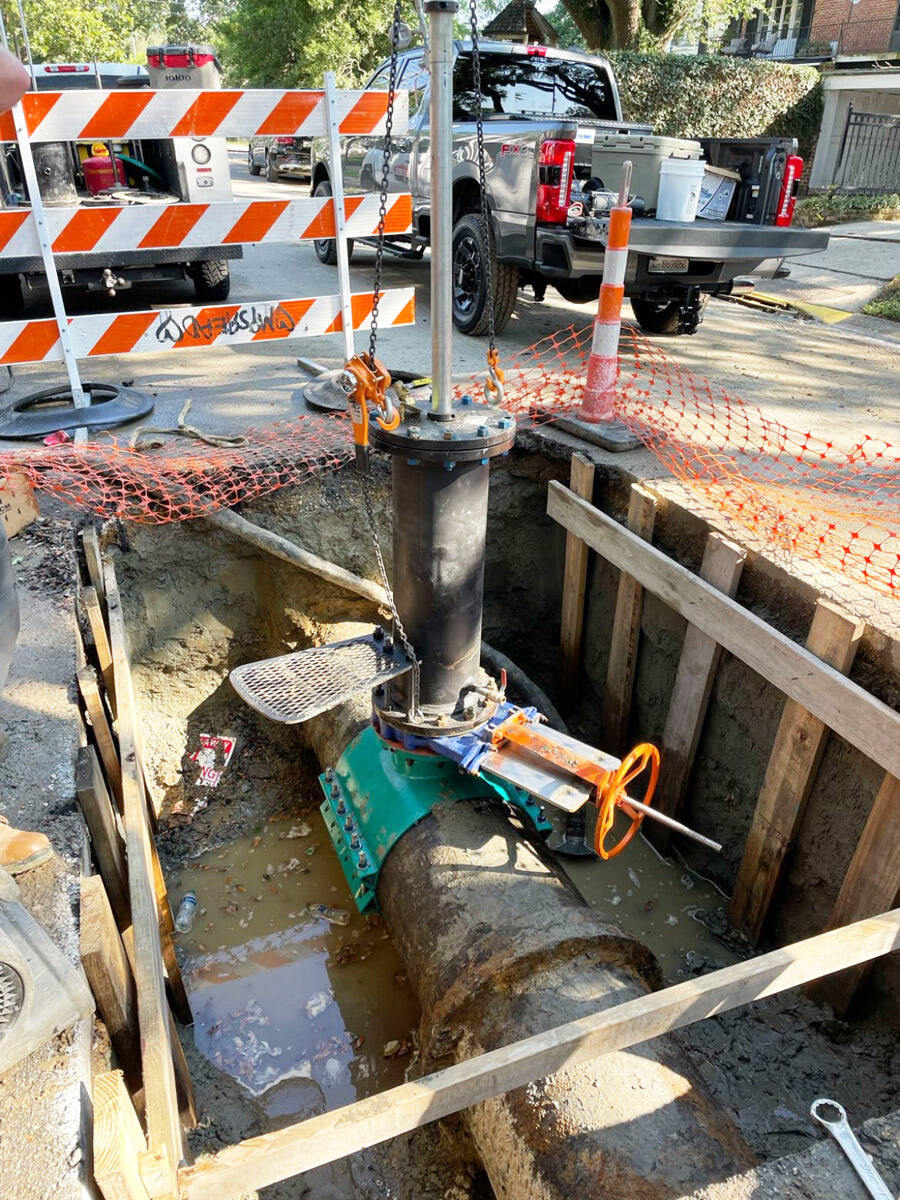
Problem: In 2023, a city in Louisiana faced the challenge of installing a valve on a 24-inch water main without interrupting the water supply. The line was under approximately 50 psi of pressure, and internal corrosion buildup made it difficult to achieve a reliable seal using standard mechanical pipe plugs.
Solution: To address this, a contractor enlisted Buckhorn Companies, which provided a custom-built PeteStop 129-Series inflatable line stop, precisely sized at 24.35 inches, from Petersen Products. A 12-inch hot tap was installed on the pressurized waterline, allowing the plug to be inserted and inflated to 100 psi. Despite the heavy internal buildup and irregularities within the pipe, the inflatable plug achieved an effective seal. These plugs are ideal for pipelines with corrosion, debris or irregular shapes, thanks to their ability to form a seal over a larger surface area. They can be customized for a wide range of pipe sizes, pressures, chemicals and temperature conditions.
Result: The valve was installed successfully and efficiently, with no need for a full system shutdown. The water supply remained active throughout the process. 800-827-5275; www.petersenproducts.com
Continue reading for free