As communities expand and infrastructure demands grow, ensuring the efficient movement of wastewater has become a vital aspect of urban planning.
A lift station is a crucial part of this system, designed to move wastewater, ultimately directing it to treatment facilities for processing.
For public entities, building a new lift station not only addresses immediate needs, but also supports long-term goals for sustainable growth and environmental stewardship.
New development
Municipal pumping jobs typically take one of three forms: wastewater pump stations, stormwater pump stations or potable water booster stations. Each of these water types utilize different types of equipment and different pump control philosophies.
In Kimberly, Idaho, the focus was on a wastewater lift station. The new Olsen Farms residential development needed a lift station to support 127 lots for single-family homes. Olsen Farms was a developer-driven, privately funded job.
As is often the case, the developer was responsible for constructing the lift station and all associated costs and then the lift station was to be turned over to the city of Kimberly for ownership after system commissioning.

Design phase
In providing the full design of a package pump station, the pump system engineer will either choose equipment based on preestablished standards/specifications or based on the site-specific application. In projects such as Olsen Farms, it’s important to value engineering the system as much as possible within the provided constraints and without compromising the life and functionality of the system.
For Olsen Farms, the local sewer agency (Kimberly, Idaho) wanted ABS pumps (Sulzer Pumps Solutions). Additionally, the city of Kimberly wanted a specific type of carbon filter on the vent, a Wager model 1800, as well as a Siemens 5100 W flowmeter system.
The city of Kimberly required an Idaho P.E. to stamp the plans.
Meeting needs
Romtec Utilities handled the design of the lift station in accordance with the Idaho Standards for Public Works Construction Standards.
The designs were submitted to the civil engineer on this project, Project Engineering Consultants, which then submitted it to the city of Kimberly for approval.
“I have been through this process a few times and I was able to outline the needs of the city and needs of staff prior to construction, which I believe streamlined the entire process to our benefit,” says Brian Reed, the city of Kimberly Engineer & Public Works director. “I assisted with the O&M manual development based upon state O&M manual requirements.”

Setting the standard
As developments continue with much of the higher-value land already built out, pump stations are going to become more and more critical for growing infrastructure.
With more developers coming in, having robust standards helps the city to reach consistency in their systems, allowing them to be easily maintained by their maintenance staff. The city needs to know that the process is thorough enough to get their point across, but not so overbearing that the developer is unable to get through the design review.
Creating these standards is a necessary part of growth and expansion. If the city wants to grow, infrastructure has to grow with it. Pumping systems are a natural part of this progression and part of this is the city owning the systems.

Mechanical design
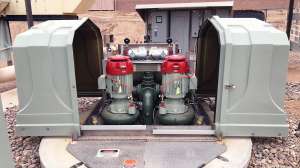
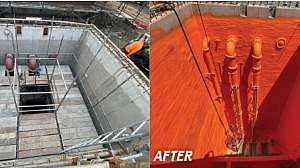
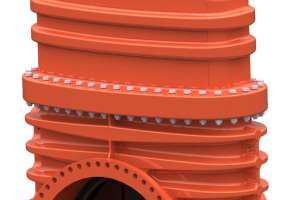
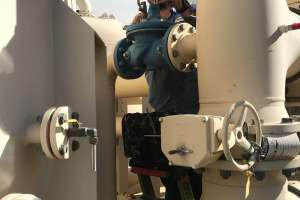
The Olsen Farms wastewater lift station includes duplex submersible Sulzer pumps, a Rockwell Automation MicroLogix 1400 PLC primary controller, pressure transducer, a precast 5106 valve vault, NEMA 3R painted steel enclosure and a 6-foot I.D. by 16.66-foot-deep wet well.
The duty point for the system is 113 gpm at 35.2 feet TDH.
The system utilizes a Generac 30 kW diesel backup generator.
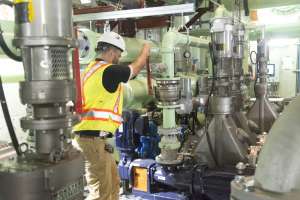
“I think Don [onsite installation adviser] and I and Romtec Utilities staff worked well together, and we are happy with the facility. We expect to have a trouble-free system for at least 10 years,” Reed says. “The training provided by Dan [Romtec Utilities technician] detailed basic and emergency operation, trouble shooting, typical fault problem resolution and safety.”

Expert advice
Reed says there are important considerations when a lift station is needed.
“If a lift station is required, make sure backup power is available and there are redundant pump and access components provided,” he says. “Sufficient alarm/fault hardware should also be provided so operators are aware of problems and failures immediately.”
Romtec Utilities provides a complete O&M manual for every project. This precisely detailed document can be used by the municipality to complete their pump station standards for all future projects. This will simplify the pumping system process of design in the future and result in a well-established wastewater system for the entire city. Treating each individual system as part of the overall system for the city is the best way to prepare for future growth and success.
Josh Gaunt is a content writer at Romtec Utilities.
Continue reading for free