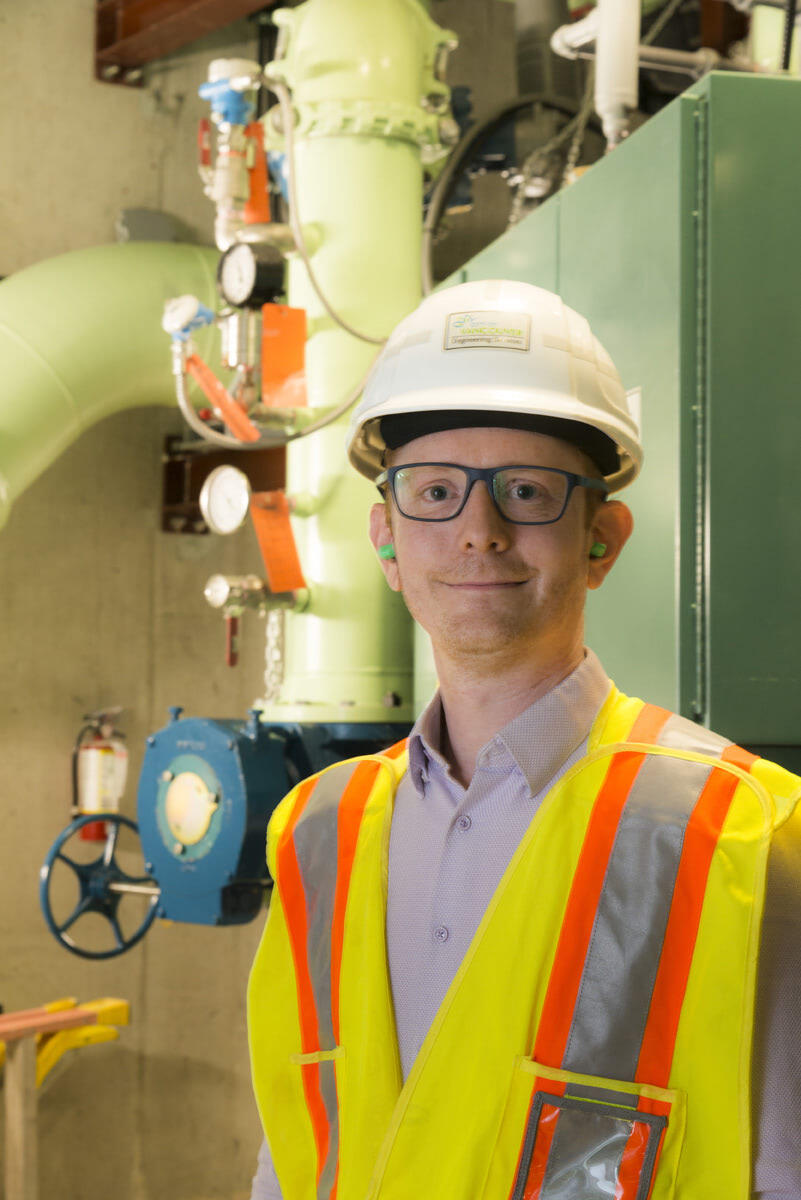
James Koscienlski, Vancouver Neighborhood Energy Utility operations manager, works in the utility’s False Creek Energy Centre.
Photography by Stuart McCall

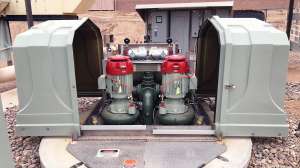
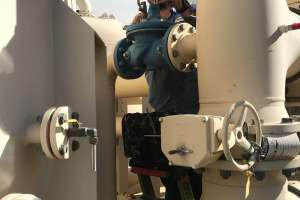
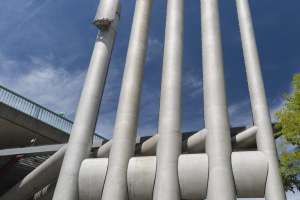
Exhaust stacks rise outside the Neighborhood Energy Utility plant.


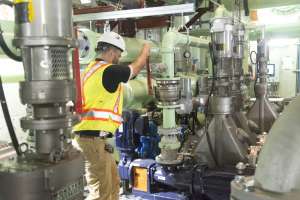
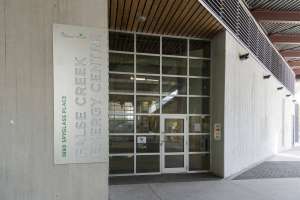
James Koscienlski, Vancouver Neighborhood Energy Utility operations manager, works in the utility’s False Creek Energy Centre.
Photography by Stuart McCall
Exhaust stacks rise outside the Neighborhood Energy Utility plant.
Whenever you have a shower, wash the dishes or flush the toilet, you’re literally wasting energy by sending warm water down the drain.
But in the city of Vancouver, British Columbia, they have been extracting warmth from wastewater for 15 years and using it to heat 6,210 apartments in the False Creek neighborhood.
“What we’ve been able to do is to effectively turn sewage into an energy resource for the community, enabling us to supply low-carbon heat to some of Vancouver’s most populated communities,” says Derek Pope, associate director at the city of Vancouver Neighborhood Energy Utility. The NEU manages a number of renewable energy sources in this jurisdiction.
“More than 50% of our city’s carbon emissions come from how we heat our buildings,” Pope says. “So that’s where this sewage heat recovery project fits in.”
Vancouver NEU’s target is for 70% of its energy supply to come from renewable energy sources. The utility is self-funded and has the dual goal of charging affordable rates to customers while generating a return on investment to taxpayers.
The genesis of the False Creek Energy Centre, which is responsible for this energy extraction process, can be traced back to the 2010 Winter Olympics in Vancouver. As part of that event, the Olympic Village was constructed in the False Creek neighborhood close to the Games. They were purpose-built to use energy extracted from sewage to heat rooms and potable water.
“The Olympic Village, whose nine buildings were being constructed to the same occupancy date, offered the perfect opportunity to demonstrate a concept such as this,” Pope says. “Since then we’ve expanded that underground thermal network from nine buildings to 47 buildings today.”
Willie Sutton was a 20th century American bank robber renowned for his nonviolence, good manners and success between stints in jail. According to fbi.gov, “When asked why he robbed banks, Sutton simply replied, ‘Because that’s where the money is.’”
Using similar logic, the False Creek Energy Centre (under the Cambie Bridge) has been integrated into an existing sewage pumping station. In this case, wastewater is where the free heat is.
Here’s how the heat extraction process works.
First, the incoming warm wastewater is filtered using a SHARC Energy screening system with the solid waste being sent back into the sanitary sewer system. Next, the screened wastewater is sent through a pipe that physically passes through a heat pump’s water piping system. As the sewage pipe passes through the piping system, its warmth is extracted by the heat pump. In turn, the heat pump’s compression system raises the water’s temperature. Finally, this heat is passed through a similar exchange to the water and heating systems of the buildings connected to this thermal network.
“Thanks to heat pump technology, wastewater that is about 68 degrees Fahrenheit can be used to create hot water up to 176 degrees,” Pope says. “And yes, it does require electricity to make this process work. But such is the efficiency of this heat recovery system, that for every unit of electricity that we put in to run the heat pump, we get over three units of the thermal energy or heat out of it.”
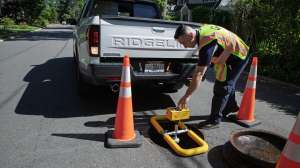
The best part: This heat extraction process works even during the coldest winter weather in Vancouver. That’s because it depends on the warmth of the wastewater being sent down the drain indoors, which doesn’t change no matter how frigid it is outdoors. “You can actually get a glimpse of this fact in action after a snowfall where you’ll see the access chambers to the sewer system being the first things to melt on the roadway,” Pope says.
Worth noting: The False Creek Energy Centre’s original Trane heat exchanger has been supplemented by two Johnson Controls heat pumps. This has boosted the Energy Centre wastewater heat recovery capacity from 3.2 MW to 9.8 MW.
In the winter months, this trio of heat pumps extract up to 9 degrees Fahrenheit of usable heat from sewage. In summer, the process reverses, with the heat pumps imparting up to 9 degrees Fahrenheit of warmth extracted from the buildings into the wastewater. This excess heat is then dissipated underground as the sewage travels to Vancouver’s wastewater treatment plant.
The False Creek Energy Centre has been harvesting heat from sewer water for 15 years. During that time, the process has proven to be highly reliable, predictable and effective. “It’s a highly efficient source of low-carbon energy,” says Pope. “What’s most exciting about it is just the high efficiency that it operates at: Again, for every one unit of electricity that you put in to run the heat pump, you get over three units of thermal energy out.”
Over the years, this project has won awards from organizations such as the United Nations, the American Society of Heating & Refrigeration and Air-Conditioning Engineers, and the Federation of Canadian Municipalities, among others. This is because heat extraction from urban wastewater works. It’s a free source of energy that most jurisdictions are wasting — but not Vancouver.
Not surprisingly, the success of the False Creek heat extraction project is inspiring similar projects in this city. “There’s new sewage heat recovery systems being developed in other parts of Vancouver, Surrey, Richmond and North Vancouver, in British Columbia,” Pope says. “We’re also seeing plans by Metro Vancouver, our regional body, to identify waste heat opportunities such as sewage heat resources that would further aid in the adoption of these systems.
“When we constructed this sewage heat recovery plant in 2010, the technology did not exist in North America. As a result, Vancouver has really helped legitimize sewage as an energy resource. It’s a renewable resource that is available for all jurisdictions to harvest, no matter how big or small they are.”
Continue reading for free