Manhole inspection best practices start with one idea: a manhole is the most accessible, information-rich asset in your collections system, and a defensible program treats every structure as capital-planning evidence, not a checkbox. Done well, manhole inspection catches the structural failures that cause sinkholes and the infiltration paths that drive sanitary sewer overflows before they surface elsewhere. Done poorly, the data sits on flash drives and in binders and the next overflow finds you first.
Getting it right comes down to a handful of fundamentals: what a manhole inspection assesses, the two inspection levels, how condition is graded, and what separates a mature program from a reactive one, all anchored to NASSCO MACP standards.
What does a manhole inspection actually assess?
A manhole inspection scores six components against a standardized code set. The governing standard is NASSCO's MACP, the Manhole Assessment and Certification Program, which shares the defect-scoring logic of the Pipeline Assessment and Certification Program, or PACP, that crews use for CCTV pipe condition coding.
MACP scores these six components on every structure:
- Cover and frame for inflow control and seal integrity
- Chimney, the frame-to-cone transition in brick, block, precast, HDPE or adjustment rings
- Cone, the tapered chimney-to-wall section, concentric, eccentric or flat-top
- Wall, from cone base to bench, in brick, precast or cast-in-place concrete
- Pipe connections: material, shape, diameter, direction, condition and seal
- Bench and channel for flow control at the base
Chimney and channel dominate operations-and-maintenance findings, while structural risk concentrates in the cone and wall, where collapse and sinkhole potential lives. Defects sort into four families and link to different initiatives for a municipality. Structural defects such as cracks, fractures, holes, deformation, and joint defects drive capital projects. O&M defects like roots, deposits, infiltration and inflow, obstructions, and surcharge drive crew schedules and maintenance activities. Construction defects covering connections, sealing rings, and lining are logged for reference, and a miscellaneous family adds context.
MACP Level 1 vs Level 2 inspections: Which do you need?
Use Level 1 inspection standards for rapid triage across a large inventory and Level 2 for design-grade evidence on flagged assets. The two levels are complementary, not competing, and the best programs run both.
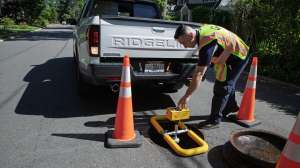
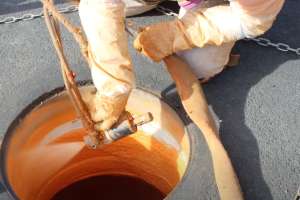
Level 1 is rapid condition screening: the cover is removed and observations are made from ground level with no entry and minimal gear. Plan for roughly 10 to 15 minutes per structure, and a leading crew can clear 40-plus assets per day. Level 1 populates the MACP Header section, which has 17 mandatory fields and no measurements, ideal for deciding what deserves a closer look.
Level 2 is comprehensive and produces measurable, rehab-grade data. It runs either remotely, using camera-based descent with no entry, or as manned entry under confined-space protocol. Plan for 25-plus minutes per structure inspection and roughly 10 to 14 assets per day. Level 2 populates the Component Observation section, which carries 35 mandatory fields with measurements, along with Component Details, where defects are logged by depth, affected component, and circumferential location. A hybrid L1+ approach lands around 15 to 20 structures inspected per day.
Five capture methods each trade detail against effort:
- Surface, or ground-level: cover removed, observations from ground level; visual notes only, no measurable defects
- Zoom camera: mounted on a telescopic mast; HD video with limited measurement
- 360 camera: measurable detail with virtual-tour playback
- 3D scanner: a millimeter-level point cloud, design-grade evidence
- Manned entry: tactile inspection plus photos, requires confined-space entry
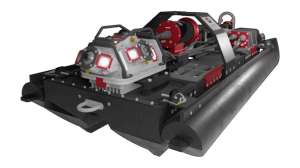
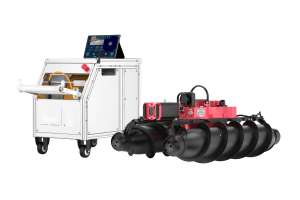
Leading programs blend two or three of these methods, running broad Level 1 surface coverage and steering selective Level 2 capture at higher-risk assets. Named field systems include the industry-leading IBAK Panoramo SI, a cost-effective 360 unit such as a GoPro paired with a visible measuring device, and systems like the RinnoVision RV-MAX 360.
How is manhole condition graded?
MACP grades each defect on a 1-to-5 severity scale, scored separately for structural and O&M so rehabilitation and maintenance can be prioritized independently. Grade 1 is minimal and Grade 2 is minor, calling for monitoring or routine handling. Grade 3 is moderate and signals that rehab should be planned, Grade 4 is significant and points to near-term rehab, and Grade 5 is critical, a collapse risk that demands immediate action.

Worked example for a manhole with one Grade 5 hole in the cone, two Grade 4 wall cracks, and one Grade 2 chimney joint:
- QSR: 5,1-4,2, meaning one Grade 5 defect and two Grade 4 defects
- OMR: 5 + 4 + 4 + 2 = 15
- MRI: 15 ÷ 4 = 3.75
That single record now ranks against every other structure in the system.
What does a best-practice manhole program look like?
A best-practice program inspects 20% to 25% of total manhole inventory each year with dedicated crews, turning the full system every four to five years so condition data stays current enough for defensible capital planning. Cadence is the foundation. Four practices separate mature programs from reactive ones.
- Blend inspection methods. Use broad Level 1 coverage for triage and selective Level 2 capture on flagged assets. It is unlikely you cannot afford 3D scans on everything, and you do not need them.
- Standardize the coding. Consistent MACP coding, verified by NASSCO-certified reviewers, is what makes one crew’s data comparable to another’s and what makes ratings hold up in front of a council or a regulator.
- Score structural and O&M separately. Feed the structural stream to capital planning and the O&M stream to crew schedules. They move on different clocks.
- Integrate the data. Value collapses when inspections stay siloed in static PDFs or a contractor database instead of flowing into GIS and asset management.
Program maturity runs from reactivity, where crews inspect based on forced compliance and data lives in binders, to systematic, operating on an annual MACP cycle with standardized coding, to predictive, where condition data feeds risk models that weigh likelihood against consequence of failure, in line with EPA asset-management guidance. One inspection record pays off six ways: rehab prioritization, I&I source identification, a searchable archive, risk-based asset management, baseline benchmarking, and capital improvement planning.
How does software tie manhole field data to capital decisions?
Inspection software closes the gap between the field crew and the capital plan by capturing MACP data once and moving it, coded and verified, into GIS and asset management. That handoff is where most municipal programs leak value.
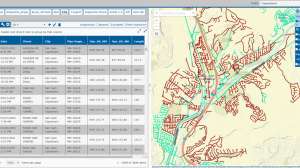
Using the Manhole Module within ITpipes SmartVision, supports MACP Level 1 and Level 2 and works online and offline with real-time defect coding and sync. Crews search manholes by ID or create new assets on the Esri map via GPS, and configurable presets saves coding time for common observations. It integrates with the field camera systems crews use for manhole inspection, including high-resolution Panoramo SI scanners, and brings that imagery into office review as both traditional and unfolded flat-panel views. Reviewers filter, sort and group by asset type, condition or date, compare multiple inspections over time, and condition coding is seamlessly delivered directly into asset management systems, no import or export required. AI-assisted coding through ITpipes AiDetect applies to manhole work too, cutting coding and QA review time by at least 50% at 97% detection accuracy, with every inspection verified by NASSCO-certified experts.
The programs that hold up before a council or a regulator share one trait: an unbroken, defensible path from the field to the capital plan. That is what a strong software solution delivers, capturing MACP condition in the field with FieldVision and carrying it into office review and QA with CoreVision, together as the SmartVision solution. The result is OMR-sorted condition data that reaches asset management as a capital plan you can stand behind, not a stack of PDFs to reconcile.
Ready to build a defensible program?
It all comes down to one through line: a defensible manhole program turns consistent MACP field data into capital decisions that trace back to evidence, so every rehabilitation dollar can be defended in front of Council or a regulator.
Keep the ITpipes Manhole Inspection Best Practices Guide close as you plan and run future inspections. Its framework, field checklists, and rating worksheets are built to be a lasting reference for scoping each new cycle, not a one-time read.
When you want a second set of eyes on your current manhole inspection workflow or help mapping what comes next, speak with an ITpipes expert about running an MACP-aligned program end to end.