Every foot of sewer CCTV footage has to be watched and coded before it is useful to anyone. Someone sits with the video, pauses at each crack, joint and root intrusion, and enters a PACP code, a distance and a severity. On most teams, that someone is an operator who should be collecting inspections or an experienced staff member who should be planning rehabilitation.
AI defect coding changes who does that first pass. For most agencies the technology is still new, so it is important to understand what AI can do to support inspection coding, where the value shows up for wastewater agencies and contractors, and the two ways ITpipes' AiDetect can support your inspection workflow regardless of what inspection software you currently run.
Why coding has become the bottleneck
The math works against manual coding. A coder reviews roughly 1 mile of footage per day, so a 1,200-mile collections system needs about 1,200 coder-days just to look at the network once. Uncoded video piles up while inspection cycles stretch into years.
The workforce is moving the wrong way. The American Water Works Association estimates that one-third of water utility workers could retire within the next decade. Each new operator brings a learning curve, and coding quality varies from crew to crew until the new hire catches up.
Inconsistency carries its own cost. Two trained coders can watch the same video and record different codes. Across thousands of segments, that makes condition data hard to compare and harder to defend. Supervisors spend time on QA and rework, and capital decisions rest on records that depend on who was on the truck that day.
Meanwhile the network keeps aging. ASCE puts the average age of US public sewer pipe at about 45 years across roughly 800,000 miles of mains, and the EPA estimates 23,000 to 75,000 sanitary sewer overflows each year. Agencies need more condition data, sooner, from teams that are getting smaller.
What AI defect coding does to an inspection
AI defect coding reviews inspection video and records observations the way a trained coder would. Every defect gets a PACP code, a distance and a severity. The same footage gets the same codes on every run, whichever operator collected it and however much coding experience that operator has.
AiDetect's model is trained on 15 years of underground inspection data from systems across North America, covering a wide range of pipe materials, ground conditions and defect types.
Human judgment stays in the workflow at two points. NASSCO-certified reviewers at ITpipes check the observations the AI flags as low confidence before results are released. Then the agency's own team can review the coded results against the video from their AiDetect dashboard and make the final decision on what gets imported into its system of record.
That matters for anyone who has to stand behind the data. AI earns its place in a sewer inspection workflow only when your team can see what it found, check it against the video, and defend the result in front of a regulator, an engineer or a city council. Your team keeps the final say.
Where the value shows up for each role in the department
Public works directors
Directors carry the backlog, the budget and the conversation with the council. AI defect coding lets the agency code more of the footage it already collects without adding coders or buying new camera hardware or even inspection software. Experienced staff move from frame-by-frame coding to maintenance, rehabilitation and planning. Condition data coded the same way across the whole system is also easier to defend when a regulator or council member asks how a project was prioritized.
Collections system supervisors
Supervisors live with turnover. With AI handling the coding, newer operators do not need years of coding experience to produce consistent data. Crews spend the shift collecting inspections instead of stopping to code in the truck, and coding quality holds steady as operators rotate. The inspection backlog stops growing.
City engineers
Rehab design and capital projects wait on current condition data, and the uncoded backlog often sits on the critical path. AI coding clears that backlog without pulling a small engineering staff off planning and design. Engineers will reasonably ask how accuracy is measured. The useful answer covers precision (how many AI flags are real defects), recall (how many real defects the AI found) and what the human review step checks.
CCTV contractors serving the agency
Contractors bid inspection work on thin margins, and coding hours come straight out of them. AI coding lets a contractor deliver more footage without adding coders and hand the agency consistent results as a NASSCO PACP exchange database that can be imported into its current inspection software.
Two ways to put AiDetect to work
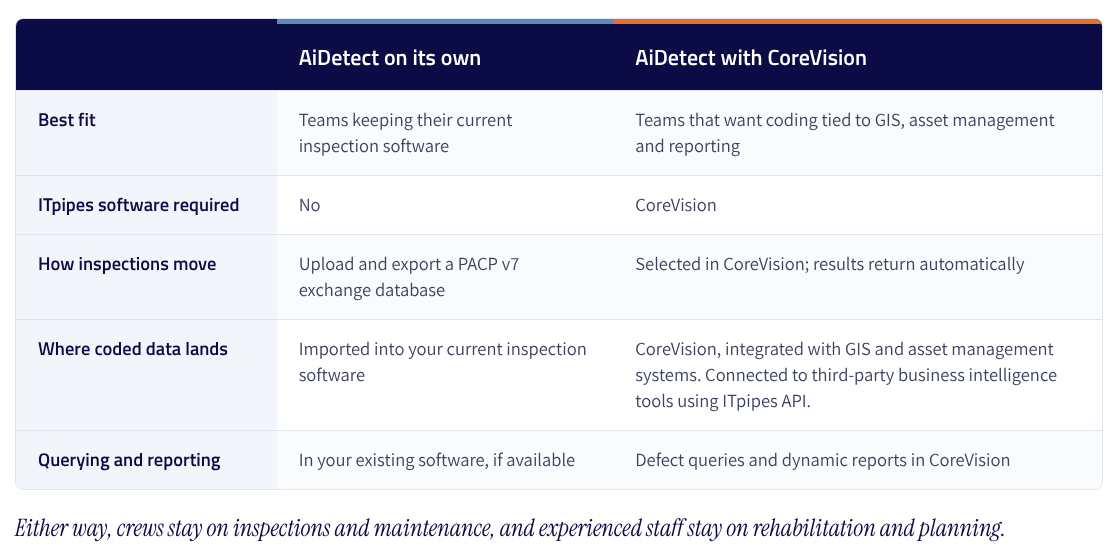
AiDetect delivers the same AI defect coding and the same expert review either way. What differs is how it fits the systems an agency or contractor already runs.
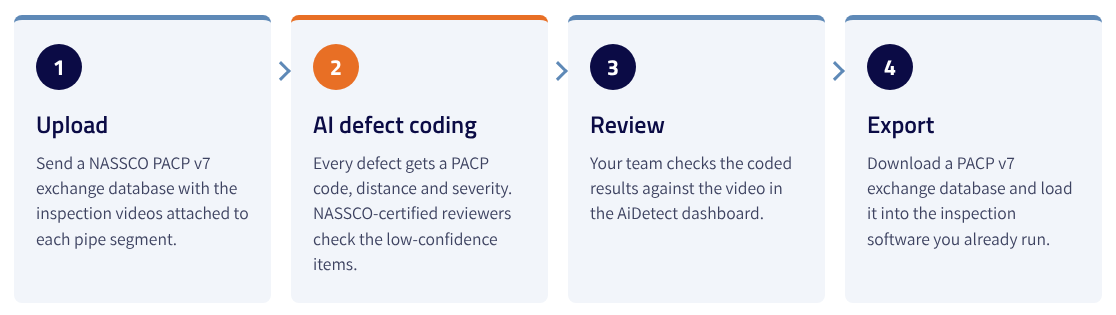
AiDetect on its own: Keep your current inspection software
This option is for agencies and contractors who want to keep their current inspection software (not ITpipes) and want repetitive coding off their team without changing their setup.
AiDetect with ITpipes CoreVision: A complete field-to-office workflow
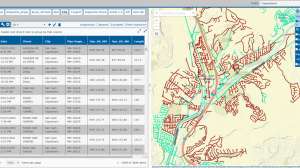
This option is for agencies that want coded results connected to the rest of their asset data. Teams select inspections inside CoreVision to send to AiDetect, and coded results come back into CoreVision with no import or export step. From there, results connect to GIS, asset management and business intelligence tools, and staff can query defect data and build dynamic reports for planning and decision-making.
Where to start
For agencies new to AI, the clearest first step is a conversation about your own inspection program: how much footage sits uncoded, who codes it today, and which software your team runs. That answer usually points to the right option.
Learn more at itpipes.com/aidetect/ai-sewer-inspection. Our AI solutions specialists are ready to answer any questions you have. Spend a few minutes to learn about how AiDetect can save your team days in coding time.