The city of Toronto has nearly completed the first phase of a massive, roughly $2.2 billion project designed to eliminate frequent combined sewer overflows into the Don River, the city’s inner harbor and a local creek that flows into the river.
The centerpiece of the sprawling, six-phase project, which is expected to be completed around 2037, is a network of three interconnected, concrete-lined deep tunnels — roughly 13½ miles long in total — that will hold CSOs until there’s sufficient treatment capacity available. The project also includes 12 wet-weather flow storage shafts that connect to the tunnels and seven offline storage tanks with a collective capacity of about 6.3 million gallons, explains Lou Di Gironimo, general manager of Toronto Water.
Toronto Water is a city department that manages stormwater, wastewater and drinking water facilities and infrastructure.
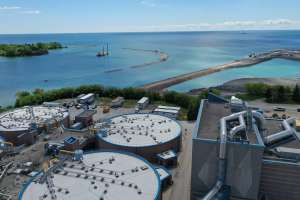
The other primary project components include a new high-rate wastewater treatment facility, which will be built just south of the Ashbridges Bay Treatment Plant, the largest of the city’s four wastewater treatment plants and the second-largest such facility in Canada. The facility will treat only CSOs collected in the deep tunnels during heavy rain events.
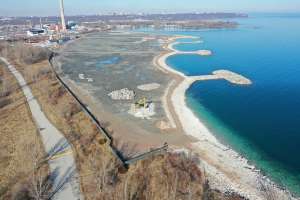
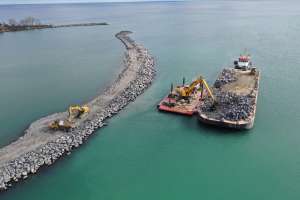
In conjunction with that, a new larger-capacity outfall currently is under construction; it will improve dispersal of treated and disinfected effluent from the Ashbridges Bay plant into Lake Ontario. The effluent will flow by gravity through a roughly 2-mile-long, approximately 23-foot-diameter concrete-lined outfall tunnel bored nearly 280 feet below ground level. From there, effluent will be dispersed into the lake via 50 roughly 3-foot-diameter riser pipes connected to the tunnel, Di Gironimo says.
“These projects represent the largest and most significant stormwater management program in the city’s history,” Di Gironimo says. “This program will greatly improve the water quality in the lower Don River, Taylor-Massey Creek and along Toronto’s inner harbor by keeping combined sewer overflows out of our waterways through upgraded technology and more capacity to capture, transport and treat it.”
In addition, the city also will replace a chlorine treatment system in the Ashbridges Bay plant with an advanced ultraviolet-light technology that’s more energy efficient and requires less space than conventional ultraviolet equipment.
The project also will include replacing an existing pumping station at the Ashbridges plant. The new station will transfer wet-weather flows from the tunnels into the high-rate treatment plant. The city also will install a real-time control system to optimize the available storage in existing sewers.
The project began in 2018 after more than a decade of planning. But its origins date back to 1987, when the International Joint Commission, a binational organization established by the United States and Canada under the Boundary Waters Treaty of 1909, identified Toronto’s waterfront as one of 43 so-called “areas of concern” in the Great Lakes basin.
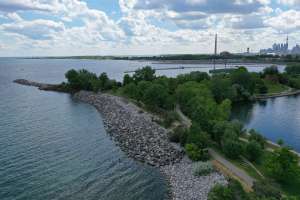
The concerns stemmed from poor water quality and sediment conditions in the Don River, which meanders through the city and empties into its inner harbor. Poor water quality is of particular concern because Lake Ontario is the city’s primary source of drinking water, as well as a popular recreation center for boating, swimming, fishing and so forth.
To understand the scope of the problem, consider that there are 50 CSO outfalls along the Don River and the city’s central waterfront. On average, these outfalls dump a mixture of polluted stormwater and untreated sewage 42 times during a typical wet-weather season, which runs from April to October.
The result? Approximately 350 million gallons of combined stormwater and untreated sewage have spilled into the river and harbor every year.
“CSO discharges contain harmful bacteria, pathogens, heavy metals, oils and pesticides, as well as nutrients like phosphorus and nitrogen that cause excessive algae growth and degrade the health of the city’s waterways,” Di Gironimo explains.
In 2003, the city adopted a Wet Weather Flow Master Plan that proposed the currently ongoing series of projects aimed at improving water quality and ecosystem health in all six watersheds across Toronto, as well as along the waterfront. The plan is considered the most comprehensive program of its kind in Canada, city officials say.
Aside from improving water quality, key objectives include protecting vulnerable city sewer and water infrastructure from the impacts of erosion and reducing the risk of flooding caused by extreme wet weather, Di Gironimo says.
Improving stormwater management in Toronto is a challenge because, like so many large and older cities, parts of its sewer system date back to the 1800s. As such, they were designed to old standards and did not consider pollution impacts from wet weather or flooding impacts from extreme storms when constructed.
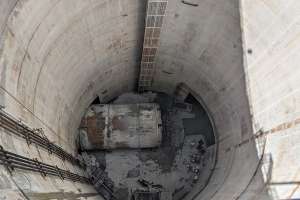
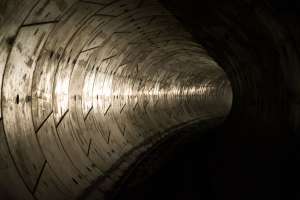
But the deep tunnels and storage shafts will dramatically improve the CSO situation. The first tunnel, known as the Coxwell Bypass Tunnel, is about 164 feet deep, around 6½ miles long and roughly 20½ feet in diameter. Its capacity is approximately 105.7 million gallons – about equal to the water in 214 Olympic-size swimming pools, Di Gironimo says.
The tunnel bore was completed in July 2022. It was performed by North Tunnel Contractors, a joint venture between Jay Dee Contractors, C&M McNally Tunnel Constructors and Michels Corp.
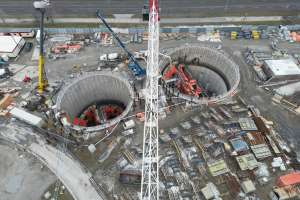
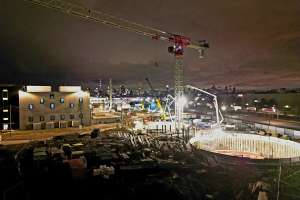
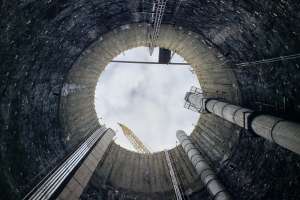
Five shafts, roughly 164 feet deep and 65 to 72 feet in diameter, will eventually connect to the Coxwell tunnel. Each concrete-lined shaft is capable of holding about 46 million gallons of combined sewage.
As its name implies, the Coxwell bypass tunnel also provides another benefit: It will allow Toronto Water to divert sewage flow from the Coxwell sanitary trunk sewer, which is the city’s most critical trunk sewer, servicing about a third of Toronto’s population. Prior to this, the city couldn’t reroute sewage flows in the event of an emergency, such as a structural failure, or to perform periodic maintenance, Di Gironimo says.
The second tunnel, known as the Inner Harbour West Tunnel, is currently in the design phase. It will be about 164 feet deep, 3.4 miles long and roughly 20 1/2 feet in diameter. Eight dropshafts, ranging from 20 to 35 feet in diameter, will connect nine existing combined sewers to the tunnel, which will provide about 46 million gallons of storage capacity, Di Gironimo says.
Two additional large-diameter storage shafts, one at each end of the tunnel, will provide an additional 9 million gallons of storage capacity.
The third tunnel, known as the Taylor-Massey Creek Tunnel, won’t be finished until around 2037. The tunnel will be 70 to 200 feet deep, around 3.7 miles long and nearly 15 feet in diameter. The tunnel and some accompanying storage shafts will provide about 25 million gallons of storage capacity.
Collectively, the three tunnels and their respective storage shafts will hold approximately 186 million gallons of wet-weather flow — roughly equal to 380 Olympic-size swimming pools, Di Gironimo notes.
Several components of the project are largely completed. As of last January, both the new UV treatment system in the Ashbridges Bay plant and the Coxwell bypass tunnel were about 90% completed and the Ashbridges Bay outfall was nearly 88% finished. And three of the five storage shafts that will connect to the Coxwell tunnel are expected to be completed during 2024, Di Gironimo says.
The project has already encountered many challenges, including disruptions from the pandemic, supply chain disruptions that affected material costs and availability and a limited pool of specialized laborers. In addition, inflation is escalating the cost of the project, Di Gironimo says.
As such, the cost of the project likely will continue to rise and the completion timelines likely will need to be adjusted. But in the end, officials believe the results will be well worth the wait.
The Ontario Ministry of Environment, Conservation and Parks, which regulates wastewater treatment and discharge requirements, requires 90% of the volume from wet-weather flows to be captured and treated. But when the project is completed, Toronto Water officials expect to virtually eliminate CSOs — they predict just one a year — and capture and treat 97% of wet-weather flows.
In addition to improving water quality, the project will improve aquatic habitat for fish and other wildlife; reduce nutrient levels that cause excessive algae growth; and support revitalization efforts along the city’s central waterfront, Di Gironimo says.
“As Toronto continues to grow, creating an acute focus on housing and building density, this project also is essential to building enough sewer-system capacity to accommodate population growth,” he says. “This is a transformative project that will provide environmental and social returns as well as spur development of new, vibrant and healthy waterfront communities at the mouth of the Don River.”
Continue reading for free