Like many older cities, Baltimore, Maryland, faces significant challenges in maintaining and improving its sewer and water infrastructure. However, the Baltimore City Department of Public Works continues an assertive program to ensure that critical projects, such as improvements to the sanitary sewer system along Chinquapin Run, are completed efficiently, affordably and equitably on behalf of residents.
The DPW is responsible for the city’s water, wastewater and stormwater systems, and solid waste collection. It also provides water and wastewater services to surrounding Baltimore County.
The city is working to complete projects under a consent decree established by the U.S. Environmental Protection Agency in 2002 to eliminate sanitary sewer overflows. That consent decree was modified in 2017, setting a deadline for all major capital projects to be completed by December 31, 2030. The Chinquapin Run project was one of the capital projects designed to move the city closer to that goal.
The average age of the system’s conveyances ranges from about 75 years for water pipes, 74 for stormwater and 87 for wastewater.
“All three are aging systems,” says Paul Sayan, the acting head of Baltimore’s Bureau of Water and Wastewater. “But with the work we’ve been doing, they’re still reliable. These systems require constant maintenance, and we’re always mindful of the need for a constant influx of new talent to maintain them.”
The city replaces 15 miles or more of its water pipe system each year and pursues an ambitious program of rehabilitation, cleaning, inspection and upsizing its wastewater infrastructure. Baltimore’s stormwater system is also a priority as the city works to address SSOs cost efficiently.
While the population of the city of Baltimore has declined in recent years, the increase in the population of surrounding Baltimore County has more than made up for it, requiring the city to ensure that its infrastructure can handle the increased demand.
“It’s a balancing act to ensure capacity for the entire county while completing infrastructure improvements here in the city,” Sayan says.
Under the original consent decree, the city was divided into eight sewersheds, each of which required a distinct plan to reduce SSOs. The Chinquapin Run project is one such improvement, designed to reduce SSOs within the 25-square-mile Herring Run Sewershed, while restoring the urban environment.
STABILIZING FLOW
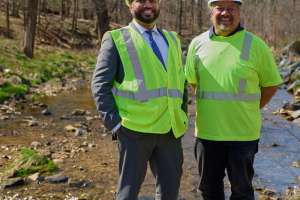
Chinquapin Run is one of the largest municipal urban stream restoration projects in Maryland. It takes its name from a stream located in north-central Baltimore, which follows tributaries and storm drain outfalls that flow through private property, public parks and a college campus before joining Herring Run. The area has experienced significant SSOs associated with inflow and infiltration and basement flooding during high peak rainfalls.
“The project involved upsizing, rehabilitation and relocation of sewer pipe located within and along the low points of Chinquapin Run Stream,” says Mohammed Rahman, who shepherded the project as director of special projects with the city of Baltimore, before taking on the role of acting chief business strategy officer. “By combining the project with stabilizing the flow of the stream and reducing bank erosion, we were able to provide additional benefits to the community in a cost-efficient manner.”
The project comprised two phases, the first of which targeted the headworks of the downstream Back River Wastewater Treatment Plant. An improvement in interceptor flow and the addition of 25 million gallons of storage at the plant provided additional capacity to prevent the backup of wastewater flows.
The second phase of the project included:
- 4,900 feet of cured-in-place pipe lining
- 13,510 feet of sanitary sewer replacement
- Upsizing of the existing sewer interceptor with a larger-diameter pipe
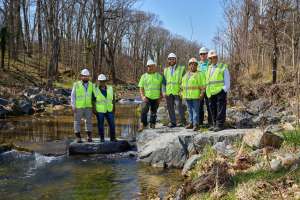
- 12,750 feet of Chinquapin Run stream stabilization
- 5,000 feet of sewer cleaning and CCTV inspection
- Replacement of 61 manholes with fixed-cover manholes
- Planting of 3,200 trees and 2,100 shrubs
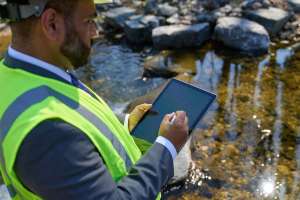
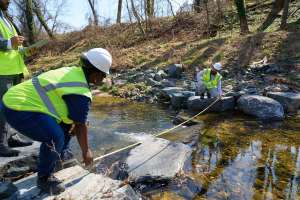
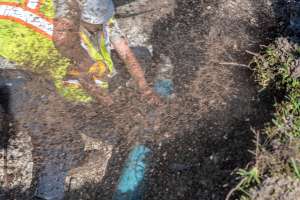
Stabilizing the stream beds through the addition of rocks and riprap prevented further erosion at the same time as it protected wastewater infrastructure. Wastewater pipes were also relocated to remove them from the stream floodplain. Upsizing and rehabilitation of pipes, in addition to sewer cleaning, improved both the efficiency and capacity of the system.
The path of the work crossed major roadways, public parks, residential areas and other private property.
“We used a whatever-it-takes approach to sewer pipe work,” Rahman says. “We relied primarily on opencut, but switched to pipe bursting across private property. When we reached two major roads that could not be shut down, we relied on microtunneling and auger boring.”
NO SSOs
The project required considerable flexibility on the part of engineers, city staff and construction contractors. Work was adjusted to actual ground conditions under the major thoroughfares, requiring additional bedrock surveys and extensive monitoring.
“We also encountered an unexpected number of rocks and boulders, which kept the engineers and contractors busy as we determined how best to remove them,” Rahman says.
He notes that ongoing erosion of the stream banks had completely exposed some infrastructure, requiring relocation of those sewer pipes. “The ongoing erosion was so severe in some areas, that when we returned to the site following the planning stage some of the stream banks had collapsed, and were now threatening to affect residential areas,” he says. “We had to stabilize the banks in their new position and also move those sewer pipes.”
Work began in 2018 and concluded in 2021. All told, the project budget totaled $23.5 million with additional costs for engineering support, construction management and inspection.
“The result of the project has been that we’ve experienced no SSOs in the target area following completion of the project,” Rahman says.
NOT DONE YET
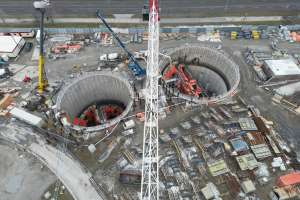
The DPW continues to undertake a significant number of major infrastructure projects. The department recently completed a project covering the open-air reservoirs at Druid Lake and Ashburton in two tanks holding 52 million gallons of water. At 500 feet in diameter, the Druid Lake tank is the largest tank of its kind in the world.
Other upgrade projects include the start of the three-year rehabilitation of the city’s two “golden egg” anaerobic digesters at the Back River Wastewater Treatment Plant, improvements to the Patapsco Wastewater Treatment Plant grit chamber, and significant upgrades at many of the city’s pumping stations.
“Whether it’s fortifying a stream bank, upsizing a pipe or improving wastewater treatment capacity, as engineers we want to fix those things,” Sayan says. “It’s our job to deliver those projects as cost-effectively as possible, but also to educate the public that these are necessary investments. Through education and community engagement we believe that ratepayers will understand the value they’re getting for their money.”