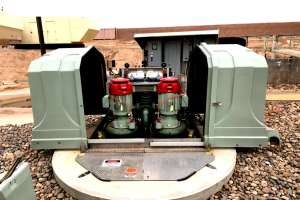
But the transmission main enables the south side plant, which can produce up to 4 mgd of reclaimed water, to supplement the north side plant’s production as needed to irrigate things like golf courses, parks, residential subdivisions and so forth.
All of the treated water from the south side plant used to be discharged into a waterway known as the Peace Creek Canal, built in the early 1900s to drain water from land to make way for agricultural use. The canal eventually flows into the roughly 100-mile-long Peace River and then into Charlotte Harbor, northwest of Fort Myers.
While excess reclaimed water still is discharged into the canal, it eventually will be used for irrigation after an underground transmission “ring” around the city is completed.
“That will allow us to push that reclaimed water to wherever we need it and even allow us to use it to recharge the aquifer,” Hubbard explains. “The ability to divert more reclaimed water to where it’s needed will greatly increase the flexibility of our water portfolio.”
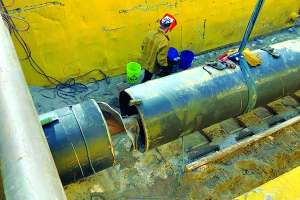
Concurrent with the transmission main project, the city also installed a 23,350-foot-long, 24-inch-diameter major wastewater force main (using both PVC and HDPE pipe) that runs from a master lift station to the aforementioned wastewater treatment plant on the city’s south side.
The line replaced a 60-year-old, 30-inch-diameter major wastewater force main. Made from ductile-iron pipe, the main had reached the end of its useful life and posed a threat of “catastrophic failure” because it carries roughly 4 mgd of raw sewage.
“We decided to address the two issues with one project,” Hubbard explains. “It represents our largest pipeline project to date.”
A major undertaking
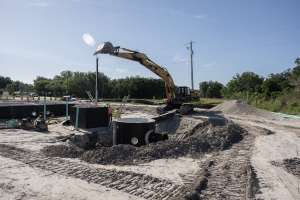
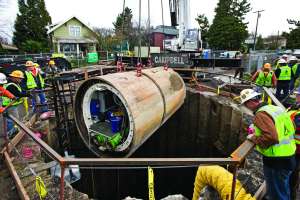
Both installations followed the same path and involved approximately 11,400 feet of horizontal directional drilling that went as deep as 65 feet to pass under wetlands, roadways, utility lines, canals and other obstacles. The bores were drilled side by side, about 6 feet apart, except for one stretch where they were stacked vertically to avoid encroaching on private property.
The bores were broken into sections as needed, with lengths ranging from 35 to 3,600 feet. Certain sections were installed via open-cut trenching and one section was laid with jack-and-bore technology to go under a railroad line, he said.
Unusually rapid population growth was the catalyst for the project. Winter Haven is in Polk County, which is the fastest-growing county in the United States.
“The average population growth for the last five years or so is more than 4%, which is tremendously fast (the city’s population is nearly 60,000),” Hubbard says. “For most communities, 1.5% is pretty good growth. But 4% is out of sight.”
The bores were performed by Florida-based DBE Utility Services, the project’s prime contractor. The engineering consultant was Florida-based Jones Edmunds & Associates.
As if those projects weren’t enough, the city — in a separate project — also installed a 6,700-foot-long, 16-inch-diameter water main that ties into the city’ water distribution system and eventually will connect to a new water treatment plant.
Limited water supply
To understand why the project was needed, it’s helpful to understand the city’s water dynamics. Winter Haven gets its water from the Upper Floridan Aquifer, which is about 800 feet underground. Spread throughout the community, 21 wells pump approximately 11.7 million gallons per day to nine water treatment plants.
The aquifer water comes from rainfall and needs little treatment — just aeration and chlorination — because it’s so pure. The aquifer also is connected to rivers, lakes and streams, including the 50 lakes that lie either within or border on the city limits, which is why Winter Haven is known as the “Chain of Lakes City.”
Across Florida, aquifer over-pumping has reduced stream flows, lake levels and spring flows. In fact, around 2017, the state capped the city’s aquifer pumping to 14 mgd, Hubbard says.
Furthermore, Winter Haven sits at the top of the local watershed, so all rainwater flows away from the city, as does groundwater.
“Our location doesn’t help us,” Hubbard says. “So it’s important to save every drop of water we can.”
Faced with significant population growth and the need to increase water supplies, water utility officials in Central Florida can turn to sources such as surface water, the Lower Floridian Aquifer (which contains water that’s saltier than the Floridan Aquifer’s water), treated wastewater and seawater. But these alternate water sources would cost more because they need more treatment and pumping.
As such, Winter Haven has turned to using reclaimed, or “reuse” water, for irrigation instead of using aquifer water. The city has been using this highly treated wastewater since the early 2000s, Hubbard says.
In the future, it could be used to restore wetlands or even recharge the aquifer, he notes.
Educating the public
The project started in early 2021 and finished in December 2022. Challenges large and small emerged along the way, including shifting project timelines due to pandemic-related supply chain issues.
On the plus side, the use of parallel horizontal directional drilling significantly reduced traffic disruptions, Hubbard says.
Constant communication with residents and businesses was critical. The utility sent letters to residents, used social media to educate the public about everything from road closures to timeline changes and even met with residents face to face.
“Providing face-to-face communication with many of the residents before and during the project was crucial to addressing ingress and egress challenges from their properties,” Hubbard says. “And both the city and Jones Edmunds frequently had staff on-site to educate the public around the project area.
“This allowed DBE Utility Services supervisors to remain focused on the task at hand: keeping the project moving.”
Enhancing connectivity, communications
The project also provided an opportunity to expand fiber optic service. About 32,000 feet of 4-inch-diameter fiber-optics conduit was installed inside the 30-inch-diameter bore for the new force main; the force main pipe and conduit were pulled in simultaneously, Hubbard says.
Drilling mud filled the annular space not filled by the force main pipe and the fiber-optics conduit.
The fiber lines are part of a broader city plan to increase connectivity and communication capabilities. The city already has installed more than 100 miles of fiber-optic conduit since around 2004.
Some of the fiber optic cable installed inside the conduit with the new force main will provide a communication link between the city’s master lift station and a new master lift station under construction.
“Almost any time we install water or wastewater lines, we also install conduit for future fiber optic cable,” Hubbard says. “We call it a ‘dig once’ philosophy.’
“We’re only using 25% of the capacity in that fiber-optics conduit, so there’s a lot of room for future expansion,” he explains.
After fiber-optic cable is installed, service providers such as Spectrum and Verizon either buy or lease as much as they need, essentially funding the line installation without any impact on water and sewer rate-payers.
“Our city is very innovative,” Hubbard notes. “We’re always looking five years or more into the future and trying to anticipate the needs of the community.”
More work on the horizon
More projects loom for the utility as it continues to contend with population growth. Its two wastewater treatment plans — one is 53 years old and another will be 50 in 2026 — need to be replaced. Plans call for consolidating those plants into one new facility, capable of treating 12 mgd; the plant will be built by around 2028.
The plant will be capable of producing more reuse water than the two existing plants, which would reduce aquifer pumping. In addition, that plant eventually will produce potable reuse water, which would even further enhance the city’s water portfolio and bolster resiliency and sustainability.
The infrastructure upgrades also are necessary to ensure future economic growth, Hubbard adds.
“The city is experiencing rapid economic growth and development,” he points out. “Without further investments in our infrastructure and making the appropriate upgrades to our system, we are not meeting our mission to provide exceptional service to our community.
“We will continue to aggressively pursue improvements to our systems that are in the best interests of our customers.”