Jeff Thompson, project engineer for SCCWWA, inspects plans at the new Springfield Creek Lift Station in Springfield, Nebraska.

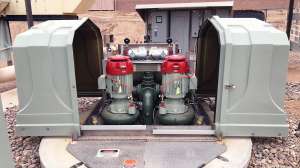
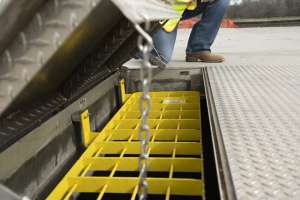
Jeff Thompson opens one of the BILCO access doors at the Springfield Creek Lift Station.



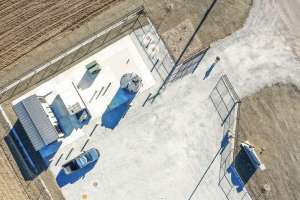
Jeff Thompson, project engineer for SCCWWA, inspects plans at the new Springfield Creek Lift Station in Springfield, Nebraska.
Jeff Thompson opens one of the BILCO access doors at the Springfield Creek Lift Station.
Nebraska was ranked the second fastest-growing Midwest state and 17th in the nation in 2024, surpassing more than 2 million people for the first time.
Late last year, one of the state’s counties unrolled a large infrastructure welcome mat to entice even more residents and businesses to the Cornhusker State.
The Sarpy County and Cities Wastewater Agency commissioned into formal operation the first phase of the Unified Southern Sarpy Wastewater System. The $130 million project delivered 45 miles of sewer lines and three lift stations and is the initial step toward bringing significant development to the area.
Sarpy County is already the state’s third most populous county and fastest growing in the state. Since 2010, Sarpy’s population has soared more than 30% and surpassed 200,000 for the first time in 2024. With the new system in place, more people are anticipated — and soon.
The SCCWWA includes Sarpy County and five cities — Bellevue, Gretna, La Vista, Papillion and Springfield. The agency expects the system, when complete, will open 97,000 new parcels for development and generate $74 million in annual sales tax revenue for the state, along with $60 million in annual property tax revenue for agency members.
Nearly two decades in the making, the system came together through the willingness and cooperation of all agency members.
“This effort is a regional solution that no jurisdiction could tackle alone,” says Don Kelly, chairman of the SCCWWA and a Sarpy County commissioner. “It has taken cooperation and partnership to get here, and I’m pleased to stand alongside our neighbors to create this system that will benefit not only Sarpy County and the Omaha metro area, but the state of Nebraska as a whole.”
Sarpy County started developing plans for a unified solution to wastewater management in 2004. The Papio-Missouri River Natural Resources District approved an interlocal agreement with Sarpy County and others to study the water and wastewater treatment needs for the region.
The problem they soon discovered was daunting. A hydrologic ridgeline running from east to west divided the northern and southern sections of the county. North of the ridgeline, water flowed to Papillion Creek and a sewer system sent wastewater north to Omaha’s treatment facilities. South of the ridgeline, the county lacked wastewater services, hindering development and preventing the region from reaching its full potential.
The ridgeline, more than 30 miles long and 1,280 feet above sea level at its highest point, hampered consequential development south of the ridgeline.
“As growth in Sarpy County continues to consume developable area north of the hydrologic ridgeline, growth pressure will redirect to southern Sarpy County,’’ according to the Southern Ridge Wastewater Treatment Study, which was published in 2016. “In order to support the impending growth, wastewater service south of the ridgeline is essential.”
Prior to the new system, the communities used a fragmented approach to wastewater management.
Three communities — Gretna, Papillion and Bellevue — collected and pumped over the ridgeline to the Papillion Creek watershed. It was then conveyed to the treatment plant in Omaha. South Bend discharged to Fountain Creek and subsequently to the Platte River. In Springfield, wastewater was conveyed through the Springfield Creek watershed to a wastewater treatment facility.
In the southwestern area of the county, wastewater was collected and conveyed to a treatment plant where it was discharged into a tributary of Buffalo Creek and eventually to the Platte River. Wastewater from single-family developments throughout other parts of Sarpy County was treated and infiltrated through private septic systems.
The summary addressed the challenges in designing a regional system. “For example, the ability to pump over the ridge is generally a less costly, short-term solution [on a case-by-case basis]. Additionally, the traditional metro area model of targeting perimeter growth areas, sequentially extending interceptor sewers to those growth areas, and having developers follow suit, does not work in Sarpy County,’’ the summary found. “Growth pressure is on the wrong end, the upstream end, and scattered across the watershed. The initial capital investment for a regional system to deliver flows for treatment at the south end of the watershed would be significant. Furthermore, Bellevue, Gretna, Papillion and Springfield are all experiencing growth. It would be unlikely that they would circumvent growth to focus growth in one area initially and then sequentially in additional areas as needed.”
HDR, which prepared the summary, evaluated multiple alternatives and recommended the regional wastewater treatment facility anchored in Springfield. “Relative cost effectiveness, nonmonetary considerations and stakeholder input provided the basis for this recommendation. It also provided a phased implementation plan and associated cash flow requirements for the recommended alternative,’’ the report stated.
HDR’s recommendation resulted in the creation of the SCCWWA in 2017. The first step was finding the funding necessary for such an ambitious project.
The primary investment came from a $69.8 million zero-interest state revolving fund loan from the Nebraska Department of Environment and Energy. The agency also secured $4.5 million in congressionally directed spending sponsored by U.S. Rep. Don Bacon. Additional funds were acquired through low-interest loans. The system is expected to cost approximately $620 million and will be built in phases over the next 10 to 50 years.
User rates and connection fees will be used to fund the system. The agency projects no property tax dollars will be used to pay for the system. Just as important, the system is expected to generate significant revenue.
According to the SCCCWA, the cities within Sarpy County will generate $21 million in annual sales tax revenue and $31 million annually in property tax revenue. Sarpy County will generate another $29 million annually in property tax revenue. The state is expected to gain $74 million annually in sales tax revenue.
“First and foremost, the largest challenge was regionalization and trying to get five cities and a county to agree to collaboratively create a utility,’’ says Jeff Thompson, project engineer. “They all want development in their communities. Who comes first and how that happens was certainly a big challenge. There were also funding issues. All the cities and the county certainly didn’t have the resources to be able to provide a large bucket of money for us to pay for that. We’ve got a fair amount of debt service right out of the gate, but it’s coming together well, and we’ve got a great plan and model to keep everything on track.”
Project administrator Dan Hoins and Sarpy County Commissioner Don Kelly, the aforementioned SCCWWA chairman, have been important figures in guiding the project along.
The project will take several decades to complete, but the critical first phase that will help launch the development in the region wrapped up in December.
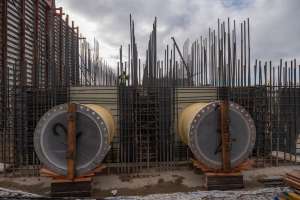
The project consists of a gravity sewer system, force mains and lift stations to get sewage across the southern part of Sarpy County.
“We’ve got about 21 1/2 miles of linear distance between all of the facilities,’’ Thompson said. “We have two sewer lines parallel from our Springfield lift station all the way to the city of Omaha’s wastewater treatment plan. In total, we have almost 43 miles of pipe in the ground.”
HDR said on its website that the system features three lift stations that use gravity to pull the flow from north to south for the Springfield Creek and Zwiebel Creek areas. Approximately 17 miles of dual force mains deliver wastewater from the Springfield basin east to the Papillion Water Resource Recovery Facility. Additionally, it includes cooling water conveyance from data centers to an equalization lagoon and a controlled discharge cooling water equalization lagoon.
One other challenging aspect of the project was acquiring the land to install the sewer lines.
“There were some pretty poor soil conditions, and land rights and easement acquisitions are always a challenge when you’re spanning 21.5 miles,’’ Thompson says. “Most of it was in private agricultural fields in rural areas. Folks don’t necessarily want to give up that land. I’m happy to say we acquired a little over 100 easements and right-of-way acquisitions, and we really didn’t have a whole lot of opposition.”
Long-term maintenance will be one of the most important tasks as the system continues to evolve.
“The only negative part of pumping is its mechanical systems,’’ Thompson said. “We have a preventive maintenance program in place to utilize the system as efficiently as we can and keep things in good working order throughout the life of the system.”
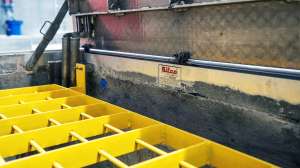
To help keep the system steady, the project includes 31 stainless steel floor doors from BILCO, a manufacturer of specialty access products. The doors were specified in a range of sizes, including two doors that are 55 inches by 168 inches. There are 10 doors that are 36 inches by 36 inches, and eight that are 48 inches by 72 inches. The doors are equipped with fall protection grates.
“There are only a few manufacturers in the industry that provide these types of doors for the corrosive environment,’’ Thompson stated. “BILCO was among the list specified by our engineer. They are a very solid and safe system. We wanted something that was going to provide a high level of security. We don’t want somebody falling into some of these areas. And they secure the equipment needed to facilitate the movement and conveyance of our sewers. They’re very functional and easy to operate.”
Even before the installation of the system, Sarpy County saw waves of new residents.
Bellevue, Sarpy County’s largest city with more than 63,000 residents, is just 10 miles from Omaha. Offutt Air Force Base has been located in Sarpy since 1921, and the county is teeming with recreational and cultural amenities.
Over the next decade, the SCCWWA estimates more than 60,000 new residents will move into the region, bringing with them tax dollars that will benefit local and state coffers.
In middle America, Sarpy County leaders have awakened a sleeping giant. It’s only a matter of time before new residents flock to the region, ushering in game-changing economic vitality.
“There was a lot of coordination with stakeholder meetings and communities at large to try to understand what made the most sense,’’ Thompson says. “At the end of the day, a lot of the politics come out of it. It was more of where things are needed, where does it make sense and what is most fiscally responsible for us to build. In a project of this magnitude, we had to get five communities to agree along with various other stakeholders. The five mayors of the cities and the county chairperson, they’re all great leaders. In addition, Don Kelly’s and Dan Hoins’ leadership and tenacity really brought a lot of this together.”
Thomas Renner writes on building, construction and other trade industry topics for publications throughout the United States.
Continue reading for free