To prepare for future water needs, diversify their water portfolios and boost both water and infrastructure resiliency, the Tualatin Valley Water District and the cities of Beaverton and Hillsboro in northwestern Oregon are inching closer to completing a $1.6 billion pipeline project that will tap into a new water source: the Willamette River.
The project — known as the Willamette Water Supply System — is expected to be completed in 2026. It will enable the Tualatin Valley, located about 20 miles west of Portland, to wean itself off water supplied by the Portland Water Bureau, its major supplier, says Marlys Ryan, communications supervisor for the Willamette Water Supply Program.
Created in 2015 to plan, design and manage the project, the Willamette Water Supply Program is a partnership between the TVWD and the cities of Beaverton and Hillsboro. The two cities currently don’t get water from Tualatin Valley but will receive water from the pipeline under the auspices of the Willamette Water Supply System Commission.
The TVWD serves mostly unincorporated parts of Washington County.
“This is a really significant project for our region, both in terms of planning ahead for our communities’ water needs and increasing the seismic resiliency of our water system,” Ryan says.
While alternatives were considered, officials concluded that tapping into the Willamette River was the most cost-effective option with the least environmental impact. The 187-mile-long river originates in mountains south and east of the city of Eugene and flows north into the Columbia River.
The project was not controversial, Ryan notes. “We’ve had really excellent leadership. From day one, everyone understood the importance of the project for future generations.”
Years in the making
About 15 years ago, the TVWD started looking at the long-range future of its water supply. At about the same time, Hillsboro did the same thing, recognizing that demand would outstrip existing water supplies. In fact, in order to handle projected population increases, business development and so forth, Hillsboro officials estimate that in the next 25 to 50 years, the city will need twice as much water compared to what’s currently available.
“Officials also recognized that existing water delivery systems aren’t built to current seismic standards,” Ryan says. “So there was interest in local ownership and control of a water system that would be designed to serve for 100 years, offer improved seismic reliability and help ensure the region could quickly recover from a big earthquake or some other natural disaster.”
When completed, the system will serve 370,000 customers. Funding includes a $638 million loan from a fund established by the federal Water Infrastructure Finance and Innovation Act, approved by Congress in 2014; rate increases from the participating agencies; and, in some cases, system development charges paid by real estate developers.
“The $638 million from the WIFIA is a loan with a 35-year payback period, which stretches out the debt so more than just current customers will help pay for the system,” Ryan explains.
A major undertaking
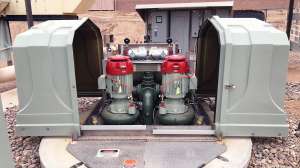
The central component of the new water system is a roughly 30-mile-long pipeline. It will also feature a new water treatment plant in Sherwood, which is located nearly 7 miles north of a new raw water intake on the Willamette River and about 16 miles southwest of downtown Portland. Construction of the plant is expected to conclude in 2025.
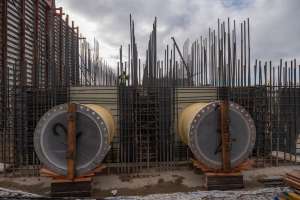
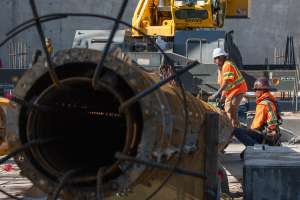
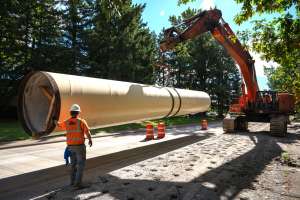
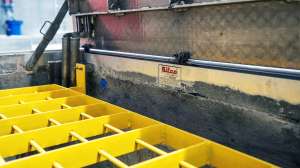
Construction of the pipeline began in 2017. It mostly consists of 66-inch-diameter welded-steel pipe. About 28 miles of pipeline have already been installed, primarily via open-trench excavation with some horizontal directional drilling required to pass under the Tualatin River and other areas.
When completed, the pipeline will stretch north from the Willamette River intake to a 15 million-gallon, roughly 30-foot-tall water tank on Cooper Mountain. Located near Beaverton, the peak offers sufficient elevation to send water via gravity to existing distribution systems, Ryan says.
More specifically, water from the river will be pumped through a nearly 7-mile section of pipeline to the new water treatment plant, which ultimately will be capable of handling up to 120 million gallons of water a day. Another roughly 9-mile section of pipeline will transport water from the plant to the Cooper Mountain water tank.
About 2 to 3 miles south of the water tank, the pipeline heads northeast for slightly more than 7 miles and takes water to portions of the Beaverton and TVWD distribution systems. From Cooper Mountain, an approximately 10-mile section of pipeline will take water north to connection points within the TVWD and Hillsboro distribution systems.
Earthquake readiness
The ability to withstand earthquakes was a major focus of the water system’s design. The Portland area is one of the most seismically active areas in Oregon, thanks to its location atop a major fault line that runs from Northern California to Vancouver Island in Canada.
The area experiences hundreds of earthquakes a year, most of them too small to feel. One organization that tracks seismic activity says that based on data from the past 55 years, about 862 earthquakes per year occur in or near Portland, with most of them a magnitude of 3.0 or less on the Richter scale.
But scientists say a major earthquake has hit the area roughly every 300 to 400 years and predict a magnitude 9.0 quake will eventually hit the region. As such, the water system is designed to withstand that level of an earthquake, Ryan says.
Most of the pipeline was installed in existing right of ways along major roadways. Furthermore, to reduce costs and minimize traffic disruptions, Willamette Water Supply System officials worked closely with local municipalities to coordinate and synchronize pipeline construction with road construction projects, she says.
“When we heard about a county or city project that would occur at about the same time as our pipeline construction, we synced up with those projects and installed the pipeline before roads were widened or improved in some way,” Ryan notes. “It took a ton of coordination between agencies, but overall, it significantly limited the impact on commuters and residents.
“It made the project more complicated, but ultimately it minimized the impacts by essentially combining separate construction projects into one big project.”
Complicated supply system
The TVWD’s current water supply chain is complex. The Portland Water Bureau supplies about 72% of its drinking water, which initially starts out as rainfall in the lush, temperate rainforests in the Bull Run Watershed located roughly 30 miles east of Portland. The watershed area averages about 130 inches of rainfall a year and two dams on the Bull Run River create storage reservoirs.
Portland augments its water supply from its Columbia South Shore Wellfield, a system of 25 wells that tap into four aquifers and produce nearly 100 million gallons of water per day.
After the Willamette Water Supply System pipeline is operational, the TVWD no longer will rely on water from the Portland bureau. But an emergency connection will enable Portland and the TVWD to share water if a regional water crisis occurs, Ryan says.
The remaining 28% of the TVWD’s water comes from the Joint Water Commission, a regional agency that is jointly owned by the TVWD and the cities of Hillsboro, Beaverton and Forest Grove. The joint commission obtains water from two reservoirs that empty into the Tualatin River. The commission also operates a treatment plant.
The TVWD will still obtain water from the joint commission after the pipeline goes online, she says.
Water for generations
After the project is completed, the TVWD will be the majority owner of the new water system and will serve as its managing agency for the Willamette Water Supply System Commission, which will consist of one representative from the TVWD, Beaverton and Hillsboro.
The water system will be one of Oregon’s most seismically resilient water systems, built to better withstand natural disasters, protect public health and speed regional economic recovery by restoring critical services faster during emergencies, she points out.
As the project nears completion, with only about 2 miles of pipeline left to install near Sherwood and the city of Tualatin, Ryan says it’ll be well worth the wait.
“The new system embodies the vision and commitment of the Tualatin Valley Water District and the cities of Hillsboro and Beaverton as water is a critical resource that supports the health, safety and prosperity of our region for generations to come,” she says. “Our success is due to the unwavering support of our community and the dedication of our partners.
“When the system comes online in 2026, Washington County will have a secure, resilient and reliable water supply for decades to come.”