A typical application of Bio-Kat provides compact and unobstructive dosing.

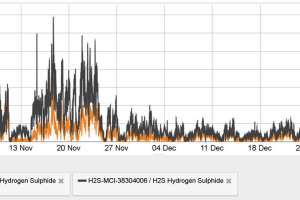
Over a four-month trial project on a 7-mile segment of the Mill Creek interceptor, usual hydrogen sulfide readings of 100-110 parts per million dropped to 5 ppm.

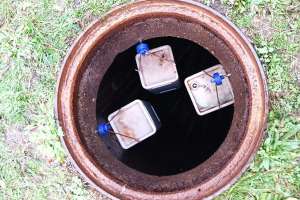
A typical application of Bio-Kat provides compact and unobstructive dosing.
Over a four-month trial project on a 7-mile segment of the Mill Creek interceptor, usual hydrogen sulfide readings of 100-110 parts per million dropped to 5 ppm.
Fix one problem and unmask another. That was the sequence by which engineers of the Metropolitan Sewer District of Greater Cincinnati discovered an egregious odor problem in an interceptor line. The solution to the problems surprised district engineers.
The problems were in a 54-inch reinforced concrete pipe. Quite a lot of water infiltrated the line after a hole developed over time. When the hole was located and repaired, the water level fell and the flow of water slowed. That’s when something else was detected: the rotten-egg stink of hydrogen sulfide.
“We inadvertently created an odor problem,” says Andy Mackowiak, a business analyst at the district who oversees odor control. It turned out to be a fortuitous discovery.
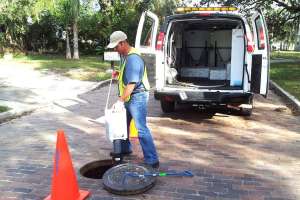
The problem was in a Mill Creek gravity trunk line that runs for approximately 15 miles toward the Ohio River, including through residential areas. Complaints about smells had been recorded for years along the route of the line, especially from a particular manhole located in a driveway. This time, engineers tested upstream from the location and eventually pinpointed concentrations of hydrogen sulfide.
Enter NRP Products, a firm headquartered in Wichita, Kansas. It has manufactured “all-green” odor-control products since 1988, producing nonchemical biocatalytic liquids that are sold under the brand name Bio-Kat.
A four-month trial project on a 7-mile segment of the Mill Creek interceptor was arranged for NRP beginning November 2022. When it wrapped up, Mackowiak and his district peers were surprised by the results: Usual hydrogen sulfide readings of 100-110 parts per million along the line had dropped to 5 ppm.
“We did not expect that dramatic a decline,” he says. “It showed us the NRP process could be effective.” The district bid out a contract for odor control, NRP won it, and the trial project results proved not to be a fluke. The average odor reading along the line today is 2-3 ppm.
None of this surprised David Pipkin, a longtime partner at NRP who is based in Florida. Pipkin calls the Cincinnati Bio-Kat experience “pretty typical.” He cites a client in Hollywood, Florida, some years ago that had hydrogen sulfide readings closer to 1,000 ppm. “We brought it down to 30 ppm. Today, we could get it to below five.”
The secret ingredient in the proprietary process is no secret: Biocatalysts in Bio-Kat accelerate the metabolic breakdown of bacteria by adding nutrients that appeal to microorganisms in sewage. This revs up the metabolism of the bacteria, which feed on the gas-producing substances on the wall of the pipe.
As a bonus, corrosion of the pipe itself by sulfuric acid is slowed by the treatment. “All sewers have a scum layer on the pipe,” Pipkin explains. “That’s where the sulfuric acid is produced by bacteria. The acid corrodes the pipe and also is converted into hydrogen sulfide. We increase the respiratory function of the bacteria and it goes looking for food and that food is the scum layer. Eliminating the scum layer ends the production of acid that produces the odor and corrodes the pipe.”
Also consumed along the way is FOG, or the fats, oil and grease that plague sewer systems and can lead to blockages. The Bio-Kat process greatly reduces FOG buildup, which means that fewer maintenance-budget dollars are spent flushing away fatty grease with a hydro jetter.
The rest of the story is that NRP is a turnkey operation. The company employs staff who install and service the small biocatalytic liquids dispensers at predetermined strategic locations in a system. In the case of the Mill Creek line, Mackowiak says the “dosing points” are both “upstream and periodic locations downstream to help dissipate odors that join the line there.”
It needs to be noted, however, that the odor-killing biocatalysts are not a permanent solution. Mackowiak discovered that a few months after the end of the trial project on the line. “It stayed the same for a couple of months and then the strength of the odor began to creep back up again. If we stop treatment, it reverts.”
Pipkin likens the process to a person taking a shower to wash away the smell of body oils and perspiration. “Bodies are always excreting waste products. One showering doesn’t stop that.
“Sewer lines are always developing a scum layer that produces sulfuric acid and hydrogen sulfide. We clean away that layer and it takes a while for the layer to re-form, but it eventually does. Removing the layer can’t be permanent unless the treatment is.”
Mackowiak says problem areas in the Cincinnati system will be consistently dosed with Bio-Kat, and not just because of offensive smells. “It helps to prevent corrosion of our pipes. What’s more, the gas is a health and safety issue. Hydrogen sulfide is a pretty dangerous gas and I don’t want it to get out into neighborhoods. It’s dangerous.”
Perhaps the best news — or at least complementing news — is that Bio-Kat treatments also are competitive cost-wise. “The cost is not prohibitive, but it isn’t cheap, either,” Mackowiak says. The price tag for treating the Mill Creek interceptor is about $300,000 a year, and Cincinnati metro sewer officials have deployed NRP dispensers on another line to combat odor and corrosion there.
The NRP biocatalyst liquids treatment typically is 25 to 45% less expensive than traditional chemical treatments, according to Pipkin. It is cost-effective in other ways. He cites reduced capital expenditures experienced by a New Orleans parish in repair/replacement of corroded pipe thanks to the treatment, and to the near elimination of sewer line spillover costs in the Hollywood, Florida, utility because Bio-Kat reduced FOG accretion.
The NRP executive calls such results evidence of the superiority of a 21st century biological process to 20th century chemical processes.
Be that as it may, Mackowiak simply attests that the Bio-Kat dispensers are performing as advertised. “I’ve been happy with the process. The product is doing exactly what the manufacturer said it would do.”
That’s why the district business analyst continues to monitor any patterns of complaints about odors in the Cincinnati system. He doesn’t expect the entire system to need biocatalyst treatment, but any problem areas that show up can expect a dose.
Continue reading for free