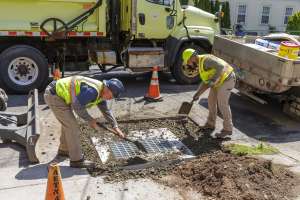
If there’s a lesson to be learned from the Yakima, Washington, sewer rehabilitation project, it’s that planning and communication are just as critical to success as vacuum trucks and CCTV equipment.
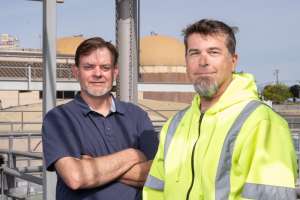
“Get started early,” says Marc Cawley, wastewater and stormwater operations superintendent for the city. “It’s important to build trust with your management and leadership team.”
Yakima Utilities had been moving along slowly rehabilitating its most aged 175 miles of sanitary sewers, spending about $500,000 a year focusing on what Cawley and Dana Kallevig, the city’s utility project manager, call “low-hanging fruit.”
Today, they have completed a project of assessing the condition of all their wastewater collection pipelines (approximately 360 miles of pipelines) using multisensor equipment, CCTV equipment and robotic cameras contracted through RedZone Robotics, and are saving significant dollars by using CIPP to replace aging or damaged pipes wherever possible.
The two reported the results of the project at the 2024 No-Dig Show in April in Providence, Rhode Island.
Background
The city could not have achieved this level of success without meetings and discussions with utility management and city leaders back in 2012. “We shared photographs with them showing what maintenance work was needed,” says Cawley. “They were willing to invest, and we’ve been able to produce results that will make a difference in our community.” He says the budget for pipeline rehabilitation has gone from $500,000 a year to $1.5 million annually and will continue to grow.
“We’ve made progress but there’s still a way to go,” adds Kallevig. “We’ve been able to identify problem areas before any catastrophic failures that might impact our community’s residential or business areas.”
Yakima system
The Yakima Wastewater Department operates a regional activated sludge wastewater treatment plant, serving about 100,000 city residents plus the neighboring communities of Union Gap, Terrace Heights and Moxee. Average daily flow is 10 mgd.
The department’s collections team is responsible for the Yakima portion of the sanitary sewer collection system only — approximately 360 miles of pipe, ranging in size from 6 to 60 inches in diameter along with 10 lift stations and approximately 7,300 manholes. Portions of the system — including sewers serving the city’s central business district — are more than 100 years old. Fully half of the 360 miles of pipes consist of vitrified clay or unreinforced concrete. Sanitary and storm sewer systems are separated.
Cawley says the major issues faced by the cleaning crews are roots, followed by grease and the accumulation of rocks, sediment and other debris. In some residential neighborhoods, access to sewer manholes are difficult, sewers are under backyards and present issues like infiltration and inflow, root intrusion, and therefore require more time and coordination to maintain properly.
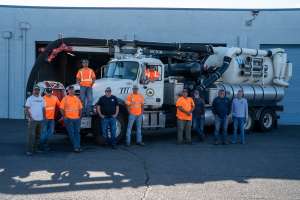
The collections team consists of 15 professionals.
Cawley manages the department. He started at ground zero with the city’s wastewater team 20 years ago as a temporary employee. Kallevig has been with the city for 15 years managing projects for the wastewater and engineering divisions. Before that he served in a similar capacity for the state department of transportation. Robert Brown supervises the collections team. He started with the department 26 years ago as a collections specialist. Scott Schafer is director of public works; Mike Price is wastewater/stormwater manager.
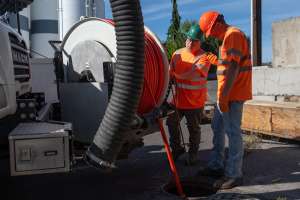
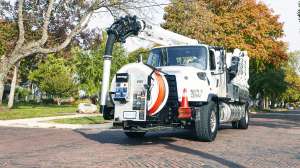
The department has one CCTV unit (TrakSTAR RST); four series 2100 Vactor trucks, two of them devoted to stormwater cleaning; and one Sewer Equipment 900 Eco.
The city usually bids out any pipe replacement work to outside contractors.
The old days
In the old days, the city was using its CCTV equipment to assess and identify that low-hanging fruit and among other things, inspect the construction of new pipeline installations.
“Staff was telling us what areas were in need of repair,” he says. “All credit to our operators. They were identifying issues. We’d make a list. But then nothing would happen.”
Any progress they did make was painfully slow. Cawley says the sewer crew worked on the smaller-diameter lines, patch repairing areas of immediate need. “At that rate, we were not reaching our desired outcomes of proactively rehabilitating the aged system,” he says.
The trust-building with management in 2012 quickened the pace. “We were able to accelerate the program,” Cawley says. Using ICOM software (now known as Integrity), the collections team was able to finalize the cleaning schedule for all pipes 27 inches in diameter and smaller.
An additional CCTV system was acquired to enable a systematic evaluation of pipeline conditions. Working with its consultant, the city developed a wastewater collections system master plan.
“We started slow, built trust and expanded our budget gradually, to the point that today pipeline rehabilitation is a line item in our budget,” Kallevig points out.
“Not only were we taking care of the system and expanding testing, we were setting priorities. It was not only the condition of the pipe, but also the consequences of failure — its potential impact on the community.”
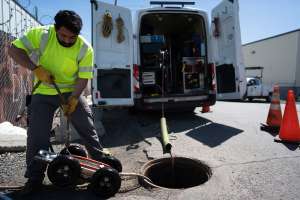
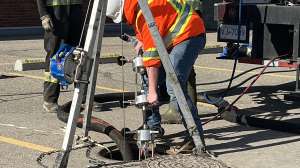
The program received a big boost in the summer of 2023, when the city contracted with RedZone Robotics to provide a systemwide condition assessment using robotic technology. The autonomous cameras can be dropped into a manhole, and can travel through the smaller pipes in the system, even some pipes that larger assessment devices would not be able to get through due to the condition of the pipeline. They return to the entry manhole, are removed, and the photo imagery is sent to RedZone headquarters for review before the data is transmitted back to the Yakima collections team.
Using the RedZone robotics, Yakima had completed assessment of 300-plus miles of sewers by last November. Crews were able to examine 12,000 feet per day, with each crew directing four robots. CCTV was used for the larger lines up to 21 inches, and for pipes 21 inch up to 60 inches in diameter, the team pulled a multisensor configuration through each section.
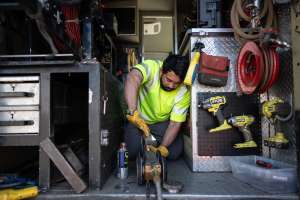
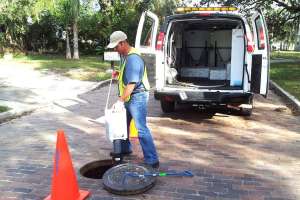
City crews supported the effort, cleaning pipes that needed it, operating lift stations, coordinating access issues and helping to inform the public.
By this past summer, all the work had been completed.
Cawley says the robots could assess and photograph a complete route of sewers in a single day. Efficiency was greatly improved. “In 85% of the cases, they indicated the line didn’t need to be cleaned before the assessment could be made,” he says.
“It gave us an accurate assessment of the entire system,” says Cawley. “Not just a selective assessment. We’re now able to clean only the pipes that need it. That saves taxpayer resources that can be better used rehabilitating deficient pipelines.”
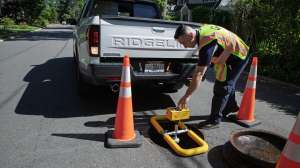
He and Kallevig agree that the robotics provided additional benefits — they are battery-operated, use less fuel and require no generator on site. The system is less obtrusive, as well. The robots can be simply dropped into a manhole, the lid replaced, and vehicle traffic allowed to continue normally. That was an important factor in the downtown business areas.
Replacement
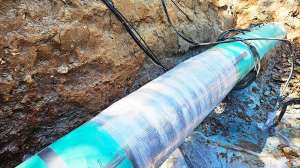
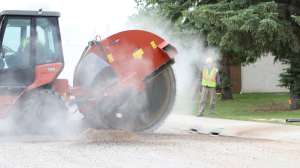
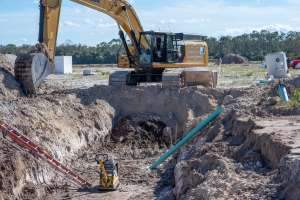
Yakima uses a number of methods to replace pipes that are prone to failure. Kallevig says the city has replaced approximately 10 miles of pipe using the CIPP technology (Insituform and Iron Horse). About 2.5 miles of old pipe have been replaced using the opencut method. The city has sliplined another 1.25 miles, and has used pipe bursting for 3,000 linear feet.
By far, CIPP has proven to be the most effective. Kallevig reports an average cost of $87 per foot for CIPP, compared to $557 a foot for opencut and $393 a foot for pipe bursting.
“There are situations where open cut is desirable, but we consider it a last resort,” says Cawley.
Kallevig says the condition assessment has enabled Yakima to update priorities and establish future budgets.
“We’ve extended the life of our rehabilitated pipes by 50-plus years, per manufacturers’ specifications. And we’ve achieved an excellent payback rate for our ratepayers by reducing maintenance costs and improving our efficiency.”
Cawley adds, “With the efforts and resources put forth by the wastewater and city leadership teams, our preventive maintenance program will continue to help prevent future catastrophic failures. Currently, the collections staff through dedication and workflow assessments have limited sanitary sewer overflows to only one in 2024. That’s a remarkable accomplishment and wastewater management is extremely grateful for all the great work contributed day in and day by all the wonderful employees in wastewater.
“Together, we’re improving our wastewater system for generations to come.”