After 23 years of painstaking work, the third and final phase of an expansive, approximately $1.5 billion sewer infrastructure project in Rhode Island — the largest public works endeavor in state history — is about halfway to the finish line.
The project, managed by the Providence-based Narragansett Bay Commission, a quasi-public and nonprofit utility agency, is expected to be completed in February 2028. The first two phases have already significantly reduced the number of combined sewer overflows into Narragansett Bay. The bay is a roughly 150-square-mile estuary off the state’s coast that’s a vital but vulnerable economic and recreational asset that harbors thousands of species of plants, fish and other wildlife.
“It’s the biggest construction project in Rhode Island that nobody ever sees,” says Vincent Mesolella, the commission’s chairman. “And it’s already working very, very well.”
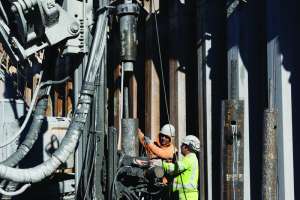
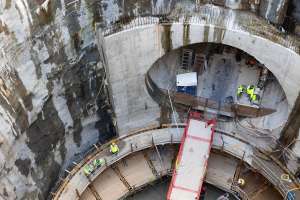
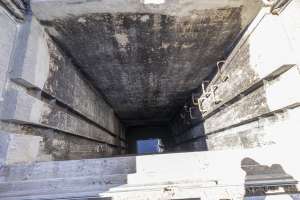
The main feature of the project’s third phase is a 2.2-mile-long, 30-foot-diameter tunnel lined with 2.3-foot-thick concrete rings. It can store about 160 million gallons of wastewater from 22 CSOs until there’s enough capacity to treat it at the commission’s Bucklin Point Wastewater Treatment Facility, one of two owned by the NBC, says Kathryn Kelly, the commission’s CSO program manager.
Most of the tunnel passes under Pawtucket, a city directly north of Providence. The tunnel generally follows the east bank of the Seekonk River, one of several local waterways that empty into Narragansett Bay, and its depth ranges from 120 to 150 feet underground.
Started in late 2022, the tunnel boring was completed in February 2024. That was a significant milestone in the project’s third phase, which is divided into four smaller phases, Kelly says.
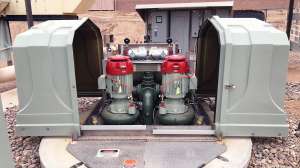
The remaining primary components awaiting completion include four dropshafts that will channel sewer overflows into the tunnel, plus the construction of a pump station that will move those overflows to the Bucklin Point plant, located in East Providence. The facility provides advanced secondary treatment for wastewater flow up to 46 million gallons per day and primary treatment and disinfection for an additional 70 mgd during wet-weather events, with an average flow of about 23 mgd.
When completed, the project is expected to reduce CSOs by 93%, Kelly says. It also will ensure that the water quality in Narragansett Bay complies with mandates outlined in a consent decree filed in 2014 by the Rhode Island Department of Environmental Management in conjunction with the U.S. Environmental Protection Agency.
Underground Solution
The main component of the first phase of the project, which started in June 2001 and went online in 2008, is a 3.1-mile-long, 26-foot-diameter tunnel lined with 2-foot-thick concrete rings. Its depth ranges from 260 to 280 feet deep and it can hold about 65 million gallons of CSOs.
“It already has captured 16 billion gallons of combined sewer overflows,” Kelly notes.
The first phase also included building seven drop shafts that channel wastewater from 12 CSOs to the tunnel, where they’re stored until there’s enough capacity for treatment at the NBC’s other wastewater plant, the Field’s Point Wastewater Treatment Facility.
The Field’s Point facility is located on the south side of Providence, adjacent to the Providence River. Built in 1901 and upgraded in the 1980s, it’s the largest such facility in the state as well as the oldest; it provides enhanced secondary treatment of 77 million mgd and primary treatment and disinfection for an additional 123 mgd during wet-weather events. The average flow treated is about 50 mgd, she says.
The project’s second phase, completed in 2015, centered on installing two long CSO interceptor sewer lines that connect to the tunnel. One interceptor follows the Woonasquatucket River and consists of around 2.4 miles of 40- to 66-inch-diameter reinforced concrete pipes; the second one is about 1.4 miles long and travels along the Seekonk River, with reinforced concrete pipes ranging from 48 to 60 inches in diameter.
CSO Ripple Effects
Like so many large and older cities in the United States, Providence’s system of combined sewers — which include some of the oldest sewer lines in the country — weren’t built to handle modern-day wastewater demands, Kelly explains.
“When built, they were designed to keep water from backing up into city streets from manholes and storm drains,” she says. “They built overflow points that emptied into the Providence, Seekonk, Moshassuck and Woonasquatucket rivers, which all flow into the bay.
“It was pretty awesome technology in the 1800s, but now it’s illegal under the federal Clean Water Act.”
At the peak of the problem, about 2 billion gallons of untreated sewage overflows, combined with rainfall runoff, were discharged into the bay annually. As a result, beach closings were common and shellfish harvesting was “conditionally” restricted after heavy rains because of the bacteria carried into the bay.
The latter is particularly important because the shellfish-harvesting industry — think scallops, quahogs (hard-shell crabs), soft-shell crabs, mussels and the like — injects about $12 million into the local economy and employs thousands of people. Recreational shellfish harvesting also is an extremely popular tourist activity.
When plans for fixing the CSO problems began percolating in the 1990s, 17 different options eventually were developed. The deep tunnels made the most sense because separating the combined sewers would require ripping up miles and miles of city streets and be extremely disruptive as well as inordinately expensive, she notes.
Good Return on Investment
The project has proved to be a worthwhile investment. The new infrastructure installed in the first two phases — which is designed to catch about 60% of the stormwater that flows through the city’s sewer system — is delivering results, Mesolella says.
“We do know that water-quality improvements so far have been pretty impressive,” he reports. “In 2017, almost 4,000 acres of shell-fishing area that once was open only conditionally (if water-quality standards were met) has been reclassified as approved, meaning there no longer are conditional limits after rainfalls.
“So the shellfish industry gained about 40 days of work a year.”
Furthermore, beach closings are down by 80% and in 2020, RIDEM opened up the upper part of Narragansett Bay to shell fishing grounds that had been closed for more than 70 years.
Moreover, news reports say that bacteria levels in the bay have been reduced by half. And research performed at the University of Rhode Island revealed that levels of unhealthy nutrients had decreased to half of what they were in the 1990s.
“NBC’s CSO control facilities are designed to reduce the frequency of CSOs to four or less during a typical year of precipitation,” Kelly says.
In addition, before the first tunnel was bored, excess wet-weather flow greater than 77 mgd and up to 123 mgd at the Field’s Point plant was directed to its wet-weather facility. There the wastewater would receive wet-weather treatment, which consisted of some solids settling and full disinfection before being discharged into the Providence River, according to an online NBC report from 2012.
But during the first three years after the tunnel went online in 2008, wet-weather discharges into the river dropped to an average of seven per year, down from an average of 38 per year – an average decrease of 81%. And the average wet-weather flow into the Field’s Point facility dropped 71%, which prevented billions of gallons of contaminated stormwater from entering local rivers and the bay, the report noted.
Building a Sterling Legacy
The deep-tunnel projects represent a crowning achievement for the NBC, which was created by the state’s general assembly in 1980 to reduce pollution in Narragansett Bay. The agency subsequently took over operation of the Field’s Point plant in 1982; at the time, the facility was one of the largest municipal polluters in the United States.
“Many generations of Rhode Islanders only knew Narragansett Bay as a polluted and shameful place,” Mesolella says. “The Field’s Point facility was the second-worst municipal polluter in New England, with 60 million gallons of sewage discharged into the Providence River every day.”
But by 1995, Field’s Point was named the best large wastewater-treatment plant in the nation — a remarkable turnaround, he says.
“We now can hang our hat on the fact that Narragansett Bay is a clean and vibrant place to have fun, go fishing and make a living,” Mesolella says. “With this project, we’re giving Rhode Islanders back their rivers and their bay — things they haven’t been able to use for decades.”