The infrastructure associated with the Passaic Valley Sewerage Commission is critical to residents in northern New Jersey.
The PVSC was established in 1902 and was initially tasked with alleviating pollution in the Passaic Valley sewerage district. Through expansions and upgrades, the PVSC became the largest wastewater treatment plant in New Jersey and the fifth-largest in the United States.
The heavily industrialized area of northern New Jersey encompasses all of the land draining into the Passaic River from the Great Falls in Paterson to Newark Bay on the Atlantic Ocean. The influent capacity is about 330 million gallons per day and PVSC’s systems handle about 25% of the state’s total wastewater.
The PVSC’s main sewer interceptor is approximately 22 miles long with 18 miles of branch intercepting sewers. There are several pump stations in the collections system along with approximately 2,000 miles of lateral sewers owned by towns within the network.
The Newark Bay treatment plant was completed in 1924 and provided primary treatment for an average sewage flow of approximately 150 mgd. Several subsequent expansion projects increased capacity, sludge handling facilities were added and modifications were made to grit chambers and screening facilities. Keeping the system running efficiently is important in any community, but especially so in an environmentally sensitive area with far-flung users.
Storm Recovery
In 2012, Superstorm Sandy devastated the region, disrupting the lives of 1.5 million residents in 48 municipalities that are served by the PVSC. The storm overwhelmed the Newark Bay Treatment Plant, the linchpin to the agency’s management system. PVSC lost power to all pump stations, and the plant was inoperable within 48 hours.
The storm has long passed, but the importance of capable and updated infrastructure remains permanently etched in PVSC’s long-term planning. In response to Sandy, PVSC initiated a “Resiliency Program” with the Federal Emergency Management Agency to make $800 million in improvements. Nearly 10 years later, those improvements are still being constructed.
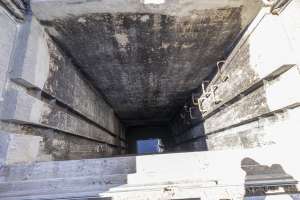
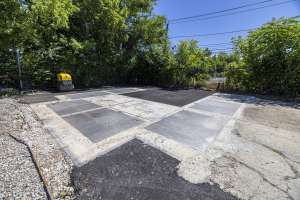
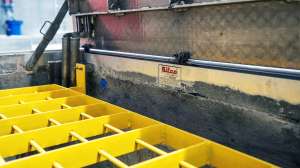
Case in point, grated covers that had been installed decades ago over two grit removal chambers within the PVSC system were deteriorating. Workers are required to clean the chambers periodically to remove large floating objects and heavy solids. As the debris collects, it can clog pipes or damage equipment, and the chambers are especially important in communities with combined sewer systems that collect sand, gravel and silt from storms.
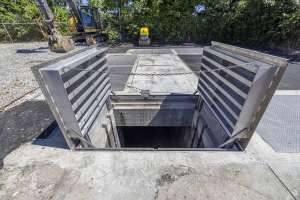
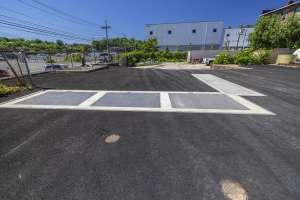
The deteriorating gates were beginning to become a maintenance and safety concern, so the commission decided it was time for an upgrade. The solution was to replace the grates with 14 floor access doors.
Chamber Danger
Grit chambers play a critical role in the PVSC system, protecting mechanical equipment from potential damage.
The grit that ends up in wastewater chambers is heavier than organic biodegradable solids and can be separated in the chamber. Gritty solids that remain in a wastewater chamber could cause wear and tear on mechanical equipment during the treatment process. Clogged pipes and channels will negatively impact the process, and removing those substances helps maintain the longevity and efficiency of the wastewater treatment plant.
Wastewater entering a grit chamber is slowed down and the heavier particles settle at the bottom of the chamber. The settled grit is collected and removed. Grit-free wastewater continues to the next stage of treatment.
One method to remove grit uses clamshells, which are located at the starting point of the treatment plant. The solid elements are removed and transported to an external container. Different types of clamshells are often used, according to the specific grit materials.
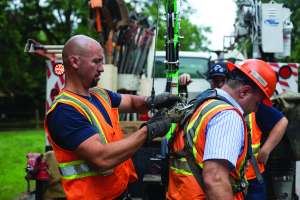
While some clamshells are automated, most rely on an operator who lowers the device’s shells into the water to begin the extraction process. The shells use an electro-hydraulic drive that opens and closes, which presses and dehydrates the waste found in the chamber.
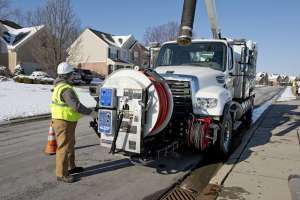
Chambers also need to be cleaned. Hydraulic cleaning uses high-pressure water jets to wash away debris, grease and grit. The water pressure can reach up to 6,000 psi to cut through grease, oil, dirt and organic debris. Mechanical cleaning uses high-pressure water and suction to clean chambers, and vacuuming removes debris that becomes loose during the jetting process.
Improved Efficiency
Under the previous system, workers needed to remove the grating to allow clamshell operators access to the chambers. PVSC engineer Eric Granholm knew BILCO access doors were a better solution.
“It eliminates the step for the operators to pick up the old grating and is a lot more efficient,’’ Granholm says. “The commission’s workers were involved in the selection process for the BILCO doors.”
The commission contracted with BR Welding of Howell Township, New Jersey, to take on the project. Extensive site work included excavating, backfilling, paving and creating new forms for the equipment. While matching the new doors with the pre-existing openings presented challenges, the crew did a great job matching everything together.
“We cut 2 feet off the top, formed it back up and inserted the doors,” says BR Welding President Chris Giglio. “It was tricky form work. But we’ve worked with BILCO doors a million times. It’s a quality product, you know what you’re getting. They’re built well. You get what’s on the drawing.”
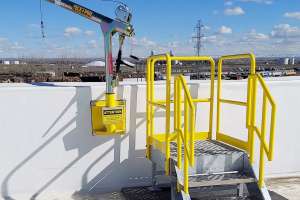
The 14 new doors from BILCO allow workers to open the access point for the clamshell operator much more quickly and efficiently. The doors are reinforced for AASHTO H-20 wheel loading and include a 25-year warranty.
“There were multiple panels that the workers had to lift out to allow the clamshell to access the chamber,’’ Giglio says. “Now they just pop the doors open. The difference is like night and day.”
The revamped chambers have improved efficiency, and one step at a time, the PVSC will continue making system improvements to become stronger and more resilient.