The grand plan to reduce combined sewer overflow volume by 98% in Lynchburg, Virginia, is on track for successful completion.
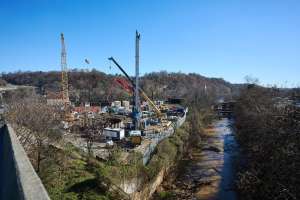
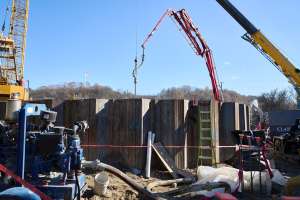
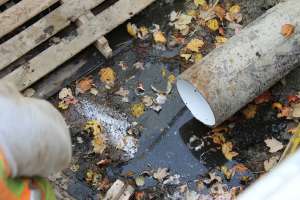
Last October, Lynchburg Water Resources broke ground for the Blackwater CSO Tunnel, designed to capture and store up to 4.7 million gallons of combined sewage and stormwater, preventing it from being discharged to Blackwater Creek and the James River.
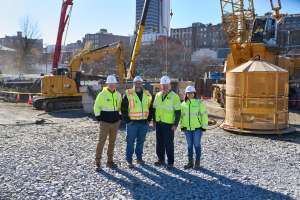
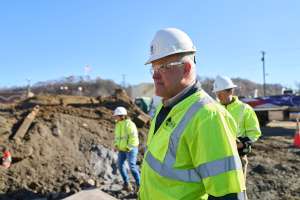
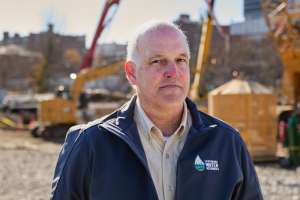
“It is not every day that there is a groundbreaking for a utility project. However, this is certainly not your typical project,” said Timothy Mitchell, P.E., director of water resources for the city at the ceremony. “This is our most ambitious project ever — the largest capital project in the city’s history and essentially the capstone of our CSO program.”
Beneath the Creek
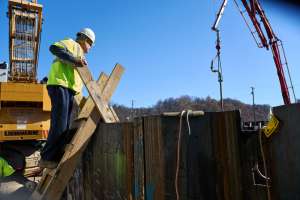
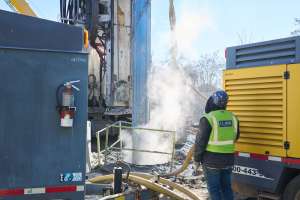
When completed in 2027, the Blackwater CSO Tunnel will be nearly a mile long, 12 feet in diameter and up to 120 feet deep beneath Blackwater Creek in the city’s downtown area. It will store combined sewage and stormwater during heavy rain events, keeping excess sewage from overflowing into the area’s waterways. Total cost is estimated at just over $104 million, $50 million coming from the American Rescue Plan Act and the remainder from the Virginia Clean Water Revolving Loan Fund. The new tunnel will be constructed through deep rock formations, using the drill and blast method. Holes are drilled in the rock and loaded with explosives, which are detonated to break the rock formation apart for excavation.
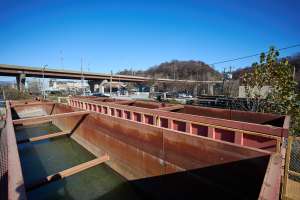
Complex diversion structures will be constructed at both ends of the tunnel to convey combined sewer and stormwater flows into the tunnel through drop shafts during heavy rain events. Once the storms pass and flows subside, the stored wastewater will then be pumped back into the sewer system via a pump station at the south end of the tunnel and directed to Lynchburg’s Regional Water Resource Recovery Facility for full treatment.
The tunnel project will also include an electrical building housing hydraulic and pumping controls.
Notice to proceed for the project was issued July 15, 2024. The entire project is scheduled for completion by July 2027 with the ARPA portion of the funding spent by the end of 2026.
Combined with efforts Lynchburg has made to control CSOs over the past 45 years, the city will reach its goal of a 98% reduction in total sewer overflow volume with the tunnel’s completion. Additionally, the tunnel will restore sewer capacity for future upstream development.
132 Overflow Points
Like hundreds of U.S. communities, Lynchburg installed combined sanitary and storm sewers as far back as the late 1800s, serving about one-fifth of the metropolitan area. Beginning in the 1970s, Lynchburg was one of the first cities in America to proactively start working to eliminate these overflows. This resulted in improved water quality in the James River, which flows from the Appalachian Mountains to the Chesapeake Bay and passes through the northern section of Lynchburg.
There were 132 original overflow points, discharging an annual overflow volume of 1.2 billion gallons to the streams in Lynchburg and the James River. The city’s initial plan included complete separation of sewers and storm systems, closing combined sewer overflow points, replacing aging interceptors and disconnecting rooftop rain leaders from the sewer system. To date, the city has separated more than 5,000 acres of combined area, eliminated 115 overflow points, replaced more than 30 miles of sewer interceptors, disconnected more than 220 acres of rooftops and reduced total overflow volume by 93%.
In 1994, the city of Lynchburg and the Commonwealth of Virginia entered into an historic CSO consent order. This consent order included provisions that the city would complete its CSO control program “as it could afford to do so” by setting sewer rates based on the median household income. “Until the CSO program is complete,” explains Mitchell, “we are required to set our sewer rates such that the average annual sewer bill is at least equal to 1.25% of the MHI. As long as we meet that requirement, then we do not have to raise our rates to meet a specified timeline to complete the program. Revenues generated from these rates first go to operations and maintenance, other regulatory programs, then whatever is remaining to our CSO program.
“The details of the first consent order were unheard of at the time,” recalls Mitchell. “The majority of CSO cities are on set timelines to complete their programs regardless of cost or impacts on ratepayers.”
A New Approach
Under the 1994 agreement, Lynchburg moved ahead with its plan to completely separate all combined sewers. However, it became obvious that digging up and replacing old sewer lines in the downtown business area would not be logistically practical nor economically feasible. Combined with increasing stormwater regulations and additional requirements to clean up the James River and Chesapeake Bay, a new approach was needed.
“Beginning in 2009, we took a proactive and more holistic approach,” says Mitchell. “We launched a major reevaluation of our CSO Long Term Control Plan, and after negotiations with the Virginia Department of Environmental Quality, we entered a new, even more flexible CSO consent order in 2015.”
The revised plan called for a “capture and treat” approach for the downtown area instead of separation. Under the new plan, Lynchburg used the demonstrative approach allowed in EPA’s 1994 CSO Policy which requires Lynchburg to meet specific water quality goals. The plan allowed 17 of the 132 overflow points to remain open but required a strategy to capture and treat much of the remaining CSO volume. Lynchburg estimates the change will save approximately a quarter billion dollars and enable the overall CSO program to be completed in 15 years instead of over 40.
“Being proactive has served us well, from negotiating favorable terms in our consent order (twice), shaving years off the program, saving millions of dollars, positioning us to take advantage of state and federal funding opportunities, and allowing us to achieve our water quality goals much sooner,” he adds.
Lynchburg has been able to keep sewer rates at the 1.25% of the MHI while making great progress on its CSO program — including the new tunnel — without the need to increase rates above the minimum the consent order requires. “We have been very proactive in pursuing state and federal grants, receiving over $120 million in grants, while creatively taking advantage of the favorable terms of the Virginia Clean Water Revolving Loan Fund for much of the rest of the funding,” Mitchell says. “These efforts, combined with innovative planning, have helped keep our sewer rates around or even below the state average.”
The combination of being proactive and innovative previously earned the city EPA’s PISCES Award — Performance and Innovation in the SRF Creating Environmental Success.
Expanded Capacity
Also, as part of the revised control plan and the renegotiated 2015 CSO consent order, the wet-weather capacity of the Lynchburg Regional Water Resource Recovery Facility was doubled in 2021 from 40 mgd to more than 80 mgd, further reducing the CSO volume.
According to Mitchell, the expansion included an innovative 4 million-gallon precast post-tensioned concrete wet weather storage tank supplied by Dutchland, significant upgrades to the headworks building facility including additional pumping capacity (Fairbanks Nijhuis) and screening capabilities (Kusters bar screens, Smith & Loveless grit classifiers). It also included a backup generator (Cummins, 1500 kW) and other electrical and chemical feed improvements using a Water Champ chemical induction system (Evoqua Water Technologies) and numerous other improvements throughout the facility.
“This facility now provides full treatment for over 80 million gallons of wet-weather flow during storm events,” reports Mitchell. “For flows in excess of 80 mgd, the facility still provides primary treatment and disinfection. It is important to note that the dry weather flows are around 13 mgd.”
He adds that working in conjunction with the tunnel and the other previous CSO projects, Lynchburg will achieve a 98% reduction in CSO volume, far exceeding EPA’s CSO policies presumptive approach requirements and also surpassing the goals of the CSO long-term control plan demonstrative approach.
Communicating Success
Lynchburg is using a variety of media to inform residents and businesses on what to expect over the next three years as the tunnel is constructed.
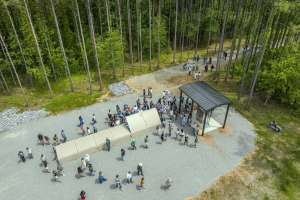
According to Jason Snyder, public information officer for the Water Resources Department, the project has been explained via online videos, media appearances, City Council meeting presentations and more. The groundbreaking involved all key public officials, including Mayor Stephanie Reed and City Manager Wynter Benda.
“Our future plans include regular construction updates on our website and social media accounts, and a permanent educational display at the completed CSO 52 (dropshaft) location along the Point of Honor Trail,” Snyder notes.
And the communications are working. “The response from citizens has been mostly positive because of the protections the project provides to public health and our waterways,” says Snyder.
“Blackwater Creek and the James River are cherished by many citizens in our community, so protecting these waterways from combined sewer overflows has generated a positive response.”