Broken water mains and flooded pump stations were among the wreckage after Hurricane Helene blew through the Southeastern U.S. in 2024. Towns and cities in North Carolina have been rebuilding their municipal water systems for the past 18 months, costing billions in replacements and repairs.
Extreme weather events are increasingly pushing water pipeline infrastructure beyond its limits. As a result, water utilities are designing and rehabilitating their distribution systems, treatment plants and pump stations for climate resiliency to ensure they provide reliable service, even during 1,000-year storms.
Water utilities don’t have the resources, however, to test and compare each innovative resiliency product and design on the market. This situation causes analysis paralysis, delaying necessary climate resiliency implementations and their resulting benefits.
East Bay Municipal Utility District in Oakland, California, faced the same predicament.
“We have a lot of engineers and staff that solve problems on a day-to-day basis. But there are big picture challenges that we really don’t have the capabilities to solve,” explains David Katsev, manager of pipeline construction at EBMUD.
Shaking things up
Oakland, California, sits on the Hayward and San Andreas fault lines, making it one of the most seismically active cities on the planet. Seismic resiliency is top of mind for utilities like EBMUD that must consider how their waterlines will be impacted by future earthquakes, landslides and shifting soils.
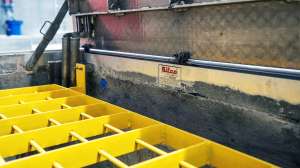
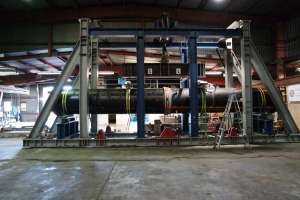
“For years, we were traveling from the West Coast to Cornell University in Ithaca, New York, to witness seismic testing of U.S. Pipe’s ductile iron pipes; almost 3,000 miles away,” says Katsev. “We did that for three or four years, when it occurred to us that the University of California, Berkeley, was minutes from us.”
Kenichi Soga, Ph.D., a professor at the University of California, Berkeley, had been engaging with EBMUD for years when the opportunity came about to bring Cornell University’s Large-Scale Four-Point Bending Test Apparatus to California. Based on his experience directing an infrastructure research center at Cambridge University in Cambridge, England, his lab was the perfect candidate.

Smarter infrastructure
“When I came to UC Berkeley nine years ago, I started networking in the Bay Area infrastructure scene. During this time, I met David Katsev and Clifford Chan, who were brainstorming how to bring seismic testing to the Bay Area,” says Soga, director of the Center for Smart Infrastructure.
Merging Soga’s academic experience with infrastructure testing and EBMUD’s need for a local seismic testing facility, the Center for Smart Infrastructure was born in 2022 at UC Berkeley. The Center’s research topics are directed by member utilities and manufacturers, focusing CSI’s research on the most pressing issues they face.
“We generate the problem statement,” says Katsev. “It’s quite beneficial for UC Berkeley; it provides their graduate students an avenue to see what’s really out there and work on practical solutions that can be applied in the field.”
What began as a seismic testing initiative for water distribution pipes quickly expanded its scope and vision under Soga and his team of graduate researchers. CSI is equipped with optical fibers, robotics, machine learning and more to expand the capabilities of smart infrastructure and utilities’ access to it.
“Aging infrastructure is not just about aging materials; our habits are changing and we’re putting additional loads on our infrastructure,” Soga says. “Our academics want to make a big impact. CSI allows academics, utility and infrastructure owners, and equipment manufacturers to come together and say, ‘these are the important topics.’”
Katsev notes that they’ve created a world-class facility. “That’s really what CSI is about. It’s a team approach between East Bay MUD, UC Berkeley and U.S. Pipe to solve these challenging problems that we just can’t solve on our own.”
Large-diameter testing
Large west coast water providers are rethinking seismic specifications for their buried infrastructure in order to withstand long-term fault activity. But there are few earthquake-resistant water distribution pipes available at larger diameters (32 inches and above) that their systems require. This technology gap limits the ability of cities like Los Angeles, San Francisco and Seattle to comprehensively safeguard their water distribution systems against seismic activity.
“I interface with our large municipal customers to learn their pain points and then turn them into innovations that address those pains,” says Jeff Mason, innovation product manager at U.S. Pipe. “From those interactions, we start seeing patterns and, in this case, customers needed larger-diameter seismic pipes.”
For the past five years, Mason and the U.S. Pipe team have been working through the process of creating a product that does not exist yet. Due to the sensitive nature of innovating around a public resource like drinking water, minimizing potential risk is paramount. However, these risk considerations can extend the innovation timeline beyond a decade.
“We follow an iterative innovation system that incorporates multiple touch points with the end users to be sure we’re creating something they want,” explains Mason. “But big items, like the 48-inch TR-Xtreme, are beyond what we can test internally. That’s where CSI comes in for us.”
Simulating a large-diameter ductile pipe operating in an earthquake is the latest of numerous performance evaluation tests conducted on U.S. Pipe products at CSI. These tests provide EBMUD and other member utilities with objective data helping them understand how the tested products will help them meet their resilient infrastructure goals.
For the U.S. Pipe team, this test will be another completed step on the road to developing the largest-diameter earthquake-resistant ductile iron pipe manufactured in the United States, enabling water systems to think bigger about seismic resilience.
“The pipeline testing is the one area that has benefited us the most. It’s provided data and information that we’ve added into our design specifications for products we purchase,” adds Katsev.

Resilient future
Natural disasters are inevitable. And as intensified weather events prove capable of taking fundamental services offline for months at a time, communities of all sizes are wondering how to protect their assets from the damage experienced in recent years.
As an example, CSI is working with CalTrans, EBMUD and other agencies on a city-scale simulation that models the damage of a major seismic event on gas lines, water and wastewater pipes, and roads, and how to effectively recover after the fact.
“It would take months to recover from a serious seismic event, but we’re simulating the best ways to do so,” says Soga. “We don’t understand everything, but we can prepare for thinking about how to recover water, gas, electricity and the road networks. We’re even working with social scientists to understand human behavior in these scenarios.”
Scalable model
Vendors, universities and utilities have historically limited communication with one another, which has slowed critical progress to developing climate resilient infrastructure. Partnerships, like the one between EBMUD, UC Berkeley’s CSI and U.S. Pipe, align these vested parties in a new approach to infrastructure innovation, ultimately putting smart infrastructure decision-making in reach for water utilities to deploy in good faith nationwide.
“Infrastructure is about serving the community. Not just the current community, but the community in 50 to 100 years,” Soga says. “Utilities are in a unique position to think about the future, since what we do is going to affect future generations in 10 years, 20 years, 50 years.”
Perhaps most encouraging is that this partnership continues to flourish and grow, offering a model that can be replicated by utilities, universities and manufacturers in every region of the United States. But it requires buy-in.
“We’re looking for more partners to get involved,” says Katsev. “They just have to reach out.”
Andrew Dugan runs WaterWrites, a utility-focused copywriting and creative agency. He helps technology companies, engineering firms and utilities communicate their work to any audience.
Continue reading for free