Shane Harris never imagined he’d lead a trenchless rehabilitation company. His foundation was built in the field — wading through pump station projects, managing critical infrastructure builds and responding to shutdowns with urgency and grit. So when the opportunity arose in 2016 to co-found a company focused on manhole rehabilitation, his reaction was immediate and candid.
“I said no,” Harris recalls. “Flat-out. I’d seen too many coatings fail. They peel, they crack, they don’t hold. And the municipalities are stuck paying twice to fix the same problem.”
The pitch came from a vendor promoting a specialized epoxy system. He was confident — so much so that he brought Harris to Massachusetts for a live demo and issued a challenge: test it, try to break it and if it failed, walk away. Harris accepted.
“I told them I wanted to try to make it fail. They didn’t hesitate. That told me something,” he says. “I’m still trying nine years later. It’s never failed me yet.”
That field trial was the catalyst for East Coast Infrastructure, launched in partnership with Shaw Construction. Harris didn’t just build a business — he built a mission-driven team grounded in quality, accountability and earned trust. What began with a bucket of epoxy and a single crew has since evolved into a robust trenchless rehabilitation firm serving municipalities, utilities and industrial clients throughout Virginia, the Carolinas and select national markets.
What sets ECI apart isn’t just the services it offers. It’s the way the company approaches every project: with high standards, strict accountability and an unwavering focus on long-term solutions. And in an industry where patch jobs and profit margins often take precedence, ECI stands out as a contractor built to solve — not sell.
“Everything we do is rooted in performance,” Harris says. “We won’t take on a job unless we can stand behind it — 5 years, 10 years, even 50.”

Growth through demand
When ECI first opened its doors, the company had one focus: protective coatings. Harris and his initial crew specialized in applying high-performance epoxy systems — primarily Warren Environmental’s 301 and 301-14 formulations — to manholes, wet wells and deteriorated concrete structures. But as projects progressed, the scope of requests from municipalities and contractors began to expand.
“At first, people were just glad someone could coat a manhole,” Harris says. “But then it became, ‘While you’re here, can you inspect the rest of the line?’”
That curiosity turned into opportunity. Clients wanted cleaning, inspections and structural repair all from the same team — especially in high-risk or hard-to-access locations. But rather than leap into unfamiliar services, Harris took his time. He studied the market, tested products and waited until he could ensure each expansion met his performance standards.
“When you grow just to grow, you dilute your quality,” Harris says. “We weren’t going to add a service unless we could do it better than anyone else around.”
Over the following years, ECI expanded into three additional service divisions, each one selected for its strategic fit with the company’s mission and clients’ evolving needs.
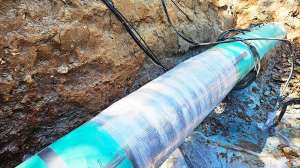
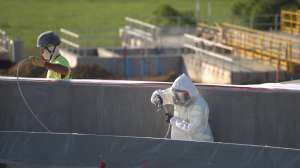
Protective coatings remain the backbone of the business. ECI’s certified teams apply epoxy coatings for structural reinforcement, chemical resistance and inflow/infiltration control. In extreme cases, they incorporated carbon fiber or basalt mesh to create composite systems capable of withstanding harsh flow, pressure or hydrogen sulfide exposure.
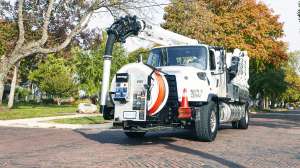
Vacuum services emerged next. ECI invested in a fleet of four Vactor 2100i combination units, giving crews the ability to clean sewer lines, remove grit, excavate around utilities and support bypass operations. This allows them to prep coating and lining projects more efficiently — without relying on subcontractors.
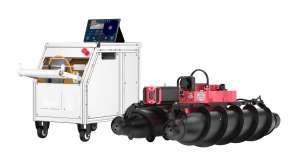
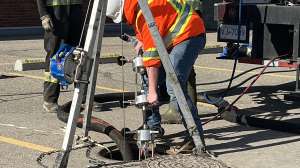
CCTV inspection soon followed. ECI operators became PACP-certified and began using advanced CUES camera systems, including lateral launch and pan-and-tilt technology. This gives their municipal customers detailed, standardized assessments they could use for capital planning and compliance — another value-add that streamlined project delivery.
UV-CIPP lining rounded out the offering. ECI became a certified installer of Reline America’s Alphaliner system, known for its cure precision, high structural strength and Quality Tracker System. For aging sewer mains, force mains and outfalls, it offered a trenchless, fast-track alternative to opencut.
Together, these four divisions transformed ECI into a vertically integrated rehab provider — capable of inspecting, cleaning, repairing and rehabilitating infrastructure assets, often within the same mobilization.
“We’re not generalists,” Harris says. “We’re specialists who know how to solve problems from multiple angles — and we’ve built our company to do just that.”

Big impact, small footprint
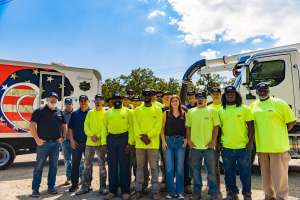
With just 17 full-time employees, East Coast Infrastructure operates lean — but delivers like a much larger firm. That efficiency is by design. Harris has intentionally kept the company small, not out of limitation, but out of principle.
“We’re a micro-business under Virginia’s SWaM program,” Harris explains. “But we take on projects that some 100-person companies won’t touch.”
Being designated as a Small, Women- and Minority-Owned (SWaM) microbusiness has opened doors for ECI in municipal contracting, especially on state and local projects with set-aside requirements. But Harris views the designation as a useful tool — not a defining trait.
“What really sets us apart isn’t our size — it’s how we operate,” he says. “We’re highly trained, cross-functional and driven by doing it right the first time.”
Crews are intentionally structured to be multi-disciplinary. A vacuum operator may also be PACP-certified to run inspections. A coatings technician might also support bypass operations. That flexibility allows ECI to mobilize efficiently and deliver full-service trenchless rehab solutions with minimal downtime or overhead.
Culture is central to that efficiency. At ECI, everyone trains together. Everyone knows the company’s standards. And everyone — from new hires to senior crew leads — is empowered to speak up if something isn’t right.
“You lose that when you grow too fast,” he says. “I’ve seen companies scale quickly and completely lose their identity.”
Harris has capped future growth at 50 employees — enough to run five full-time rehab crews while maintaining quality and culture. He has no interest in building a national brand or adding satellite offices just to chase contracts. “I don’t want to be the biggest,” he says. “I want to be the best in our region.”
That region is focused on the Tidewater area of Virginia, extending into parts of the Carolinas. ECI does take on select out-of-state work — particularly when a client specifically requests their involvement or when their skill set fills a critical gap — but the company’s core remains firmly local.
This commitment to local excellence has earned ECI a strong reputation with regional agencies, facility owners and engineers alike. It’s not uncommon for past clients to call Harris directly with new challenges — knowing his team will find a way to deliver where others hesitate.

Problem-solving in action
At ECI, reputation is built in the field — project by project, structure by structure. Some of the company’s most defining moments have come not from massive contracts, but from projects others considered too risky, too complex or too unusual to take on. For Harris, those are the jobs that matter most.
One of ECI’s most dramatic turnarounds occurred at Norfolk International Terminals, where the company was originally brought in for what appeared to be a routine siphon chamber rehab. Once the flow was bypassed and the structure was exposed, the crew realized they weren’t dealing with a coating project — they were dealing with a total structural failure. “There weren’t even walls,” Harris says. “It was just compacted soil where the concrete used to be.”
Due to the chamber’s location beneath active rail and dense utility lines, opencut or reconstruction was off the table. Harris and his team engineered a solution from the inside out. They designed a pourable composite structure using Warren Environmental’s 501UVR epoxy (Garney Construction) blended with a custom aggregate. Compression test cylinders taken on site reached over 5,500 psi in 72 hours. “We treated it like a structural rebuild — not a patch,” Harris says.
Hampton Roads Sanitary District reviewed the data, approved the plan and ECI rebuilt the chamber in place. The entire process — from discovery to completion — was done in under a week. “That project changed a lot of minds about what’s possible with epoxy composites,” Harris says. “It proved that trenchless doesn’t mean temporary.”
In another standout project, ECI addressed a deteriorating 10-inch gravity sewer line running through a sensitive tidal marsh in Norfolk. The pipe’s degradation had allowed saltwater intrusion, which was interfering with downstream treatment plant operations.
“Most contractors wouldn’t go near it,” Harris recalls. “The access was terrible, the conditions unpredictable.” ECI used portable equipment to clean, inspect and confirm liner feasibility. Within a single day, they installed a UV-cured liner using Reline America’s Alphaliner system.
“The very next day, the plant reported a 90% drop in salinity,” Harris says. “They thought an upstream section of pipe was blocked or collapsed.” But the reading held steady — and the intrusion was gone. “That’s the kind of immediate, measurable impact we aim for,” Harris says. “No guesswork — just results.”

The next generation
For Harris, running a trenchless rehab company has never been just about equipment or contracts — it’s about people. He’s quick to point out that most of the work ECI performs can’t be automated or outsourced. It requires hands-on skill, good judgment and trust earned in the field.
“Our success lives and dies with the crew,” Harris says. “You can have the best product in the world, but if the application isn’t right, it’s worthless.”
But workforce development doesn’t stop at the crew. Harris has taken steps to build the next generation of trenchless professionals — starting far earlier than most companies would consider.
A few years ago, ECI launched a local outreach program targeting middle schools in the Tidewater region. The idea was simple: Get in front of kids before the “college-or-bust” mentality fully sets in, and show them the real, rewarding careers available in construction and water infrastructure.
“We brought videos, safety gear, even demo cameras,” Harris says. “We wanted them to see the technology and understand the impact this work has.”
The initiative struck a chord — not just with students, but with teachers and administrators. Several students stayed in touch, asking about internships or summer job opportunities. Harris sees that as proof that the trades still resonate — if presented in the right way.
While the outreach program was paused, he plans to revive it and expand its reach. “You can’t complain about a labor shortage if you’re not doing anything to fix it,” Harris says. “We’re trying to do our part.”

Holding the line
As trenchless technology becomes more mainstream, Harris has watched the industry shift — especially with the rise of private equity-backed consolidators buying up local contractors and forming national rollups. The appeal, he says, is obvious: economies of scale, regional presence, rapid market access. But it often comes at a cost.
“When you’re one of 40 offices reporting to a spreadsheet, you lose connection,” Harris says. At ECI, Harris is determined to keep things different. The company remains privately owned and fiercely independent. “We’re not chasing stockholders or quarterly goals,” Harris says. “We answer to our clients and our people.”
That independence also allows ECI to remain nimble in the face of regulatory hurdles. Many municipalities still require trenchless contractors to demonstrate a minimum of 50,000 linear feet of past lining experience to qualify for bids — a threshold that often excludes smaller or newer companies, regardless of their actual capability.
Instead of complaining, Harris takes a practical approach. He’s worked directly with municipal decision-makers to update procurement language and add alternative qualification paths. In most cases, once clients see the quality and outcomes firsthand, the specifications evolve.
“They stop asking about footage once they see how we work,” he says. “Performance wins the argument.” Harris believes that small, specialized firms like ECI are critical to keeping the industry grounded, innovative and connected to local communities. They may not have national marketing budgets or corporate sales teams, but they bring something else to the table: accountability.
“When something goes wrong, I’m the one who answers the phone,” Harris says. “That matters to people.”

Built on purpose
Ask Shane Harris about the future of East Coast Infrastructure, and his answer is equal parts ambition and restraint. He’s not aiming for national expansion, a massive fleet or multimillion-dollar offices. What he envisions instead is a stronger, tighter, smarter version of the company he’s already built.
One area of interest is lateral lining — specifically for municipal main-to-clean-out laterals. While ECI has no plans to enter the residential market, Harris sees real value in helping cities eliminate inflow and infiltration by tackling smaller-diameter lines that are often overlooked.
No matter what the next chapter holds, one thing is certain: Harris’s vision for ECI is grounded in longevity — not just for structures, but for people. He wants his team to grow in their careers, for the communities they serve to benefit from lasting improvements, and for every asset they touch to hold up for decades to come.
“We don’t do five-year fixes,” he says. “We want our grandkids to be the next ones who touch that manhole.”
At its core, East Coast Infrastructure isn’t defined by what it builds — but how it builds. With precision. With purpose. And with a deep belief that trenchless rehab isn’t just a job — it’s a responsibility.
Continue reading for free