For wastewater collection crews, some problems become all too familiar. Certain lift stations demand repeated visits. Grease accumulates faster than crews can remove it. Pumps clog, odors spread and maintenance teams find themselves locked in a cycle of playing defense instead of proactive system management.
That was the situation facing the utilities team in Palm Bay, a fast-growing city on Florida’s Space Coast. With dozens of lift stations serving an expanding community, staff members had been battling persistent FOG problems.
But after installing a new aeration system in one of the city’s most problematic stations, Palm Bay’s wastewater team began seeing dramatic changes to both operations and costs.
Maintenance challenge
According to Palm Bay Wastewater Collections Superintendent Derek Acker, the problem had plagued one major lift station for years.
“This station has been a real thorn in our side,” Acker said during a recent discussion with members of the city’s utilities leadership team.
The lift station, known internally as Lift Station 9, serves as a major hub in Palm Bay’s collection network. Wastewater from roughly 16 upstream stations ultimately flows through it, making it a critical point in the system.
With that heavy flow comes a constant stream of grease and organic material.
To keep the station operational, the city had relied on a combination of chemical treatments and frequent mechanical cleanings. Degreasing agents were injected into the wet well, often combined with enzyme treatments designed to break down organic material.
But even with those measures in place, the problem never truly disappeared.
“It helped to some degree,” Acker said. “But it was a never-ending battle.”
Fighting expense
The operational costs associated with that battle were significant.
The city typically began treatment with a 55-gallon drum of degreaser costing roughly $2,500. After the initial application, another drum was required each month to maintain the treatment program.
Combined with enzyme additives, the station required roughly $3,100 in chemical treatments every month. And that was only part of the picture.
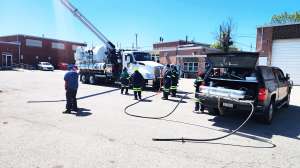
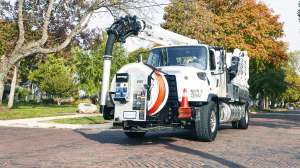
Because grease buildup still occurred, maintenance crews regularly dispatched vacuum trucks to remove accumulated material. Each cleaning involved both a vacuum truck crew and a crane truck team responsible for pulling pumps and removing rags and debris.
“In total, you’re looking at about $1,500 a month just in vacuum truck operations,” Acker explained.
When those costs were combined with chemical treatments, the city was spending more than $4,500 per month maintaining a single lift station.
“It was a constant cycle,” Acker said. “We were spending the money and still fighting the same problem.”
Different approach
Palm Bay’s search for a better solution began somewhat unexpectedly.
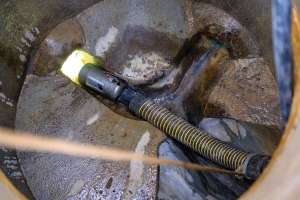
During industry conversations about water system mixing technologies, city staff learned about aeration systems designed specifically for wastewater lift stations. The technology uses fine bubbles to introduce oxygen into the wet well while gently circulating the water column.
That circulation helps prevent grease from forming the thick floating mats that often create operational headaches.
The team decided to install a single test unit at Lift Station 9: the HydraForce Lift Station Agitator from Kasco.
“We wanted to see if it would actually make a difference,” Acker said.
Once installed, the system began introducing oxygen into the wastewater while keeping the contents of the wet well in motion. The goal was simple: prevent grease from accumulating and allow naturally occurring bacteria to break down organic material more effectively.
Within months, the results were clear.
Dramatic drop
Perhaps the most striking improvement came in the form of reduced maintenance calls.
Before installing the system, the station required routine vacuum truck visits to remove grease buildup. After installation, those visits virtually disappeared.
“The vacuum truck is not going to that station anymore,” Acker said.
In fact, the only time crews have returned recently was to address an unrelated pump failure, not grease accumulation.
“That diffuser has been in there about six to eight months,” Acker said. “And the vacuum truck hasn’t been back because of grease.”
That shift alone represents a major operational improvement.
“When you’re constantly going back to the same issue, you’re not accomplishing anything else,” said Dave Wright, wastewater collection supervisor at the city of Palm Bay. “Now our crews can focus on other work.”
For utilities managing large systems, freeing up staff time can be just as valuable as direct cost savings.
Chemical costs
The financial benefits have been equally significant.
With the aeration system operating, Palm Bay has been able to drastically reduce its reliance on chemical treatments.
Degreaser use has already been cut roughly in half, dropping from a full drum each month to approximately 25 to 30 gallons. Enzyme treatments have been reduced by a similar amount. And the city expects to eliminate the degreaser entirely in the near future.
“We should be completely out of degreaser by the end of March,” Acker said.
That change alone will represent thousands of dollars in annual savings.
“When you start adding up the numbers, it’s pretty amazing,” he said.
Rapid ROI
Given the operational savings, the payback period for the system has been remarkably short.
City staff estimate the equipment cost between $5,000 and $6,000, including installation.
Considering the previous monthly expenses associated with chemicals and maintenance, the return on investment came quickly.
“It basically paid for itself in the first month,” Acker said.
Even by conservative estimates, utilities leaders say the payback period falls somewhere between one and three months. For Palm Bay Utilities Director Gabriel Bowden, that kind of return makes the decision straightforward.
“We like saving money and spending it in the right places,” he said.
Additional benefits
While the cost savings are significant, Palm Bay’s utilities team has also noticed other improvements.
One of the most noticeable changes has been odor reduction. Lift stations located near residential neighborhoods can sometimes generate complaints when grease buildup creates strong sewer odors.
Since installing the aeration system, staff say those concerns have diminished.
“The odor has gone down tremendously,” Wright said.
That improvement can make a meaningful difference for nearby residents.
“When homes are right next to these stations, odor control matters,” Wright said. “Keeping the neighbors happy is important.”
Early concerns
Before installing the system, Palm Bay’s engineers did have one concern: corrosion.
Introducing additional oxygen into wastewater environments can sometimes raise questions about whether metal components might deteriorate more quickly.
To monitor the situation, the team closely inspected the lift station during the test period. So far, those concerns have not materialized.
“We haven’t seen anything alarming,” Wright said.
Operators did notice some surface staining initially, but closer inspection showed no actual deterioration of equipment.
“It’s just things being moved around,” Wright said. “Nothing is breaking down.”
With that concern resolved, the team now feels confident expanding the technology to other parts of the system.
Program expansion
Encouraged by the success at Lift Station 9, Palm Bay’s utilities department has already begun planning additional installations.
The city has submitted purchase requests for several new units to address other high-maintenance lift stations.
“We’ve already identified the next handful we want to tackle,” said Thomas Marinelli, assistant utilities director for Palm Bay.
Some of those locations present even greater operational challenges, including stations that operate under unusually high pressures and require complex bypass pumping strategies.
In those cases, reducing grease accumulation could help prevent serious infrastructure failures.
“If we can eliminate the FOG buildup there, it removes a huge risk,” Marinelli said.
Prevention strategy
Palm Bay’s utilities leadership is also thinking beyond individual stations.
One goal is to incorporate aeration systems into design specifications for future developments, ensuring new lift stations are built with preventive tools in place from the start.
“We’re looking at adding it into our lift station specs for new developments,” Bowden said.
By including aeration systems during construction, the city could prevent grease problems before they begin.
“That shifts us from corrective maintenance to preventive maintenance,” Marinelli said.
Message for utilities
For Palm Bay’s wastewater team, the results of the pilot installation have been convincing. After years of managing grease through chemicals and frequent cleanouts, a relatively simple mechanical solution has delivered measurable improvements.
“It works,” Marinelli said. “Put it in your budget and make it happen.”
Acker agrees.
“I’ve been in collections for about 18 years,” he said. “And I haven’t seen a product do what this one has done.”
For utilities across the country grappling with similar grease problems, Palm Bay’s experience suggests that sometimes the most effective solutions come from rethinking the fundamentals of wastewater management.
By keeping wastewater moving and supplying oxygen to naturally occurring bacteria, the system allows biology to do what it does best.
And for Palm Bay’s operators, that means fewer emergency cleanouts, lower operating costs and a wastewater system that runs more smoothly every day.
Continue reading for free